An overview of the distinctions between exposure, infection, and disease, alongside global mortality trends related to infectious microorganisms. Explores pathogen transmission and epidemiological patterns.
Understanding how diseases spread and how they impact global populations is a cornerstone of public health. To effectively control the spread of illness, one must first distinguish between the various stages of a biological encounter—from the moment a microbe enters the vicinity of a host to the point where clinical symptoms manifest. This article explores the critical distinctions between exposure, infection, and disease, the mechanisms of pathogen transmission, and the epidemiological trends that shape global mortality.
Defining the Biological Encounter: Exposure, Infection, and Disease
In the study of epidemiology, it is a common misconception that exposure, infection, and disease are synonymous. However, they represent distinct stages in the progression of a biological event.
Exposure: This is the initial contact between a potentially pathogenic microorganism and a host's vulnerable surfaces, such as the eyes, mouth, gut, mucous membranes, or compromised skin.
Infection: This occurs when a microorganism successfully invades the body and begins to multiply (proliferation). An individual may be an asymptomatic carrier, meaning they are infected but show no symptoms.
Disease: This is the clinical stage where the infection results in a medical condition characterized by symptoms that adversely affect the structure or function of tissues, organs, or body parts.
The progression from exposure to disease can be visualized as a spectrum. An individual might experience exposure but no infection, or they might develop a sub-clinical infection (no symptoms) or a full-blown clinical disease.
Exam Tip: Remember that an individual can be a "carrier." A chronic carrier can harbor a pathogen for long periods after recovery, potentially spreading it to others without ever feeling ill themselves.
Infectious Microorganisms and Pathogenicity
An infectious agent is a microorganism—such as a bacterium, virus, fungus, or parasite—that causes disease. Not all microorganisms are harmful; many are non-pathogenic commensals that live in harmony with the host. A pathogen is specifically a microorganism capable of causing disease.
Pathogens are characterized by their virulence, which refers to the severity of the disease they cause. Pathogens can increase their virulence through genetic modifications or, in the case of bacteria, through plasmid transfer.
The Mechanism of Pathogenesis
For a pathogen to cause disease, it must undergo several stages:
Colonization: The establishment of the pathogen at a portal of entry (e.g., adhering to mucosal surfaces).
Invasiveness: The production of "invasins" that allow the microbe to enter tissues.
Toxigenesis: The ability to synthesize toxins.
Evasion: The ability to bypass the host's immune system.
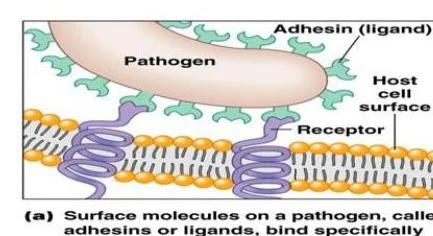
Pathogens often use adhesins (ligands) to bind to specific receptors on host cells, a process essential for successful colonization.
Illustration showing how surface molecules on a pathogen, called adhesins or ligands, bind specifically to receptors on a host cell surface.
The Chain of Infection and Transmission Routes
The chain of infection describes the process by which infectious diseases spread. Breaking any link in this chain—through vaccination, hand hygiene, or environmental controls—is essential to halting an outbreak.
Modes of Escape
Pathogens must leave the host to find a new one. Common modes of escape include:
Respiratory Tract: Escape via droplets from coughing, sneezing, or breathing.
Gastrointestinal Tract: Escape through secretions like stool or vomit (e.g., Hepatitis A).
Skin: Escape through wound drainage or lesions.
Blood: Transmission through contact with infected blood.
Primary Transmission Routes
Transmission is generally classified into three categories:
Vertical Transmission: The passage of a pathogen from mother to baby during the perinatal period (in utero, intrapartum, or postpartum). A notable example is the Zika virus, which can cause microcephaly in newborns via vertical transmission.
Horizontal Transmission: The passage of a pathogen between contemporary individuals (person-to-person).
Vector-borne Transmission: Transmission facilitated by an intermediary organism, such as Aedes mosquitoes carrying the Zika or Dengue viruses.
While many diseases rely on biological vectors, some utilize non-vector routes, such as blood transfusions, organ transplants, or breastfeeding.
Epidemiology: Community vs. Healthcare-Associated Infections
Epidemiology is the study of how diseases spread and how they can be controlled. In clinical settings, we distinguish between two main environments of infection:
Community-Acquired Infections: Infections contracted in the general public, such as influenza, norovirus, or food-borne illnesses like Salmonella.
Healthcare-Associated Infections (HAIs): Also known as nosocomial infections, these are acquired while receiving medical treatment. Common HAIs include infections caused by MRSA, C. difficile, and surgical site infections.
Note on Risk: In healthcare settings, approximately 80% of HAIs are transmitted by healthcare workers, patients, and visitors.
Global Mortality Trends
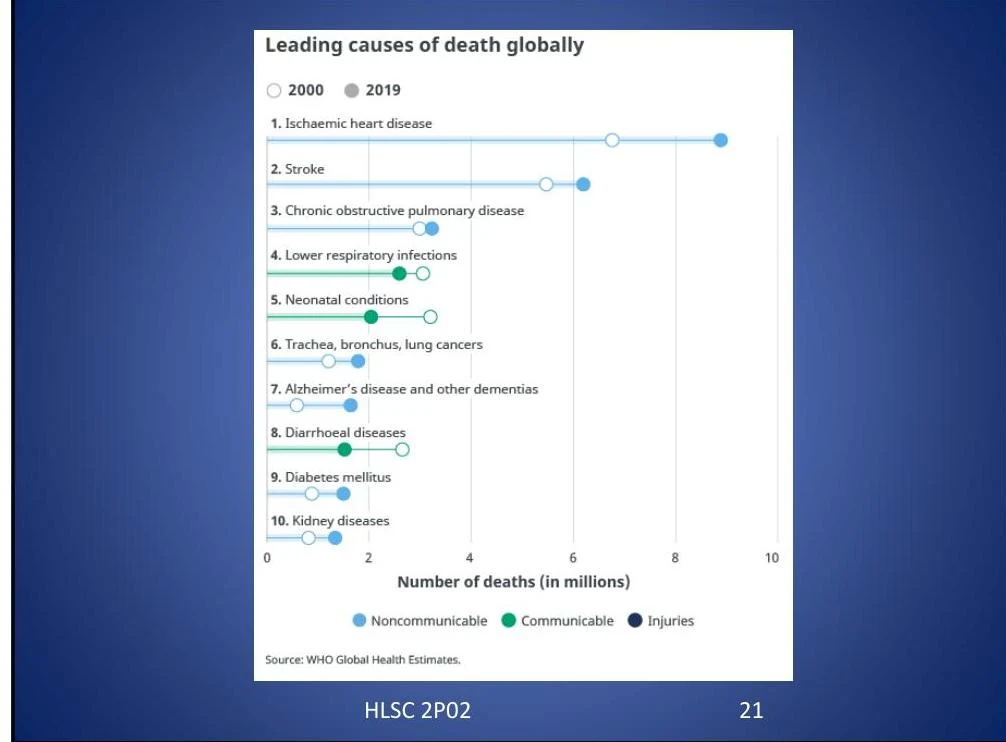
The impact of infectious diseases varies significantly based on geography and economic status. While high-income countries often face mortality from chronic conditions like cancer or heart disease, low-income countries face a much higher burden of infectious diseases.
In the developing world, infectious diseases like pneumonia, measles, diarrhea, and malaria disproportionately target children. For example, tuberculosis remains a major global killer, ranking as the second leading infectious killer after COVID-19.
A bar chart showing the leading causes of death globally in 2000 and 2019, categorized as noncommunicable, communicable, or injuries.
By understanding these epidemiological patterns and the mechanics of the chain of infection, public health officials can implement targeted interventions—such as administrative controls, environmental engineering, and personal protection—to reduce the global burden of disease.
Keep reading for free.
Create an account to finish this reading and make it part of your study routine.