An overview of fire science, including the fire tetrahedron, heat transfer mechanisms, flammability limits, fire classifications, and safe handling and storage of materials. This guide is essential for understanding industrial safety and preparing for professional examinations.
Understanding the science of fire is the cornerstone of industrial safety. For safety professionals preparing for the ASP examination, mastering fire prevention requires more than just knowing which extinguisher to use; it requires a deep understanding of the chemical and physical properties of fuels, the mechanics of heat transfer, and the precise classifications used to categorize hazards. This guide breaks down these fundamental concepts into actionable knowledge.
The Fire Tetrahedron and Heat Transfer
Historically, fire was explained using the "fire triangle" (fuel, oxygen, and heat). However, modern fire science utilizes the fire tetrahedron to account for the self-sustaining nature of combustion. To sustain a fire, four elements must be present simultaneously:
Fuel: The combustible material (solids, liquids, gases, or vapors).
Oxygen: The oxidizing agent required for the chemical reaction.
Heat: The energy required to raise the fuel to its ignition temperature.
Chemical Chain Reaction: The self-sustaining reaction that keeps the fire burning once ignited.
Removing any one of these four elements will effectively extinguish the fire. For example, dry chemical extinguishers work by interrupting the chemical chain reaction rather than just cooling the fuel.
This diagram illustrates the four elements required for combustion: fuel, heat, oxygen, and a chemical chain reaction.
Heat moves through a workspace via three primary mechanisms:
Conduction: Heat transfer through direct physical contact between materials (e.g., a metal handle heating up on a hot pan).
Convection: Heat transfer through the movement of fluids or gases (e.g., hot air and smoke rising through a room).
Radiation: Heat transfer through electromagnetic waves that does not require a medium or contact (e.g., feeling the heat from a distance of a large fire).
Flammability and Explosive Limits
When dealing with liquids and gases, safety professionals must distinguish between different temperature thresholds and concentration limits.
Temperature Thresholds
A liquid's susceptibility to ignition is often determined by its flash point—the minimum temperature at which it produces enough vapor to form an ignitable mixture near the surface. A higher, more critical threshold is the fire point, which is the temperature at which the vapor production is sufficient to sustain continuous combustion. Additionally, the autoignition temperature (or kindling point) is the lowest temperature at which a substance will ignite without an external spark or flame. Notably, the autoignition temperature decreases as pressure or oxygen concentration increases.
Flammable Limits
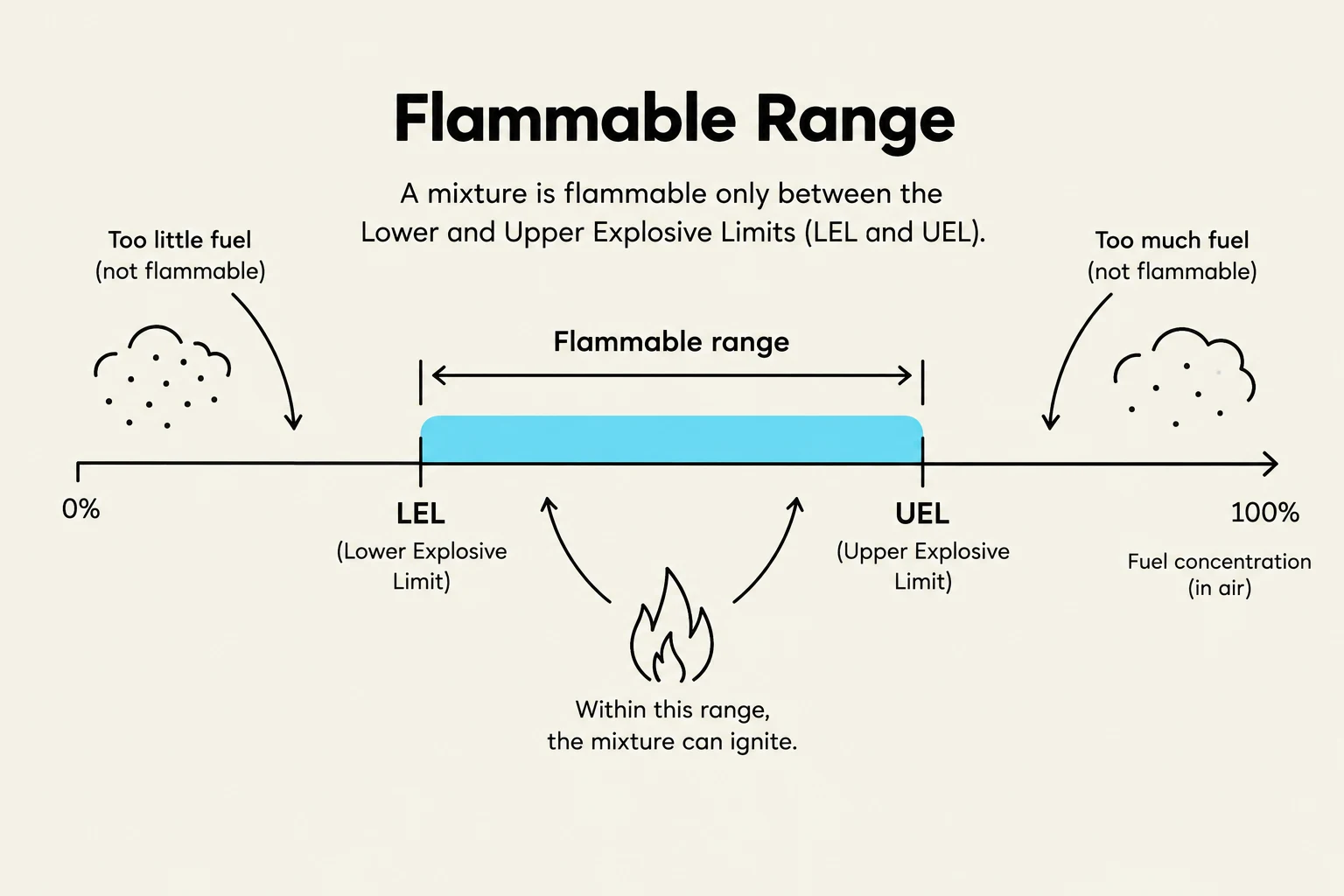
For gases and vapors, the concentration of fuel in the air determines whether an explosion is possible. This is defined by two limits:
Lower Explosive Limit (LEL): The minimum concentration of vapor in air required for ignition; below this, the mixture is considered too "lean".
Upper Explosive Limit (UEL): The maximum concentration of vapor that remains combustible; above this, the mixture is too "rich" due to a lack of sufficient oxygen.
A diagram illustrating the flammable range of a mixture, defined by the Lower Explosive Limit (LEL) and Upper Explosive Limit (UEL). Mixtures outside this range are not flammable due to insufficient or excessive fuel concentration.
Exam Tip: Gas meters used in industrial settings are typically set to alarm at 10% of the LEL to provide a significant safety margin before a combustible atmosphere is reached.
Fire Classifications
Fires are categorized by their fuel source. This classification is critical because using the wrong suppression method (such as water on an electrical fire) can be fatal or exacerbate the hazard.
Class
Fuel Type
Examples
Class A
Ordinary combustibles
Wood, paper, cloth, rubber, plastics
Class B
Flammable liquids/gases
Gasoline, oil, paint, solvents, propane
Class C
Energized electrical
Wiring, motors, appliances
Class D
Combustible metals
Magnesium, sodium
Class K
Cooking media
Vegetable oils, animal fats in commercial kitchens
Note on Class K: These fires are common in commercial kitchens and require specialized wet chemical extinguishing agents because of their ability to reflash.
Liquid Classifications (NFPA 30)
The National Fire Protection Association (NFPA) 30 code provides specific classifications for liquids based on their flash point and boiling point.
Flammable vs. Combustible
Class I (Flammable Liquids): Liquids with a flash point below 100∘F.
Class II/III (Combustible Liquids): Liquids with a flash point at or above 100∘F.
Class IIIA: Flash point ≥140∘F and <200∘F.
Class IIIB: Flash point ≥200∘F.
Subclasses for Class I liquids are further defined by their boiling points:
Class IA: Flash point <73∘F and boiling point <100∘F.
Class IB: Flash point <73∘F and boiling point ≥100∘F.
Class IC: Flash point ≥73∘F and <100∘F.
Safety, Handling, and Storage
Effective fire prevention requires managing the physical properties of chemicals and ensuring proper storage protocols.
Chemical Properties
Specific Gravity: This measures the density of a liquid relative to water. This is vital during spills: liquids with a specific gravity ≤1 float on water, while those ≥1 sink.
Vapor Pressure: Components with high vapor pressure are known as "light components".
Compatibility: To determine if chemicals can be stored together, always consult Safety Data Sheets (SDS), specifically Section 7 (Handling and Storage) and Section 10 (Stability and Reactivity).
Storage Hazards
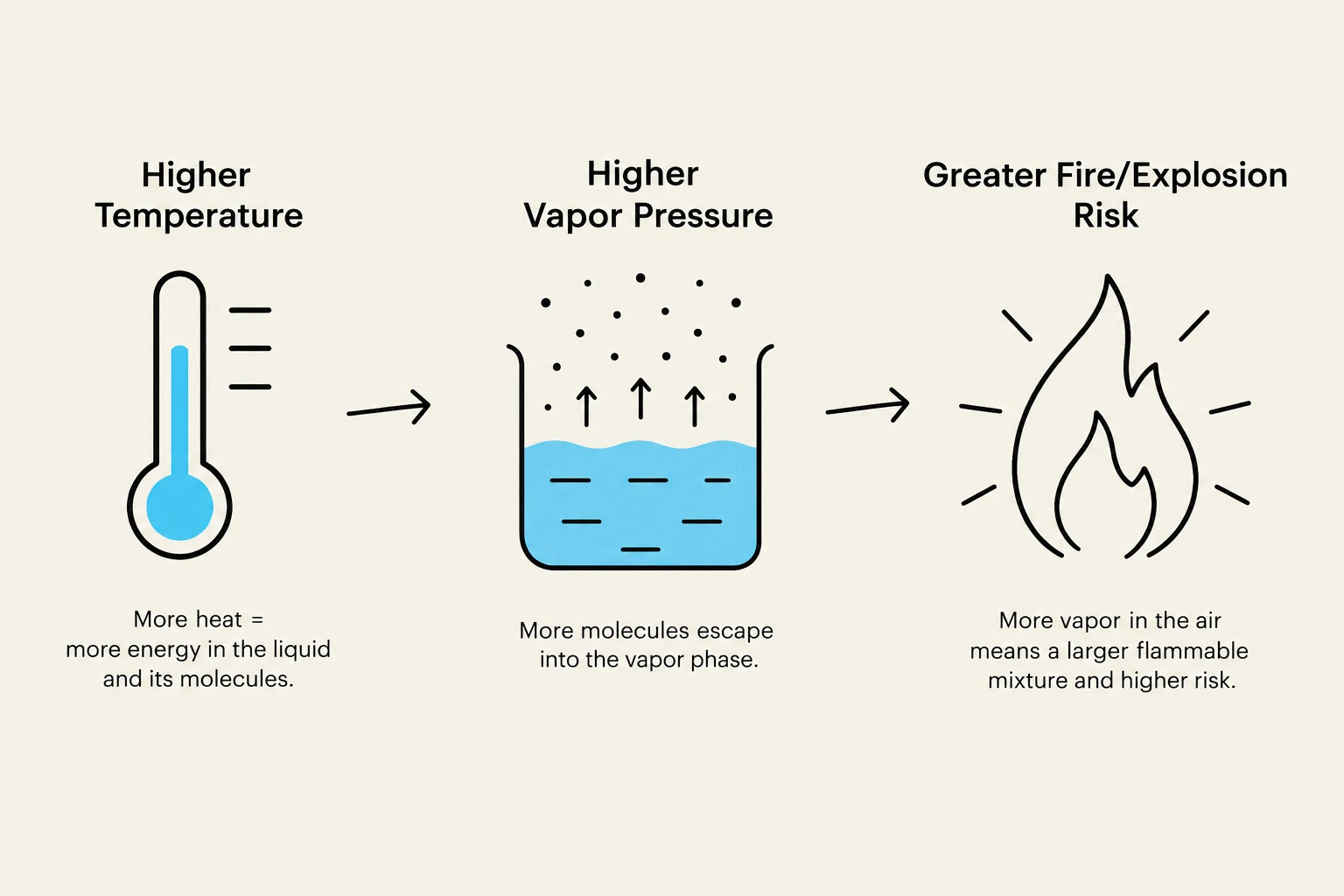
One major risk in storage is over-pressurization. As ambient temperatures increase, the pressure inside a closed container increases, which can lead to catastrophic container failure.
This diagram illustrates the relationship between higher temperature, increased vapor pressure, and a greater risk of fire or explosion, explaining that more heat leads to more energy in molecules, causing them to escape into the vapor phase, thus creating a larger flammable mixture.
Housekeeping and Signage
Good housekeeping is a primary defense against fire. This includes removing combustible debris and using wet methods or vacuum systems (rather than compressed air) to manage dust, as airborne dust clouds create significant explosion risks. Finally, for emergency response, the NFPA 704 "Fire Diamond" should be used to communicate health, flammability, reactivity, and special hazards to responders at a glance.
Keep reading for free.
Create an account to finish this reading and make it part of your study routine.