Explore the fundamental science of drug action on the Central Nervous System (CNS), the complex pathways of pain, and the physiological mechanisms of pain perception and modulation.
Understanding how drugs interact with the Central Nervous System (CNS) requires a dual mastery of pharmacology and neurophysiology. To treat pain or mental health disorders effectively, one must understand not only how a drug moves through the body but also how the body generates and perceives signals of distress. This article explores the fundamental science of drug action, the complex pathways of pain, and the physiological mechanisms that allow us to sense and modulate our environment.
Fundamentals of Pharmacology
Before diving into specific systems, we must distinguish between the two pillars of pharmacology: pharmacokinetics and pharmacodynamics.
Pharmacokinetics refers to what the body does to the drug. This involves the processes of absorption, distribution, metabolism, and excretion. It determines the concentration of the drug at its site of action over time.
Pharmacodynamics refers to what the drug does to the body. This involves the biochemical and physiological effects of drugs and their mechanisms of action—essentially how the drug interacts with receptors to produce a response.
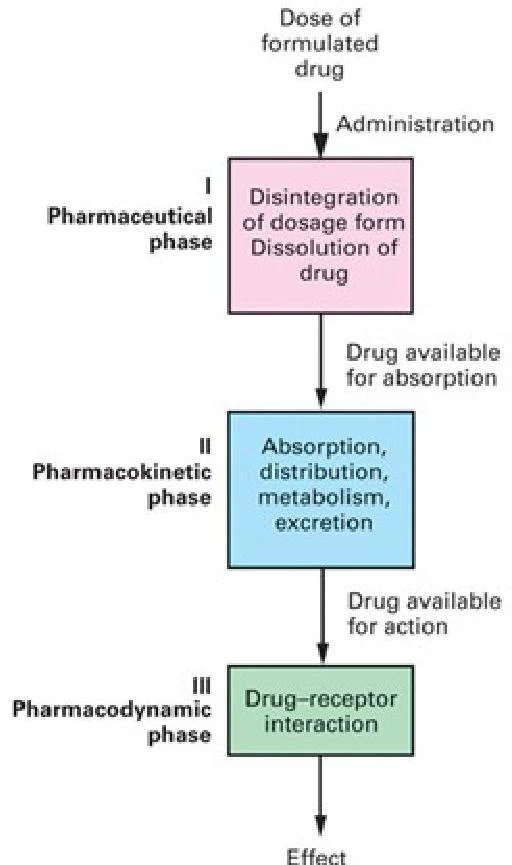
This diagram illustrates the three phases of drug action: pharmaceutical, pharmacokinetic, and pharmacodynamic. It shows the journey of a drug from administration to its effect on the body.
A historical example of CNS drug development is chlorpromazine, discovered in 1951. It was the original antipsychotic drug and belongs to a chemical class known as phenothiazines.
The Physiology of Pain
Pain is defined as an unpleasant sensory and emotional experience associated with actual or potential tissue damage. To understand how to treat it, we must classify it by duration and etiology.
Classifying Pain
Pain can be categorized by its temporal nature:
Acute Pain: Sudden onset, well-localized, and time-limited. It often triggers the Sympathetic Nervous System (SNS), leading to tachycardia, hypertension, and sweating.
Chronic Pain: Gradual onset, long-lasting (typically >6 months), and often described as a dull, aching sensation. It generally lacks SNS stimulation.
It can also be classified by its source:
Nociceptive Pain: Resulting from tissue damage (can be somatic or visceral).
Neuropathic Pain: Resulting from damage to the nervous system itself.
Ischemic Pain: Caused by a lack of blood supply to tissues.
Referred Pain: Pain perceived at a location other than the site of the painful stimulus.
The Four Stages of Pain Physiology
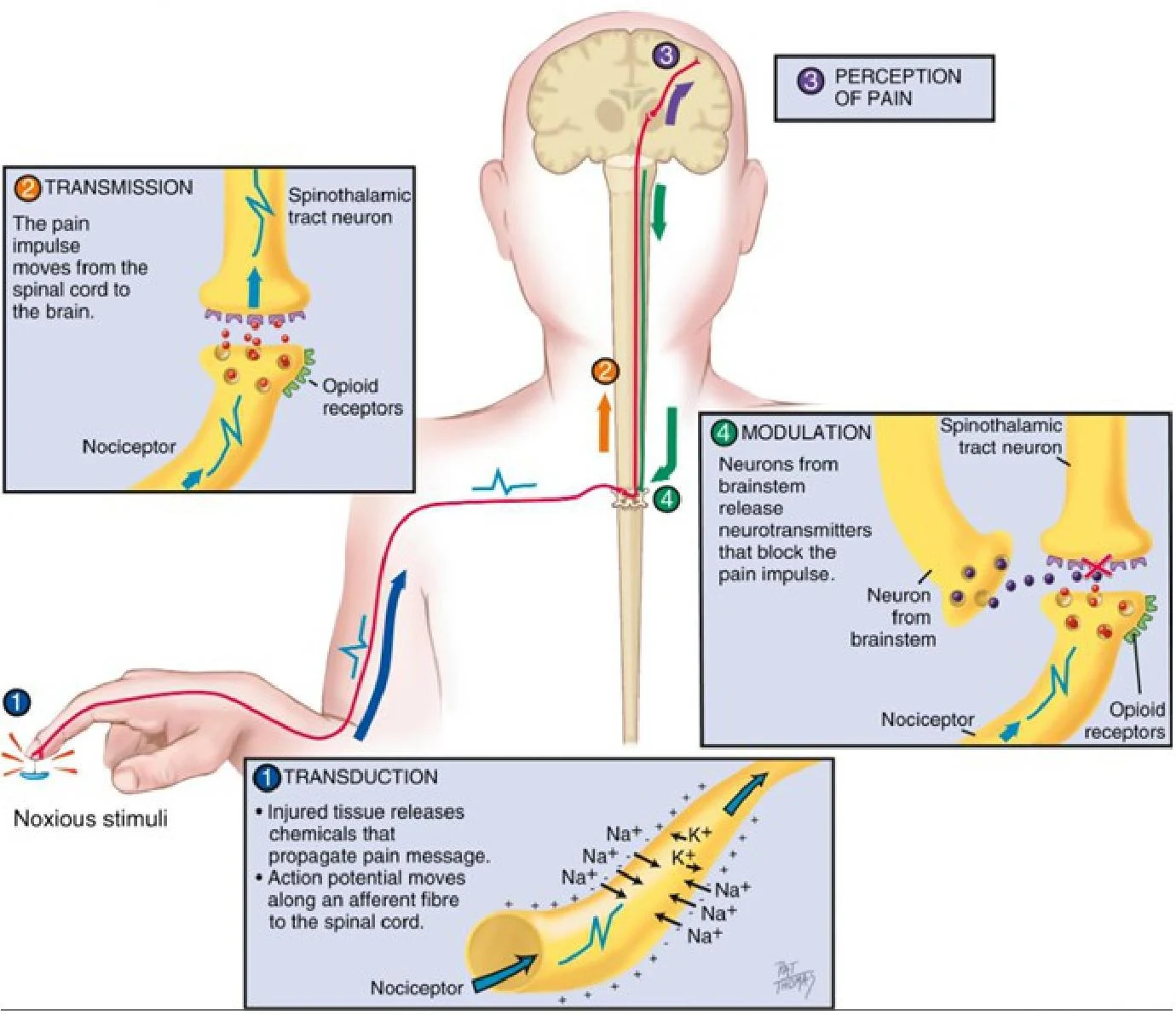
The process of feeling pain follows a specific physiological sequence: transduction, transmission, perception, and modulation.
1. Transduction
When tissue is damaged by mechanical, thermal, or chemical stimuli, cells release chemicals such as histamine and prostaglandins. These chemicals lower the pain threshold by sensitizing nociceptors (the first-order neurons). This process converts the noxious stimulus into an electrical signal.
2. Transmission
The electrical signal travels along the nerve fibers. In the dorsal horn of the spinal cord, neurotransmitters like glutamate and substance P are released across the synaptic cleft to stimulate the second-order neuron. This signal then travels via the spinothalamic pathway to the thalamus, and finally to the somatosensory cortex.
This diagram illustrates the four stages of pain processing: transduction, transmission, perception, and modulation. It shows how a noxious stimulus leads to the generation of a pain signal, its transmission to the brain, its perception as pain, and how the body can modulate this signal.
3. Perception
Perception is the conscious experience of pain in the brain. The intensity of this perception is closely linked to the availability of mu opioid receptors in the brain.
4. Modulation
The body has an internal mechanism to dampen pain signals known as the descending pain system. Neurons descending from the brain release neurotransmitters like serotonin and norepinephrine, which activate interneurons in the spinal cord. These interneurons release endogenous opioids, such as endorphins and enkephalins, which bind to opioid receptors to inhibit the transmission of pain signals.
Exam Tip: Remember the difference between presynaptic inhibition (which reduces neurotransmitter release) and presynaptic facilitation (which increases it).
Cellular Electrophysiology
Neural communication relies on changes in the electrical charge across cell membranes.
Transmembrane Potential: The distribution of electrical charges across the plasma membrane.
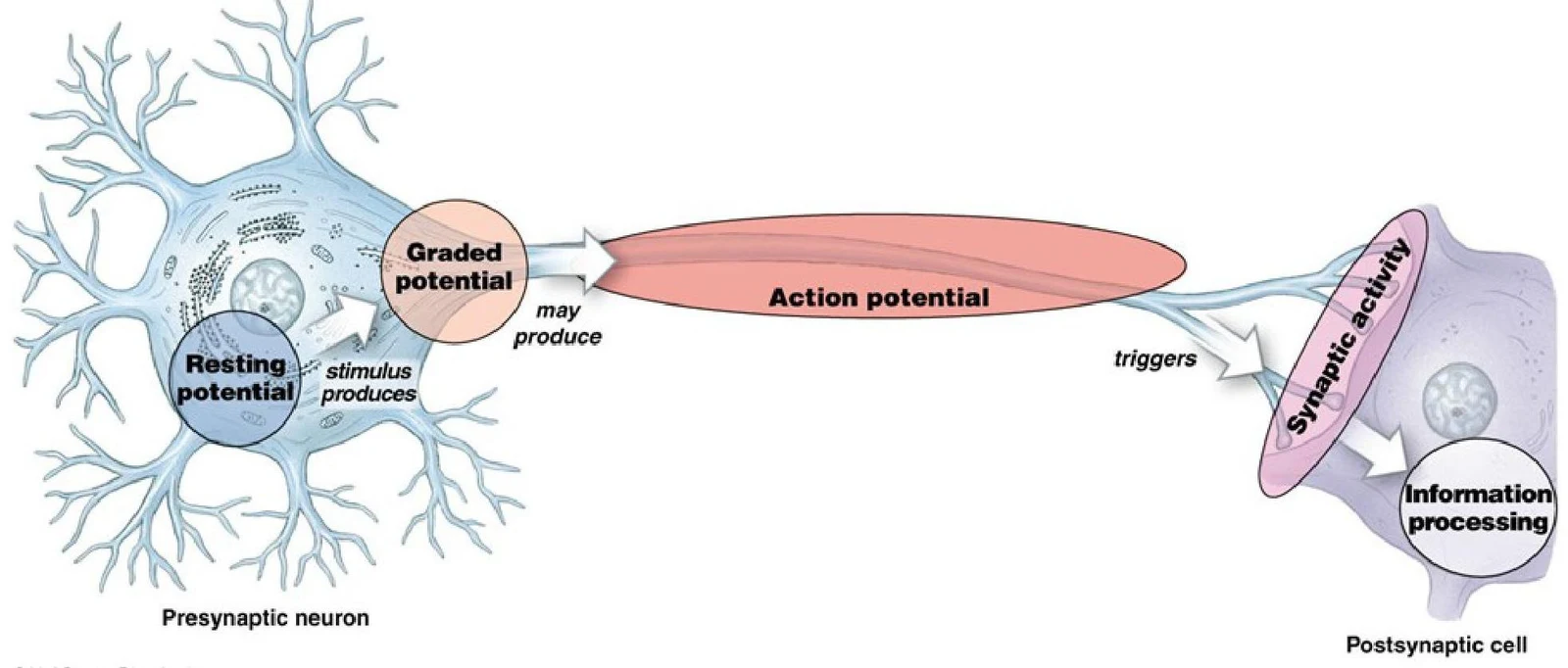
Resting Potential: The stable potential of a neuron when it is not being stimulated.
Graded Potential: A temporary, localized change in membrane potential that varies in magnitude.
Action Potential: A rapid, large-scale reversal of membrane potential that allows a signal to travel long distances along an axon.
Diagram illustrating the process of synaptic transmission, showing the transition from resting potential to graded potential and action potential in a presynaptic neuron, leading to synaptic activity and information processing in a postsynaptic cell.
Inflammation and the Arachidonic Acid Pathway
Inflammation is a protective response to injury, characterized by heat, redness, swelling, and pain. When cells are damaged, they release phospholipids from their membranes, which are then converted into arachidonic acid.
Through the arachidonic acid pathway, enzymes called cyclooxygenases (COX-1 and COX-2) convert these lipids into prostaglandins. Prostaglandins are key mediators of inflammation and pain because they sensitize nociceptors.
This diagram illustrates the biochemical pathways of leukotrienes and prostaglandins, both derived from arachidonic acid, and their roles in inflammation.
Analgesics: Treating Pain
Drugs used to relieve pain are called analgesics. They are broadly divided into two groups:
Non-Opioid Analgesics
This group includes nonsteroidal anti-inflammatory drugs (NSAIDs) and acetaminophen.
NSAIDs: These work by inhibiting the COX enzymes. While COX-2 is primarily involved in inflammation, COX-1 helps maintain the gastrointestinal mucosa. Most NSAIDs inhibit both. Aspirin is unique because it irreversibly binds to COX-1, providing anti-platelet effects.
Acetaminophen: This drug inhibits prostaglandin synthesis and regulates temperature in the hypothalamus, but it lacks significant anti-inflammatory effects.
Opioid Analgesics
Opioids are powerful pain relievers that act on specific receptors in the CNS, most notably the mu opioid receptors.
Full Agonists: (e.g., morphine, fentanyl) produce a maximal response.
Partial Agonists: Produce a sub-maximal response and exhibit a "ceiling effect".
Neurotransmitters and Psychotherapeutics
The CNS uses various neurotransmitters to communicate, including acetylcholine, dopamine, serotonin, glutamate, and gamma aminobutyric acid (GABA).
In the context of mental health, the levels of monoamines (serotonin, dopamine, and norepinephrine) are critical. Low levels are often associated with depression.
First-Generation Antidepressants: Such as Tricyclic antidepressants (TCAs), which block the reuptake of serotonin and norepinephrine but are often non-selective and cause more side effects.
Second-Generation Antidepressants: Such as SSRIs (Selective Serotonin Reuptake Inhibitors) and SNRIs (Serotonin-Norepinephrine Reuptake Inhibitors), which are more targeted and generally safer.
Finally, drugs like benzodiazepines act as CNS depressants by binding to GABA receptors. This increases the influx of chloride ions, making the neuron more negatively charged and harder to depolarize, thereby reducing anxiety and promoting sedation.
Keep reading for free.
Create an account to finish this reading and make it part of your study routine.