Fundamentals of Chemistry: Measurement, Matter, and Nomenclature
A comprehensive guide to essential chemistry concepts including measurement, significant figures, accuracy vs. precision, density, temperature conversion, classification of matter, and chemical nomenclature for ionic compounds and acids. Includes worked examples for molecular formula determination.
Preparing for a Chemistry I midterm requires more than just memorizing formulas; it demands a deep understanding of how to quantify the world around us. This guide breaks down the core pillars of the exam—ranging from the precision of your measurements to the complex naming of chemical compounds—to help you navigate your upcoming assessment with confidence.
Measurement and Data Analysis
The foundation of all scientific inquiry is measurement. However, a measurement is only as useful as the precision with which it is reported. This is where significant figures come into play. Significant figures are the digits in a number that carry meaning regarding the precision of a measurement. When performing calculations, you must follow specific rules to ensure you do not overstate the certainty of your results. For example, a number like 3.0650 contains five significant figures, whereas 1.04 contains only three.
Exam Tip: Always check the rules for zeros! Leading zeros (like in 0.043) are never significant, while trailing zeros after a decimal point (like in 3.0650) are significant.
Accuracy vs. Precision
Students often confuse accuracy and precision, but they represent two very different concepts in a laboratory setting.
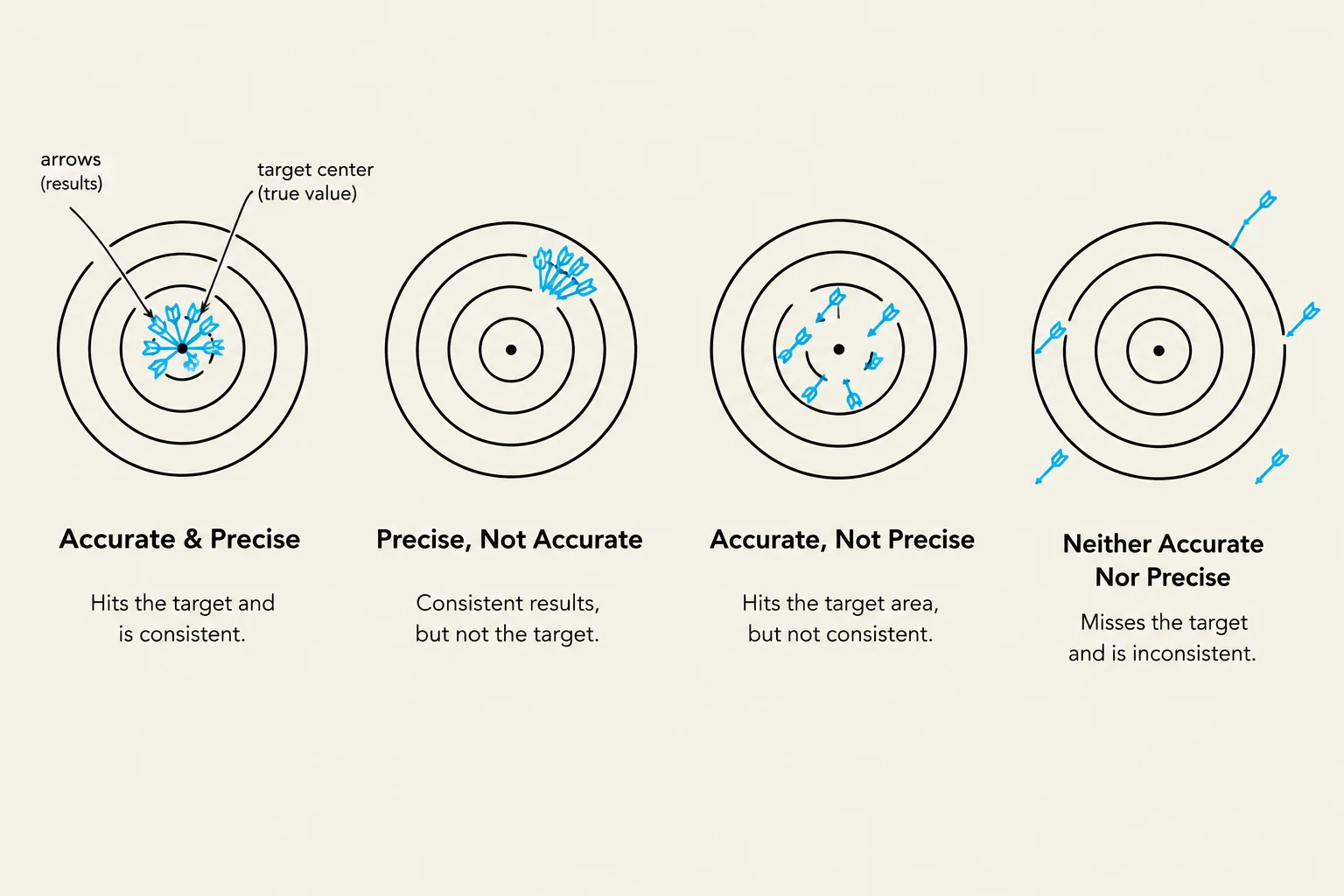
Accuracy describes how close a measurement is to the "true" or accepted value. If the actual pH of blood is 7.40 and a technician measures it as 6.98, that measurement is inaccurate.
Precision describes the reproducibility of your results. If a technician measures the same sample three times and gets 6.98, 6.99, and 6.98, the results are highly precise because they are consistent, even though they are far from the true value.
This diagram illustrates the concepts of accuracy and precision using target practice scenarios. It shows four different outcomes: Accurate & Precise (hits the target and is consistent), Precise, Not Accurate (consistent results, but not the target), Accurate, Not Precise (hits the target area, but not consistent), and Neither Accurate Nor Precise (misses the target and is inconsistent).
Density and Temperature
Quantitative skills also extend to physical properties like density. Density is an intensive property that relates the mass of a substance to the volume it occupies. The mathematical relationship is expressed as:
Density=volumemass
For instance, if you have a liquid with a density of 2.70 g/mL and a volume of 36.0 mL, you can calculate the mass by multiplying the two: 36.0 mL⋅2.70 g/mL=97.2 g.
Additionally, you must be comfortable with temperature conversion. The exam may require you to calculate a temperature change (interval) between Fahrenheit and Celsius scales. Note that a change in temperature is different from a specific temperature reading; a change of 16.0 degrees Fahrenheit must be converted to its equivalent Celsius interval.
Classification of Matter
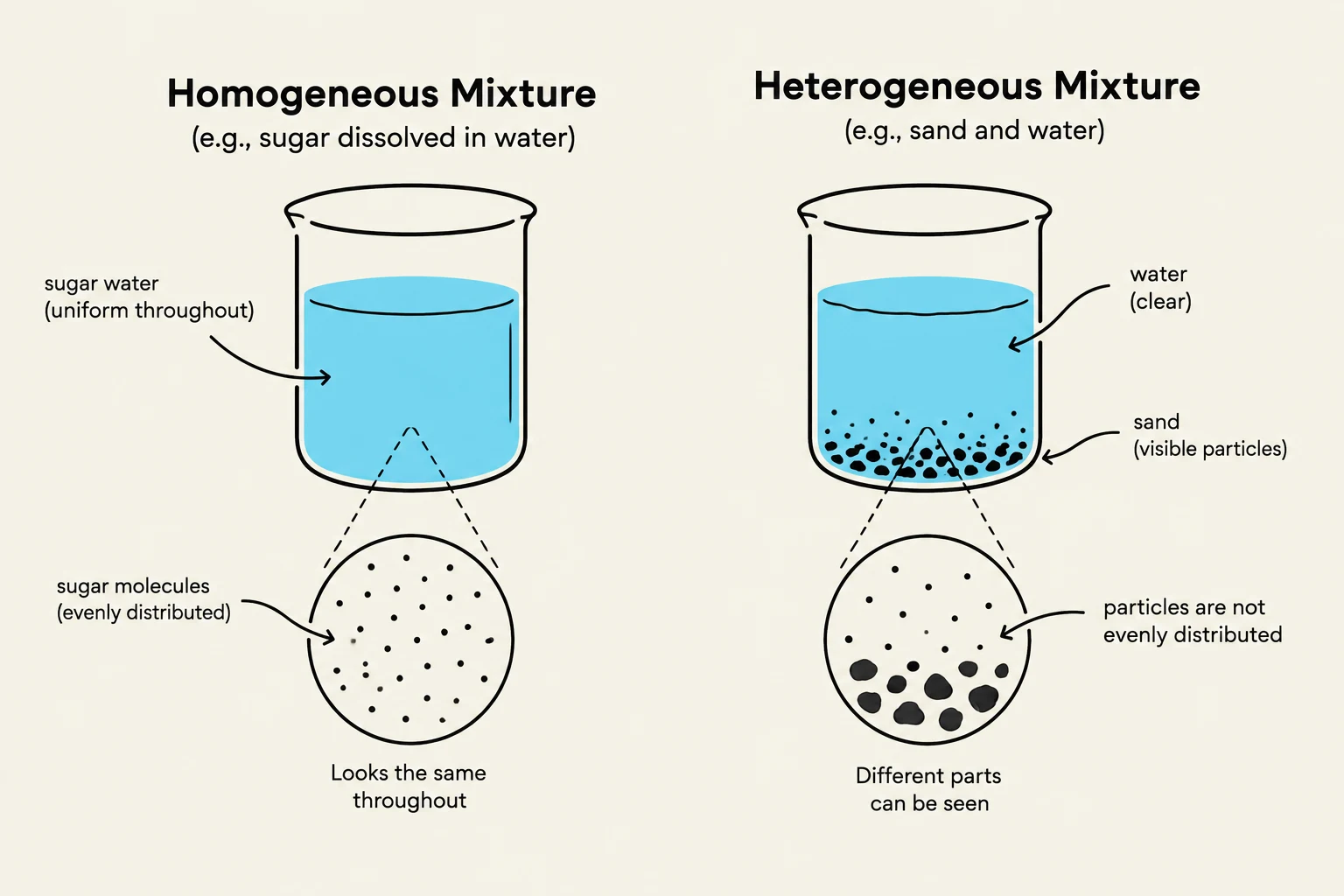
Matter can be classified based on its composition. One key concept is the homogeneous mixture. In a homogeneous mixture, the components are distributed uniformly throughout the entire sample, meaning the composition is the same no matter where you take a sample.
A classic example is sugar water. Unlike a heterogeneous mixture—such as a rock collection, chocolate chip cookies, or oil and vinegar dressing, where you can clearly see the different parts—a homogeneous mixture appears as a single phase.
This illustration compares homogeneous and heterogeneous mixtures, using sugar dissolved in water as an example of a homogeneous mixture and sand in water as an example of a heterogeneous mixture.
Chemical Nomenclature and Formulas
Perhaps the most challenging section of the midterm involves naming and writing formulas for chemical substances. This requires distinguishing between different types of bonding and following specific naming conventions.
Ionic Compounds and Naming
Ionic compounds are typically formed between a metal and a non-metal. For example, Na3P is an ionic compound. When naming these, you must be careful with several factors:
Polyatomic Ions: You must recognize specific groups of atoms that stay together. For example, the formula for rubidium sulfite is Rb2SO3. Be careful not to confuse "sulfite" (SO32−) with "sulfate" (SO42−).
The Stock System: Transition metals can have multiple possible charges. To clarify which one is being used, we use Roman numerals. For example, Cu(ClO3)2 is named copper(II) chlorate.
Acids: Naming oxyacids (acids containing oxygen) follows specific patterns based on the polyatomic ion. For instance, chlorous acid is written as HClO2.
Worked Example: Finding a Molecular Formula
A common high-level question involves using empirical formulas and molar mass to find a molecular formula.
Problem: A compound has a molecular weight of 146 g/mol. A sample contains 0.321 g of Carbon, 0.044 g of Hydrogen, and 0.285 g of Sulfur. What is the molecular formula?
Step 1: Find the Empirical Formula
Convert mass to moles:
Moles C=12.01 g/mol0.321 g≈0.027 molMoles H=1.01 g/mol0.044 g≈0.044 molMoles S=32.0 g/mol0.285 g≈0.0089 mol
Divide by the smallest number of moles (0.0089):
C: 0.00890.027≈3,H: 0.00890.044≈5,S: 0.00890.0089=1
The empirical formula is C3H5S.
Step 2: Find the X-factor
Calculate the empirical formula mass:
Mass=(3⋅12.01)+(5⋅1.01)+32.0=73 g/mol
Find the multiplier (X):
X=Empirical MassGiven Molar Mass=73146=2
Multiply the empirical formula by 2 to get the molecular formula: C6H10S2.
Final Study Tip: For stoichiometry and limiting reactant problems, always balance your chemical equation first! A mistake in balancing will lead to incorrect mole ratios and an incorrect final answer.
Keep reading for free.
Create an account to finish this reading and make it part of your study routine.