An overview of chemical reactions, including stoichiometry, redox reactions, and various acid-base theories (Arrhenius, Brønsted-Lowry, and Lewis). It also touches upon extreme chemistry and related disciplines like kinetics and electrochemistry.
At its core, chemistry is the study of change. A chemical reaction occurs when substances undergo a transformation into new material forms with entirely different properties. These changes are often visible to the naked eye, manifesting as a change in color, a shift in the state of matter (such as the formation of a gas or a solid precipitate), or a significant change in temperature.
Stoichiometry: The Mathematics of Matter
Chemical reactions are not random collisions; they are governed by strict quantitative relationships known as stoichiometry. In any given reaction, a specific amount of reactant A will react with a precise amount of reactant B to produce a predictable amount of product. This predictability allows chemists to perform calculations to determine how much starting material is needed to achieve a desired yield, or how much product will be generated from a specific sample.
Redox Reactions and Electron Transfer
One of the most fundamental ways to classify reactions is by how electrons move between atoms. These are known as redox (reduction-oxidation) reactions.
Oxidation and Reduction
In a redox process, one species loses electrons while another gains them.
Oxidation is the loss of electrons, which results in an increase in the oxidation number.
Reduction is the gain of electrons, which results in a decrease in the oxidation number.
A fundamental rule of nature is that oxidation and reduction must occur simultaneously. You cannot have a "lone" electron floating in a stable system; if one atom gives up an electron, another must be there to accept it to prevent charge accumulation and Coulomb repulsion.
Tracking Changes with Oxidation Numbers
To determine which species is being oxidized or reduced, we use oxidation numbers—a bookkeeping tool to track the "apparent" charge of an atom. While there are complex rules for many molecules, several simple guidelines exist for beginners:
Elements in their elementary state (like O2 or Fe) have an oxidation number of 0.
Alkali metals are typically +1, and alkaline earth metals are +2.
Oxygen is generally −2 (though it can be −1 in peroxides).
Halogens like Fluorine are typically −1.
Exam Tip: When balancing a redox equation, always check that the total change in oxidation number on the reactant side equals the total change on the product side.
This diagram illustrates the process of oxidation-reduction (redox) reactions, showing an electron transfer from a reducing agent (which loses electrons and is oxidized) to an oxidizing agent (which gains electrons and is reduced).
Worked Example: Balancing a Redox Reaction
Consider the reaction between Iron and Nitric Acid:
Fe+HNO3→Fe(NO3)3+NO+H2O
By tracking the oxidation numbers:
Fe goes from 0 to +3 (Oxidation: loss of 3 electrons).
N in HNO3 goes from +5 to +2 in $NO$ (Reduction: gain of 3 electrons).
Because the electron exchange is balanced (3 lost, 3 gained), we can balance the equation using coefficients:
1Fe+4HNO3→1Fe(NO3)3+1NO+2H2O
Acid-Base Theories: Three Perspectives
While redox reactions focus on electrons, acid-base reactions focus on the movement of protons ($H^+$) or the behavior of electron pairs. Because our understanding of chemistry has evolved, there are three distinct ways to define acids and bases.
1. Arrhenius Theory: The Aqueous Perspective
The oldest model, the Arrhenius theory, defines substances based on their behavior in water:
Acid: A substance that releases $H^+$ ions in water (e.g., HCl, H2SO4).
Base: A substance that releases $OH^-$ ions in water (e.g., NaOH, KOH).
The reaction between an Arrhenius acid and base typically produces a salt and water:
HCl+NaOH→NaCl+H2O
2. Brönsted-Lowry Theory: The Proton Perspective
The Brönsted-Lowry theory expands the definition to include reactions that don't necessarily involve $OH^-$ ions:
Acid: A proton ($H^+$) donor.
Base: A proton ($H^+$) acceptor.
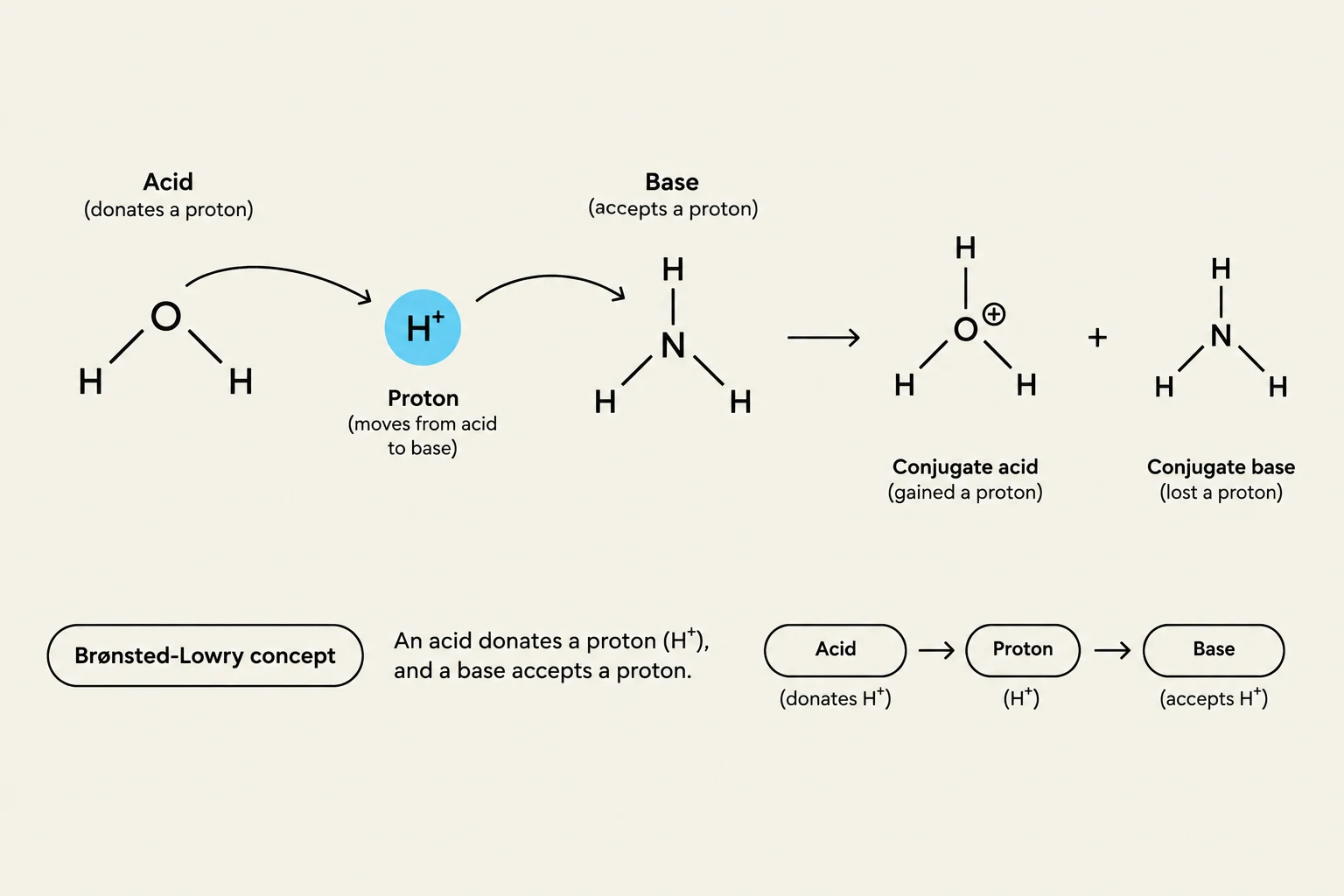
This theory introduces conjugate pairs. When an acid gives up a proton, it becomes a "conjugate base." Conversely, when a base accepts a proton, it becomes a "conjugate acid".
Key Principle: A strong acid will have a very weak conjugate base, and a strong base will have a very weak conjugate acid.
The Brønsted-Lowry concept explains acid-base reactions where an acid donates a proton (H+) and a base accepts a proton. The diagram illustrates the transfer of a proton from water (acting as an acid) to ammonia (acting as a base), forming a hydronium ion (conjugate acid) and an ammonium ion (conjugate base).
3. Lewis Theory: The Electron Perspective
The most expansive definition is the Lewis theory, which moves away from protons entirely and focuses on electron pairs:
Lewis Acid: An electron-pair acceptor (an atom with an electron-pair deficit).
Lewis Base: An electron-pair donor.
When a Lewis acid and base interact, they form a complex through a dative bond (a covalent bond where both electrons come from the same atom). This theory is so broad that it even includes substances like H3BO3, which acts as a Lewis acid by accepting an $OH^-$ group rather than donating a proton.
Extreme Chemistry and Applications
The strength of these interactions can reach incredible levels. For example, superacids—created by mixing extremely strong acids like H2SO4 with Lewis acids like SbF5—are so potent they can protonate even highly stable molecules like methane (CH4) to form CH5+.
Understanding these fundamental transformations is the gateway to mastering more complex chemical disciplines:
Reaction Kinetics: Studying the speed at which these transformations occur.
Chemical Equilibrium: Understanding how reactions reach a state of balance between reactants and products.
Electrochemistry: Applying redox principles to study charge, current, voltage, and conductivity.
Keep reading for free.
Create an account to finish this reading and make it part of your study routine.