Fundamentals of Chemical Nomenclature and Intermolecular Forces
This article explains the fundamentals of chemical nomenclature, including naming ionic and molecular compounds, and introduces intermolecular forces (IMFs) such as dispersion forces, dipole-dipole interactions, and hydrogen bonding, and their impact on physical properties like boiling points.
Understanding the language of chemistry is essential for any student. Chemistry relies on a systematic way of naming substances (nomenclature) and understanding how they stick together. This article explores the relationship between electron configurations, ionic charges, and the rules used to name different types of compounds, as well as the forces that hold molecules together.
The Foundation: Electron Configuration and Typical Charges
At the heart of chemical reactivity is the electron configuration of an atom. An atom's arrangement of electrons determines how many electrons it will gain, lose, or share to achieve a stable state. This process results in the formation of ions—atoms or groups of atoms with a net electrical charge.
When an atom loses electrons, it becomes a positively charged cation; when it gains electrons, it becomes a negatively charged anion. For example, Sodium (Na) typically loses one electron to become Na+, while Chlorine (Cl) gains one to become Cl−. Other common ions include Al3+, which carries a higher positive charge due to its specific electron configuration.
The charge of an ion is the "key" to building a neutral compound. Because compounds must be electrically neutral, the total positive charge must equal the total negative charge.
Worked Example: Balancing Charges
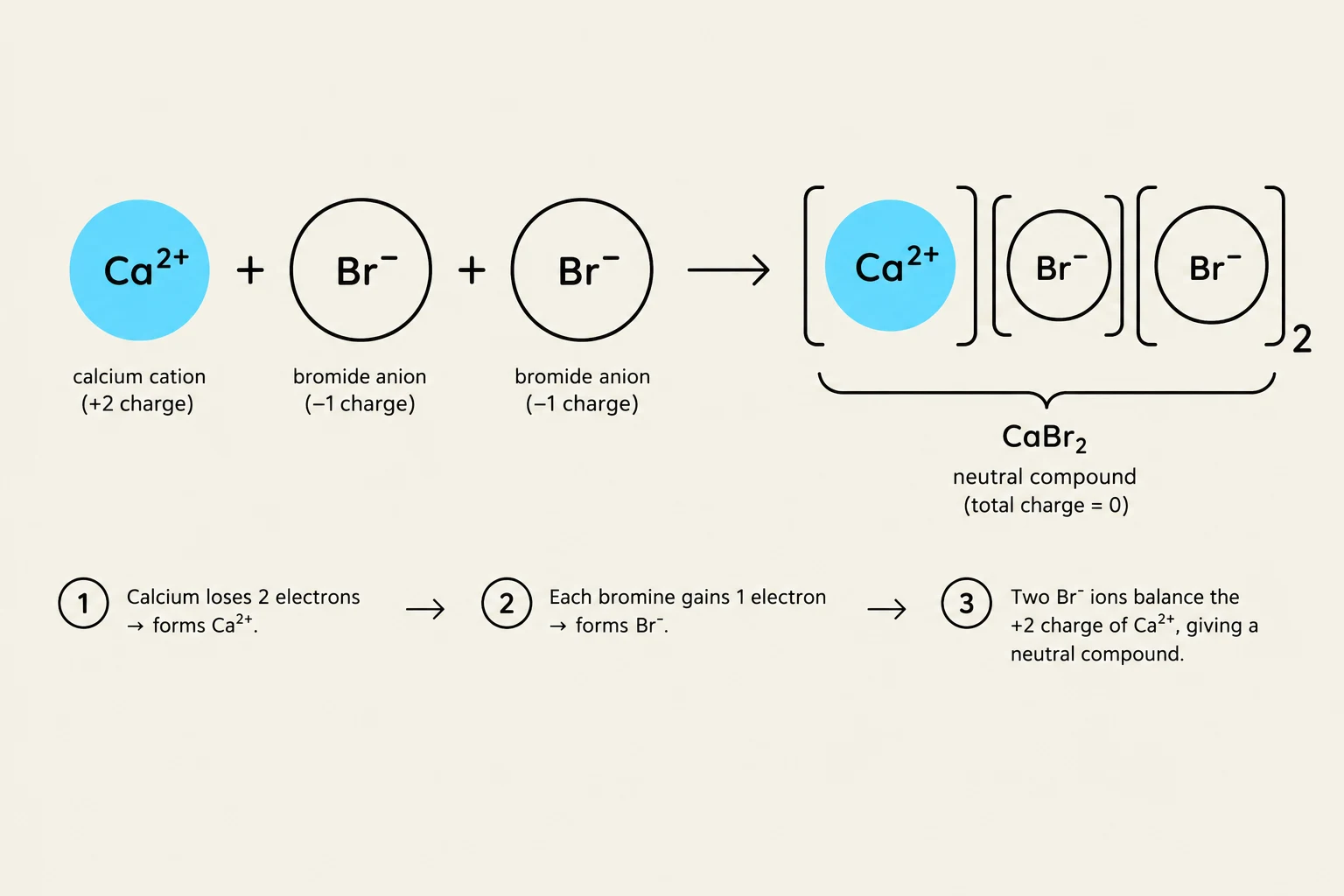
If you are asked to write the formula for calcium bromide:
Identify the ions: Calcium forms Ca2+ and Bromine forms Br−.
Balance the charges: To cancel out the +2 charge of one Calcium, you need two −1 charges from Bromine.
Result: CaBr2.
This diagram illustrates the formation of calcium bromide (CaBr2), a neutral compound, from calcium cations (Ca2+) and bromide anions (Br-). It shows that calcium loses two electrons to form a Ca2+ ion, and each bromine atom gains one electron to form a Br- ion. Two bromide ions are needed to balance the +2 charge of the calcium ion, resulting in a neutral compound with a total charge of zero.
Polyatomic Ions
Not all ions consist of a single atom. Polyatomic ions are clusters of atoms that stay together as a single unit and carry an overall charge. Recognizing these is vital for both writing formulas and naming compounds.
Some of the most critical polyatomic ions to memorize include:
Ammonium: NH4+
Hydronium: H3O+
Hydroxide: OH−
Cyanide: CN−
Phosphate: PO43−
Chemical Nomenclature: Naming Compounds
Nomenclature rules change depending on whether you are looking at an ionic compound or a molecular (covalent) compound.
1. Ionic Compounds
Ionic compounds generally consist of a metal followed by a non-metal.
Naming Rule: Name the metal first. Name the non-metal second and change its ending to the suffix "-ide".
Example: CaCl2 is calcium chloride.
With Polyatomic Ions: If the compound contains a polyatomic ion, simply use the name of that ion.
Example: Mg(OH)2 is magnesium hydroxide.
Transition Metals: Many metals (transition metals) can have multiple possible charges. In these cases, we use Roman numerals to specify the charge of the metal.
Example: CoBr2 would be named cobalt(II) bromide.
2. Binary Molecular Compounds
These consist of two non-metals. Because non-metals can combine in various ratios, we cannot rely on charges alone; instead, we use prefixes to indicate exactly how many atoms of each element are present.
Common prefixes include:
Mono- (1)
Di- (2)
Tri- (3)
Tetra- (4)
Penta- (5)
Deca- (10)
Examples of Molecular Naming:
CO2: Carbon dioxide
N2O5: Dinitrogen pentoxide
This image illustrates the difference between ionic and molecular compounds, showing the ionic lattice structure of NaCl and the molecular structure of CO2.
Intermolecular Forces (IMFs)
While chemical bonds hold atoms together within a molecule, intermolecular forces (IMFs) are the attractions between different molecules. The strength of these forces determines the physical state of a substance—whether it is a gas, liquid, or solid.
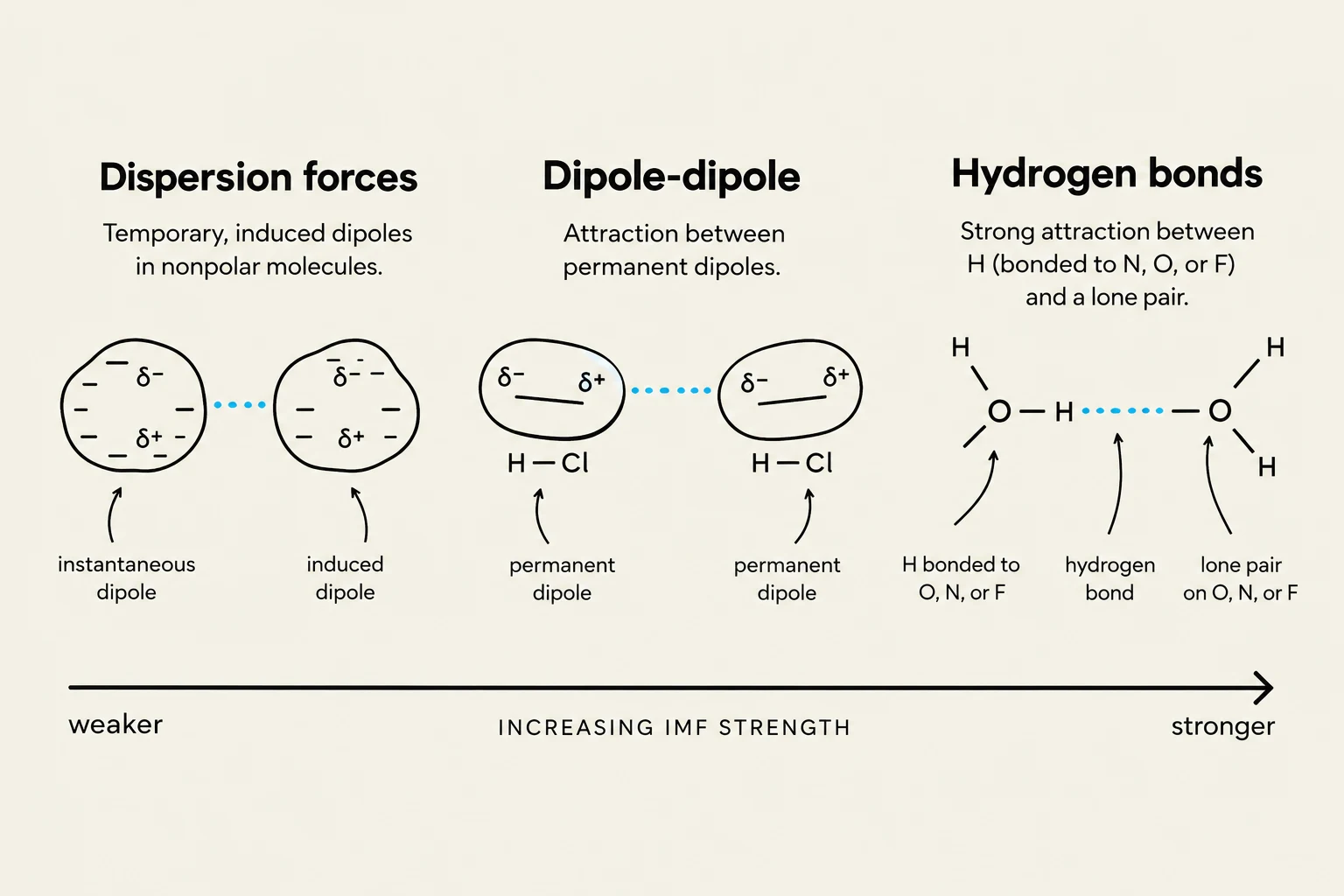
There are three primary types of IMFs, listed here from generally weakest to strongest:
1. Dispersion Forces (Van der Waals)
These occur in all molecules, regardless of whether they are polar or non-polar. They are caused by the movement of electrons, which can create a temporary, "induced" dipole (a momentary imbalance of charge).
Polarizability: This refers to how easily an electron cloud can be distorted to create that temporary dipole.
Trend: Dispersion forces increase as the mass and size of the molecule increase.
2. Dipole-Dipole Interactions
These occur only in polar molecules. In a polar molecule, there is a permanent partial positive end and a permanent partial negative end. The positive end of one molecule is attracted to the negative end of another.
3. Hydrogen Bonding
Hydrogen bonding is a particularly strong type of dipole-dipole interaction. It occurs when hydrogen is bonded directly to a highly electronegative atom—specifically Nitrogen (N), Oxygen (O), or Fluorine (F).
This illustration depicts three types of intermolecular forces: dispersion forces, dipole-dipole interactions, and hydrogen bonds, ordered by increasing strength.
Exam Tip: Boiling Points and IMFs
There is a direct relationship between IMF strength and boiling points: The stronger the attractive force between molecules, the higher the boiling or melting point. If you are asked to compare two substances, identify their strongest IMF first; the one with the stronger force will have the higher boiling point.
Summary Table of Naming
Compound Type
Components
Naming Convention
Example
Ionic
Metal + Non-metal
Metal + Non-metal-"ide"
LiCl (Lithium chloride)
Ionic (Polyatomic)
Metal + Polyatomic Ion
Metal + Ion Name
Mg(OH)2 (Magnesium hydroxide)
Molecular
Non-metal + Non-metal
Use Prefixes
CCl4 (Carbon tetrachloride)
Keep reading for free.
Create an account to finish this reading and make it part of your study routine.