Fundamentals of Atomic Structure, Periodic Trends, and Chemical Bonding
Explore the quantum mechanical model of the atom, electron configurations, periodic trends like effective nuclear charge and ionization energy, and the principles of chemical bonding including polarity and nomenclature.
Preparing for Chemistry Exam II requires a shift in thinking from the macroscopic world to the microscopic, probabilistic nature of atoms. This exam covers the fundamental building blocks of matter: how electrons are organized, how they dictate the trends of the periodic table, and how they interact to form the bonds that create everything from salt to complex organic molecules.
The Quantum Mechanical Model of the Atom
In classical physics, we might imagine an electron orbiting a nucleus like a planet around a sun. However, modern chemistry relies on Schrödinger’s quantum mechanical model, which replaces fixed orbits with atomic orbitals. An orbital is not a path, but a three-dimensional probability space where an electron is likely to be found.
This shift in understanding is necessitated by the Heisenberg Uncertainty Principle, which states that we cannot simultaneously know both the exact position and the exact momentum of an electron. Because of this inherent uncertainty, we describe electrons using subshells ($s, p, d$) which have distinct geometric shapes.
This illustration displays the 3D shapes and probability distributions of s, p, and d atomic orbitals, which are fundamental concepts in chemistry and physics.
Rules for Electron Configuration
To describe how electrons occupy these orbitals, we use electron configurations. When writing these, we must follow three fundamental rules:
The Aufbau Principle: Electrons fill the lowest energy orbitals first.
Hund’s Rule: When filling degenerate orbitals (orbitals of the same energy), electrons will occupy empty orbitals singly with parallel spins before pairing up.
The Pauli Exclusion Principle: No two electrons in an atom can have the same four quantum numbers; essentially, an orbital can hold a maximum of two electrons with opposite spins.
Exam Tip: Watch out for excited states. An excited state occurs when an electron absorbs energy and jumps to a higher energy orbital than the ground state configuration. If you see a configuration that skips a lower-energy orbital, it is likely in an excited state.
Additionally, remember that half-filled orbitals confer special stability to an atom. This stability directly influences the oxidation states (the predictable charges) an element can form when it becomes an ion.
Periodic Trends and Effective Nuclear Charge
The behavior of elements in the periodic table is not random; it is driven by the relationship between the nucleus and the electrons. The core concept here is effective nuclear charge (Zeff), which is the net positive charge experienced by a valence electron.
While the nuclear charge (the total number of protons) increases as you move across a period, the electrons are also subject to electron shielding. Inner-shell electrons act as a screen, partially blocking the pull of the nucleus from the outer electrons.
Key Trends to Memorize
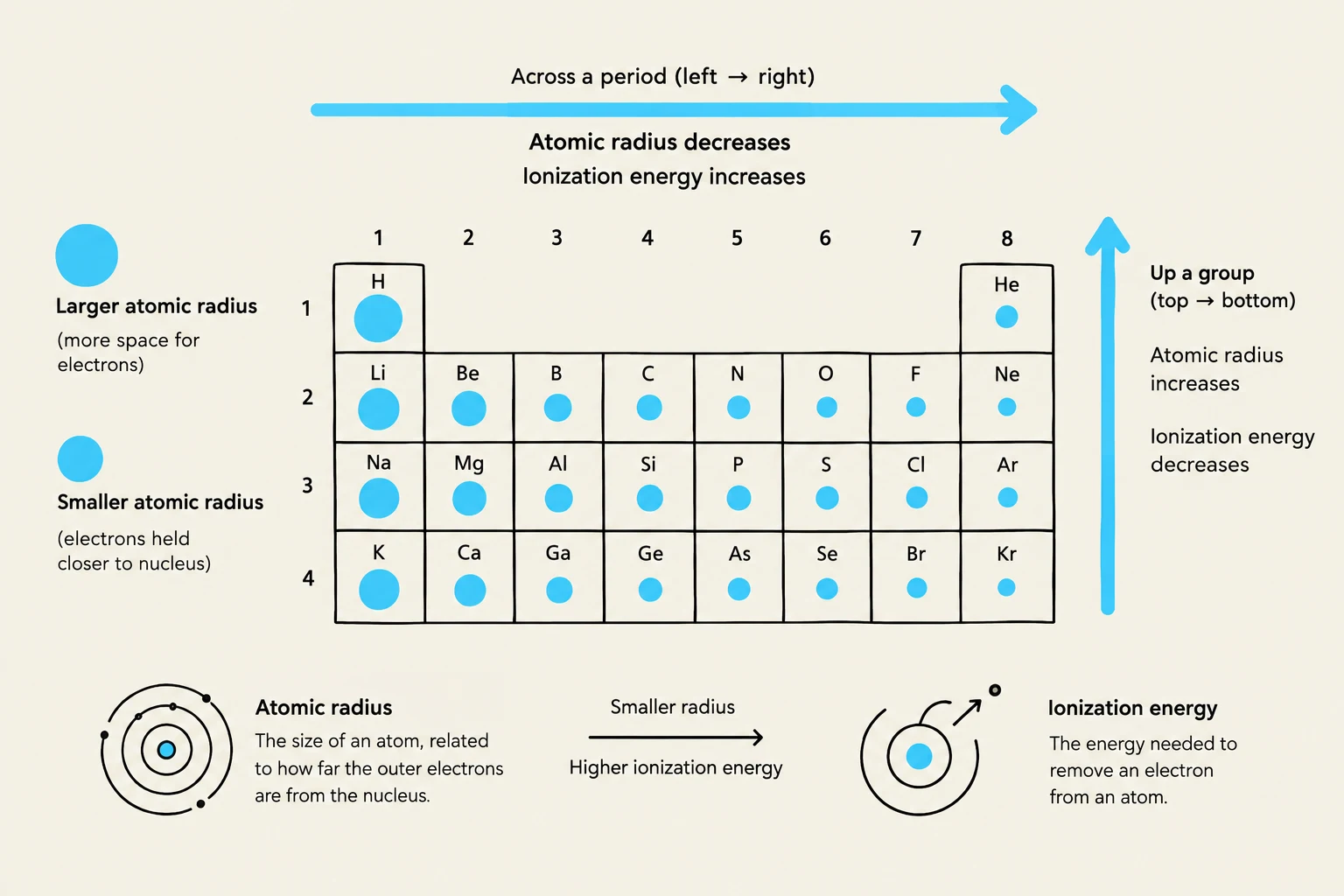
Atomic and Ionic Radius: As you move across a period, Zeff increases, pulling electrons closer and decreasing the radius. Conversely, as you move down a group, more electron shells are added, increasing the radius.
Ionization Energy: This is the energy required to remove an electron. It generally increases across a period (due to higher Zeff) and decreases down a group.
Isoelectronic Series: These are atoms or ions that have the same number of electrons. To predict their properties, look at the proton count: the species with more protons will have a higher Zeff and a smaller radius.
This illustration explains the trends of atomic radius and ionization energy across periods and down groups in the periodic table, along with definitions and visual representations of these concepts.
Chemical Bonding and Polarity
Chemical bonds form because atoms seek to reach a state of minimum potential energy. There are three primary types of bonds:
Ionic Bonds: Formed by the complete transfer of electrons from a metal to a non-metal.
Covalent Bonds: Formed when two non-metals share electrons.
Metallic Bonds: Occur between metal atoms, characterized by a "sea of electrons" that allows for conductivity.
Electronegativity and Polarity
Within covalent bonds, we often see polarity. This is determined by electronegativity, the ability of an atom to attract electrons in a bond.
If the electronegativity difference is small, the bond is nonpolar covalent.
If there is a significant difference, the bond is polar covalent, creating a dipole where one side is partially negative (δ−) and the other is partially positive (δ+).
Solubility Rule: Remember "like dissolves like". Polar solvents (like water) dissolve polar or ionic solutes, while nonpolar solvents (like oil) dissolve nonpolar solutes. Substances that dissociate into ions in solution are called electrolytes.
Nomenclature and Molecular Representation
Naming Compounds
Ionic Compounds: Named by the cation followed by the anion. If the metal can have multiple oxidation states (like Iron), you must use Roman numerals to specify the charge (e.g., Iron(III) chloride).
Binary Molecular Compounds: These consist of two non-metals and use Greek prefixes (mono-, di-, tri-) to indicate the number of atoms (e.g., Carbon dioxide).
Lewis Structures and Resonance
Lewis structures are visual representations of valence electrons. While most atoms follow the octet rule (seeking 8 valence electrons), there are exceptions:
Incomplete Octets: Hydrogen and Beryllium often have fewer than 8.
Expanded Octets: Elements in higher periods (those with d orbitals available) can hold more than 8 electrons.
To determine the most stable Lewis structure, we calculate the formal charge for each atom. Sometimes, a single Lewis structure cannot accurately represent a molecule; in these cases, we use resonance structures. The true molecule is a "hybrid" of these structures, which affects the bond order, energy, and length.
This illustration explains chemical bonding concepts including single bonds, double bonds, and resonance structures, illustrating electron sharing and delocalization in molecules.
Finally, for large organic molecules, we use line structures (skeletal structures). These omit Carbon and Hydrogen atoms to simplify the drawing, though we must still be mindful of polar regions within the molecule that might affect its overall behavior.
Keep reading for free.
Create an account to finish this reading and make it part of your study routine.