Acid-base chemistry is one of the most fundamental pillars of science, governing everything from the pH of our blood to the complex mechanisms of organic synthesis. To master this topic, one must move beyond the simple idea of "sour" or "bitter" substances and instead focus on the movement of particles—specifically protons and electrons.
Defining Acids and Bases: Brönsted vs. Lewis
Historically, the definition of an acid or a base has evolved to become more inclusive. The two most important frameworks used in chemistry are the Brönsted-Lowry definition and the Lewis definition.
The Brönsted-Lowry Definition: Proton Transfer
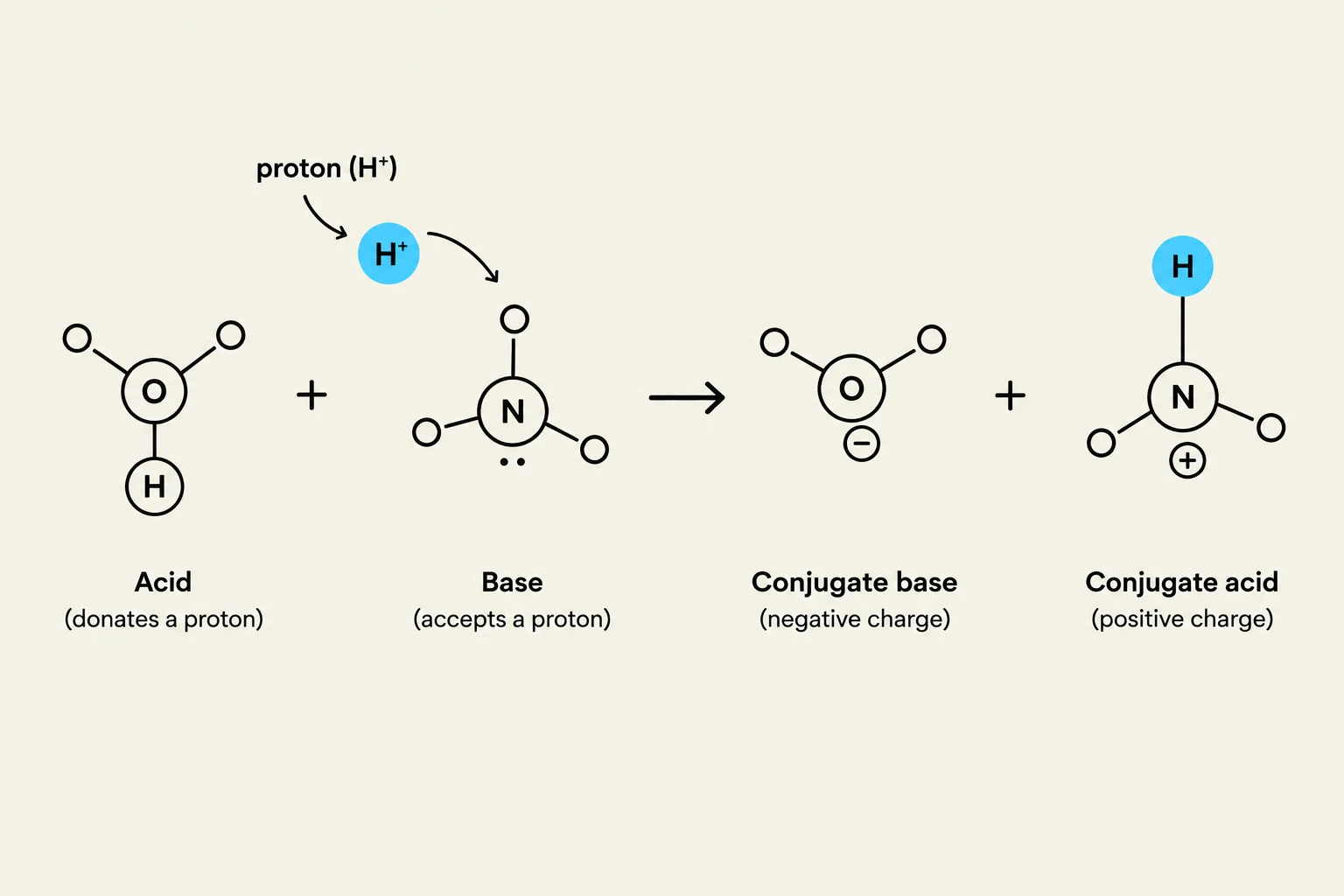
The Brönsted definition focuses on the movement of a proton ($H^+$). In this framework, an acid is a substance that donates a proton, while a base is a substance that accepts a proton. This process is known as proton transfer.
When an acid (HA) reacts with a base (B), the reaction can be represented as:
HA+B⇌A−+HB+
In this reaction, HA is the acid and B is the base. Once the proton is transferred, $A^-$ is known as the conjugate base and HB+ is the conjugate acid.
This diagram illustrates the Brønsted-Lowry acid-base theory, showing an acid donating a proton (H+) to a base, forming a conjugate base and a conjugate acid.
The Lewis Definition: Electron Pair Movement
The Lewis definition is broader and more versatile. It does not require the presence of a proton at all. Instead, it focuses on electron pairs. A Lewis acid is an electron pair acceptor, and a Lewis base is an electron pair donor.
Because a proton ($H^+$) is essentially an empty orbital looking for electrons, it acts as a Lewis acid. This means that all Brönsted acid-base reactions are also Lewis acid-base reactions, but not all Lewis reactions involve protons.
Quantifying Strength: Ka and $pK_a$
Acid-base reactions are equilibrium reactions, meaning they can proceed in both the forward and reverse directions. To describe how far an equilibrium lies toward the products, we use the equilibrium constant, Ka.
For the dissociation of an acid HA in water:
HA+H2O⇌A−+H3O+
The equilibrium constant is:
Ka=[HA][A−][H3O+]
A high Ka indicates a strong acid that dissociates significantly, while a low Ka indicates a weak acid. Because Ka values can span a massive range (from 1012 to 10−50), chemists use the negative logarithm to make the numbers manageable. This is the $pK_a$:
pKa=−log(Ka)
A lower $pK_a$ value signifies a stronger acid.
The Relationship Between pH and $pK_a$
While $pK_a$ tells us about the strength of the acid itself, pH tells us about the concentration of $H^+$ in the solution. These two are linked by the following relationship:
pH=pKa+log([HA][A−])
Exam Tip: If the concentration of the acid $[HA]$ is equal to the concentration of its conjugate base $[A^-]$, then the pH of the solution will be exactly equal to the $pK_a$ of the acid.
Predicting Acid Strength: Stability and Trends
The strength of a Brönsted acid is primarily determined by the stability of the anion formed after deprotonation. If an acid can lose a proton and leave behind a stable, low-energy anion, it will be a strong acid.
Anion Stability and Nucleophilicity
An unstable anion carrying a free electron pair will have a strong tendency to donate that pair to a proton, making it a strong base. In organic chemistry, these electron-rich species are also called nucleophiles, as they seek out electron-deficient centers.
Two key factors influence this stability:
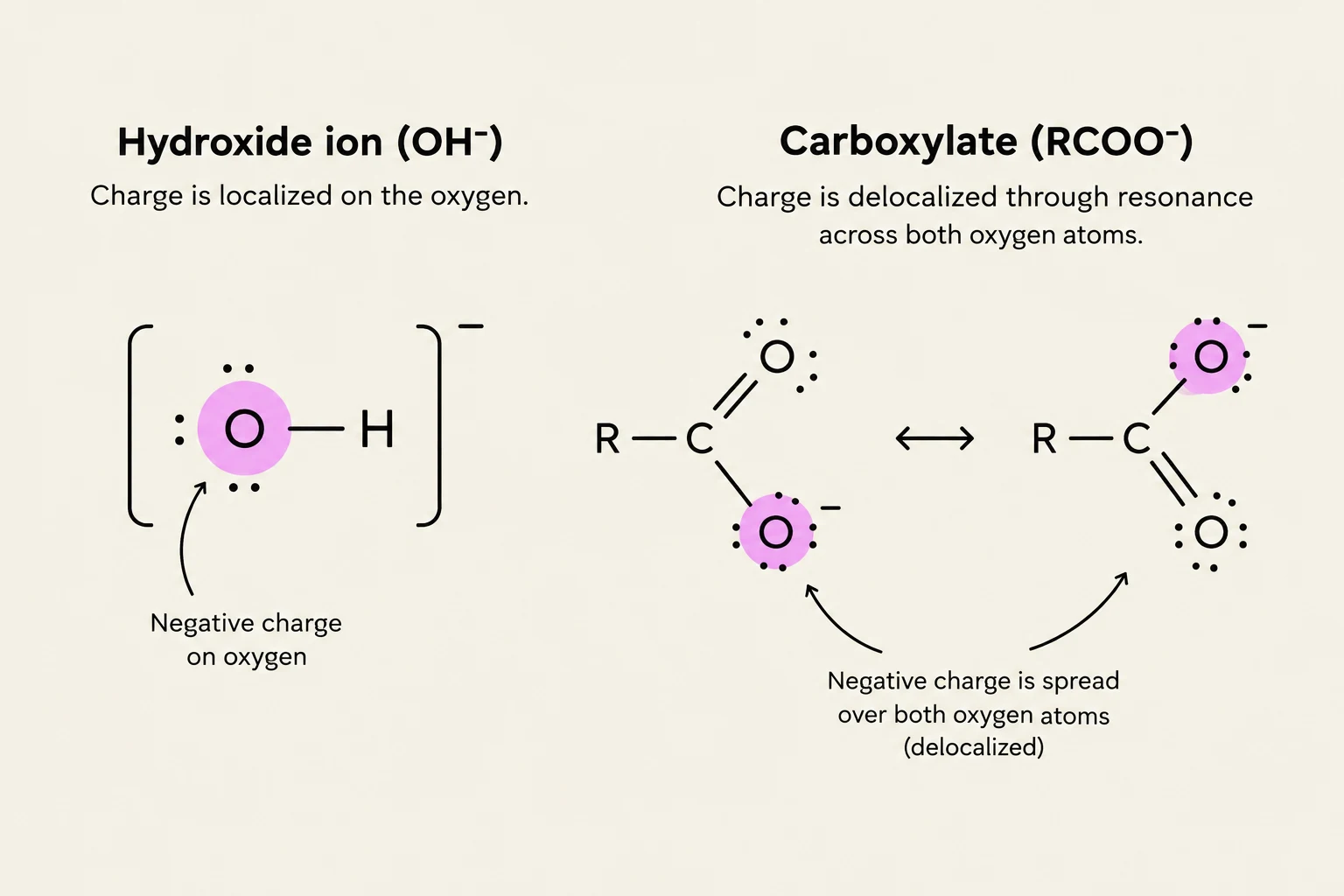
Resonance and Charge Density: If a negative charge can be spread out over multiple atoms via resonance, the anion becomes more stable. For example, the carboxylate anion ($RCOO^-$) is much more stable than a hydroxide anion ($OH^-$) because the negative charge is distributed over two oxygen atoms rather than being concentrated on one. This reduces the charge density and makes the parent acid much stronger.
Electronegativity: Atoms that are more electronegative are better at carrying a negative charge.
This illustration compares the hydroxide ion, where charge is localized on oxygen, with the carboxylate ion, where charge is delocalized through resonance across both oxygen atoms.
Periodic Table Trends
We can predict acidity by looking at the periodic table. Two main trends emerge:
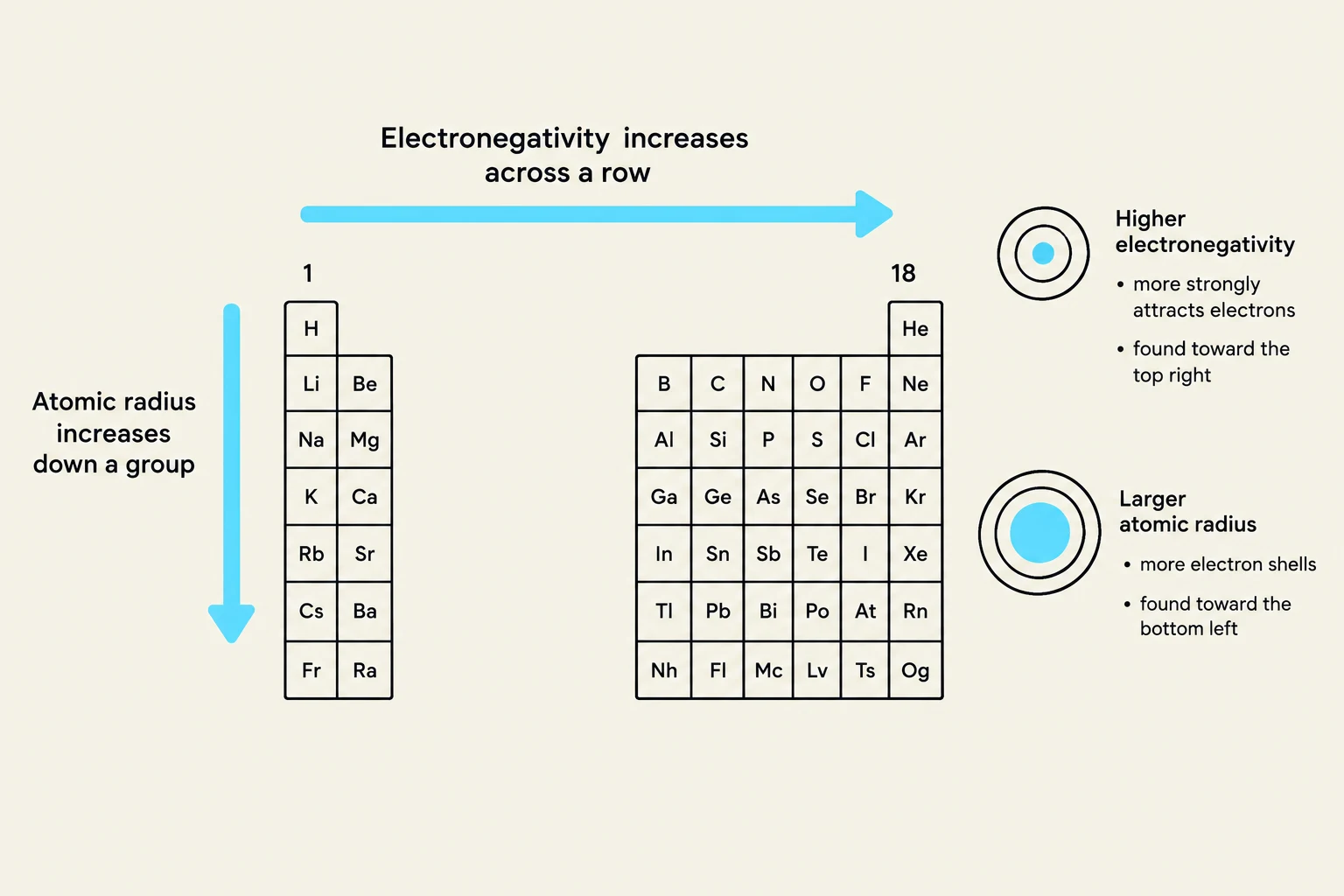
Across a Period (Rows): As you move from left to right, electronegativity increases. This increases the atom's ability to carry a negative charge, thereby increasing acidity. For example, in the series CH4<NH3<H2O<HF, acidity increases as electronegativity increases.
Down a Group (Columns): As you move down a group, the atomic/ionic radius increases. A larger radius reduces the charge density of the anion, which stabilizes it. This is why HI is a much stronger acid than HF.
This diagram illustrates trends in the periodic table, showing that electronegativity increases across a row and atomic radius increases down a group.
Summary of Bond Strength
In many cases, such as the hydrohalic acids ($HF, HCl, HBr, HI$), the strength of the acid is also tied to the strength of the X−H bond. As the halogen gets larger, the bond becomes weaker (e.g., HF bond strength is 136 kcal/mol, while HI is only 78 kcal/mol), making it easier for the proton to leave.
Worked Example: Predicting Equilibrium Direction
To determine which way an acid-base reaction will shift, always identify the acids on both sides and compare their $pK_a$ values. The reaction will always favor the side with the weaker acid (the one with the higher $pK_a$).
Question: In which direction is the following reaction displaced?
RCOOH+HO−R⇌RCOO−+H3O+−R
(Note: Simplified for conceptual analysis)
Step 1: Identify the acids.
Left side: RCOOH (Carboxylic acid)
Right side: H3O+−R (Protonated alcohol/species)
Step 2: Compare $pK_a$ values.
$pK_a$ of RCOOH≈5
$pK_a$ of the conjugate acid ≈15.7
Conclusion: Since the acid on the right has a much higher $pK_a$ (is a much weaker acid), the equilibrium will be displaced to the right.
Keep reading for free.
Create an account to finish this reading and make it part of your study routine.