This content explains the principles and applications of functional orthotics, a therapeutic approach used to correct flexible deformities by manipulating soft tissues and joint alignment to restore optimal function. It differentiates between flexible and rigid deformities and details the mechanism, clinical applicatio
In the field of biomechanics and clinical orthotics, a critical distinction is made between the structural integrity of a joint and its functional position. When a patient presents with a deformity, the clinician must first determine if that deformity is "fixed" (bony/structural) or "flexible" (soft tissue/functional). Functional orthotics represent a specific therapeutic approach designed to address the latter.
Comparison of flexible and rigid joint deformities.
The primary goal of functional orthotics is to use rigid external supports to correct and hold flexible deformities in a neutral, biomechanically advantageous position. Unlike structural orthotics, which may be used to accommodate a permanent change in bone shape, functional orthotics aim to manipulate the soft tissue and joint alignment to restore optimal function.
Understanding Flexible vs. Rigid Deformities
To apply functional orthotics effectively, one must understand the nature of the deformity being treated. A deformity is generally classified based on its response to manual manipulation or external force.
Flexible Deformities
A flexible deformity is one where the joint can still be moved into a neutral or corrected position through manual force or passive stretching. In these cases, the underlying bone structure is often still capable of being realigned, but the soft tissues (ligaments, tendons, or joint capsules) have become elongated or imbalanced, allowing the joint to "collapse" into an abnormal position.
Rigid Deformities
In contrast, a rigid deformity occurs when the change is structural—often involving the bones themselves or significant degenerative changes in the joint (such as advanced osteoarthritis). In a rigid deformity, no amount of external force can return the joint to a neutral position.
Clinical Tip: Always perform a manual reduction test before prescribing a functional orthotic. If you can manually move the joint back to a neutral position, the deformity is likely flexible and a candidate for functional orthotic intervention.
The Mechanism of Functional Orthotics
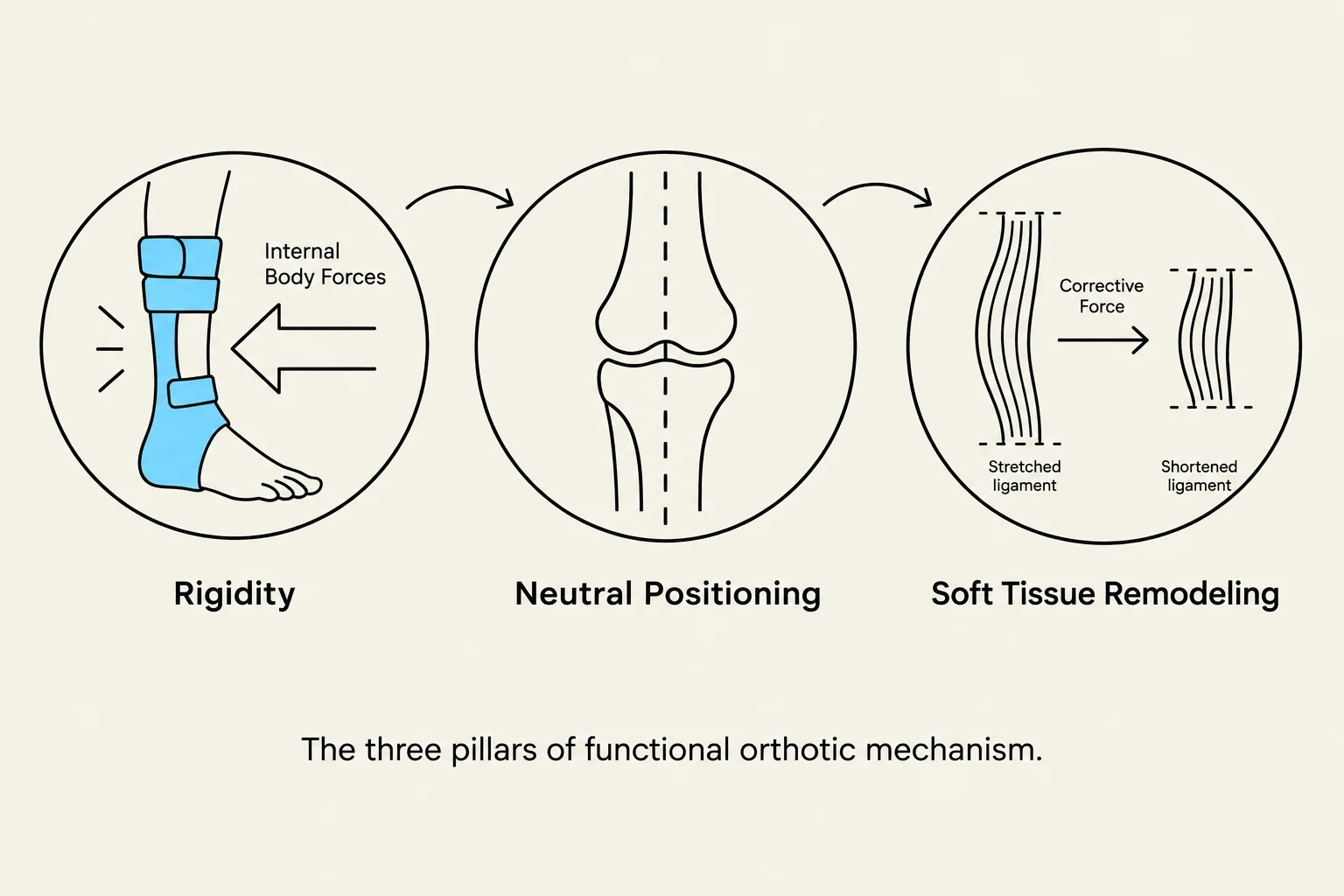
The three pillars of functional orthotic mechanism: rigidity, neutral positioning, and soft tissue remodeling.
Functional orthotics operate on the principle of applying a constant, controlled force to counteract the forces causing the deformity. Because the deformity is flexible, the orthotic acts as a "template" for the correct alignment.
The mechanism involves several key components:
Rigidity: The orthotic itself must be rigid enough to resist the internal forces of the body that are driving the deformity. If the orthotic flexes under load, it will fail to maintain the neutral position.
Neutral Positioning: The device is designed to hold the segment (such as a toe, a finger, or a foot) in a neutral position. This position is typically the one that allows for the most efficient muscle activation and the least amount of joint stress.
Soft Tissue Remodeling: By holding the joint in a neutral position over a period of time, functional orthotics encourage the soft tissues to adapt. This may involve the gradual shortening of stretched ligaments or the lengthening of contracted muscles, effectively "training" the body to maintain the corrected alignment.
Clinical Application and Goals
The application of functional orthotics is not merely about immobilization; it is about functional restoration. While a rigid orthotic might simply stop movement to prevent pain, a functional orthotic seeks to optimize the movement that is possible.
Correcting Alignment
By applying a rigid force against the deformity, the orthotic shifts the joint from its pathological state back to its neutral state. For example, in a patient with a flexible hallux valgus (bunion), a functional orthotic would apply a lateral force to the great toe to pull it back toward the midline.
Maintaining Neutrality
Once the correction is achieved, the orthotic must provide enough stability to prevent the deformity from recurring during activity. The "neutral position" is the target state where the biomechanical lever arms of the surrounding muscles are most effective.
Worked Example: The Flexible Hallux Valgus
To better understand how this works in a clinical setting, let's look at a hypothetical case of a flexible hallux valgus.
Patient Presentation:
A patient presents with a noticeable deviation of the great toe toward the second toe. Upon physical examination, the clinician performs a manual correction: by applying pressure to the medial side of the first metatarsal head, the clinician can successfully push the great toe back into a straight, neutral alignment.
Diagnosis:
Because the toe can be manually corrected, the deformity is classified as flexible.
Orthotic Intervention:
Design: A rigid orthotic is designed to apply a corrective force to the lateral aspect of the hallux (great toe) and a stabilizing force to the first metatarsal.
Action: The orthotic holds the toe in the neutral position achieved during the manual exam.
Outcome: Over time, the constant pressure from the rigid orthotic helps manage the soft tissue tension, aiming to maintain the neutral alignment during walking and weight-bearing activities.
Summary Table: Orthotic Approaches
Feature
Functional Orthotics
Structural/Rigid Orthotics
Target Deformity
Flexible (Soft tissue driven)
Rigid (Bone/Structural driven)
Primary Goal
Correct and hold in neutral
Accommodate and stabilize
Mechanism
Tissue remodeling & realignment
Support of fixed anatomy
Joint Capability
Can be moved to neutral manually
Cannot be moved to neutral
By focusing on the distinction between flexible and rigid pathologies, clinicians can use functional orthotics to not just manage symptoms, but to actively work toward the correction of biomechanical deviations.
Keep reading for free.
Create an account to finish this reading and make it part of your study routine.