Freedom of the Press and Trial Access in the US Legal System
Explores the constitutional framework, historical foundations, and landmark jurisprudence surrounding the public and press's right to attend criminal trials in the United States, balancing fair trial rights with transparency.
In the United States legal system, the courtroom is not merely a site for resolving disputes between individuals; it is a cornerstone of democratic transparency. The tension between a defendant's right to a fair trial and the public's right to know is a recurring theme in constitutional law. This article explores how the First and Fourteenth Amendments, working in tandem with historical legal traditions, establish a presumptive right for the press and the public to attend criminal trials.
The Constitutional Framework
To understand trial access, one must navigate several distinct constitutional guarantees. While they often overlap in practice, they serve different legal functions.
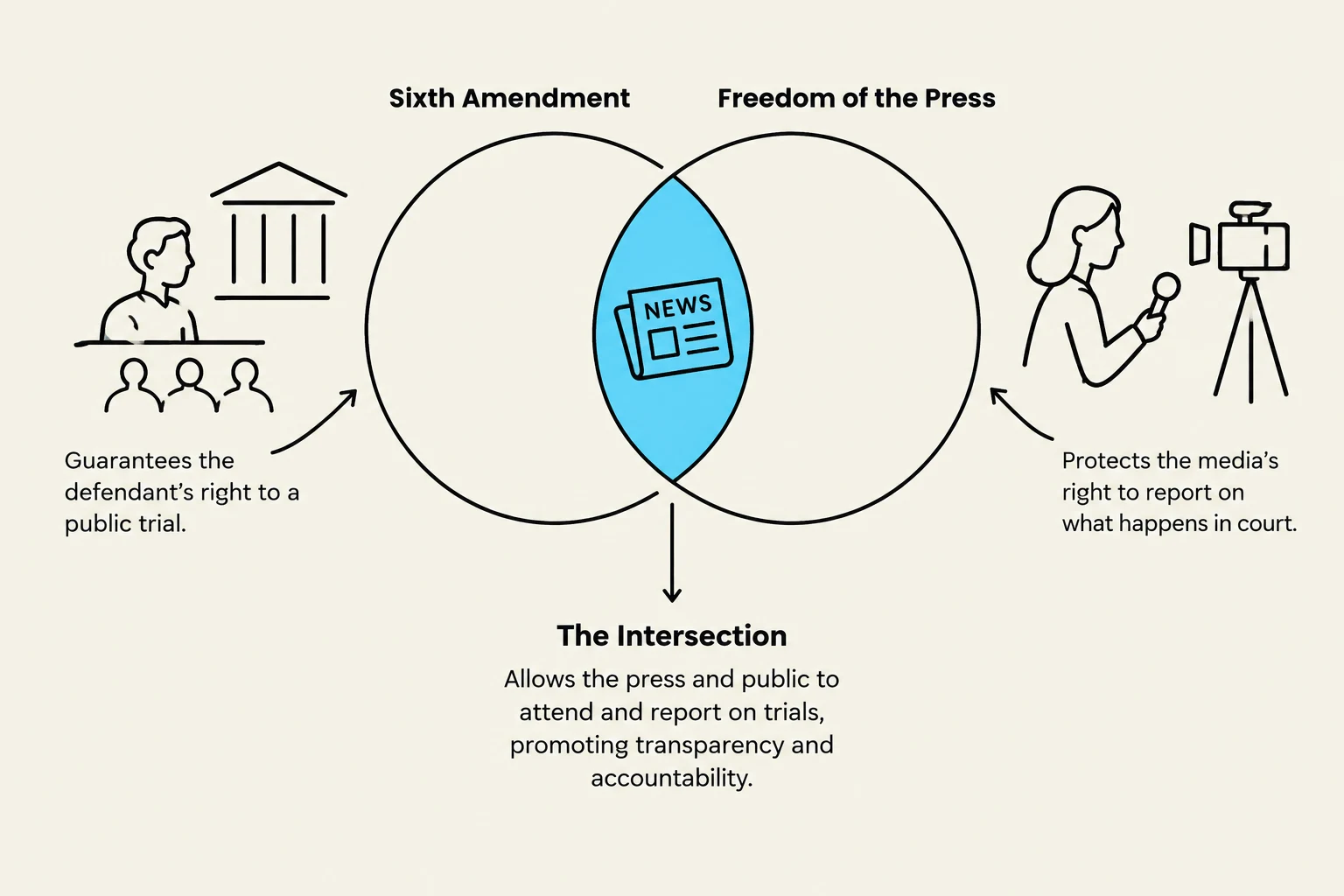
The Sixth Amendment guarantees the accused the right to a "public trial". However, the Supreme Court has clarified that this right is personal to the defendant; it is a shield to protect the accused from secret proceedings, not a sword for the public to demand entry.
The First Amendment provides the primary basis for public access. It protects the freedom of speech and the freedom of the press. Crucially, the Court has interpreted these protections to include not just the right to speak or publish, but also a "right to receive information". This implies that the government cannot arbitrarily block the flow of information from the very sources—like courtrooms—where significant public interest resides.
The Fourteenth Amendment ensures that these First Amendment protections are applied to the states, preventing local jurisdictions from closing their courtrooms without constitutional justification.
Exam Tip: When analyzing a case involving courtroom closure, distinguish between the Sixth Amendment (which protects the defendant's right to a public trial) and the First Amendment (which protects the public's right to attend and observe).
This diagram illustrates the intersection of the Sixth Amendment, which guarantees the defendant's right to a public trial, and the Freedom of the Press, which protects the media's right to report on court proceedings. The intersection highlights how allowing the press and public to attend and report on trials promotes transparency and accountability.
Historical Foundations of Open Justice
The concept of the open trial is not a modern invention but is deeply rooted in Anglo-American justice history. From the early English "moots" to the development of the modern jury system, trials have been traditionally open to those who wished to observe.
Legal scholars like Blackstone and Hale emphasized that openness is essential for the proper functioning of justice. Openness serves several critical functions:
Accountability: It discourages perjury and misconduct by participants.
Prevention of Bias: It prevents decisions based on secret partiality.
Community Catharsis: It provides a "prophylactic" outlet for community emotion, preventing "self-help" or vigilante justice by allowing the public to see that the law is being administered.
As noted by Jeremy Bentham, without publicity, other legal checks might act more like "cloaks" than actual safeguards.
Landmark Jurisprudence: From Gannett to Richmond Newspapers
The evolution of trial access law is best understood through two pivotal Supreme Court cases.
Gannett Co. v. DePasquale (1979)
In Gannett, the Court addressed whether the public had a right to attend a pretrial suppression hearing. The Court held that the Sixth Amendment's guarantee of a public trial did not extend to pretrial motions. Because the Sixth Amendment right is personal to the accused, it does not grant the press an enforceable right to access proceedings that are not the trial itself.
Richmond Newspapers v. Virginia (1980)
This case changed the landscape of constitutional law. The question was whether a criminal trial itself could be closed to the public upon the unopposed request of a defendant.
In a landmark decision, the Court held that the First and Fourteenth Amendments, in conjunction, guarantee a right of access to criminal trials. The Court reasoned that:
The First Amendment protects the "stock of information" from which the public draws.
The right of assembly is "cognate" to free speech and press, and courtrooms are public places where people assemble to listen and learn.
Even if a right is not explicitly "enumerated" in the text (like the right to privacy), it can be implicit in the guarantees provided.
The First Amendment ensures a presumption of openness in court proceedings, protecting free press and public access.
Balancing Rights: Can Trials Ever Be Closed?
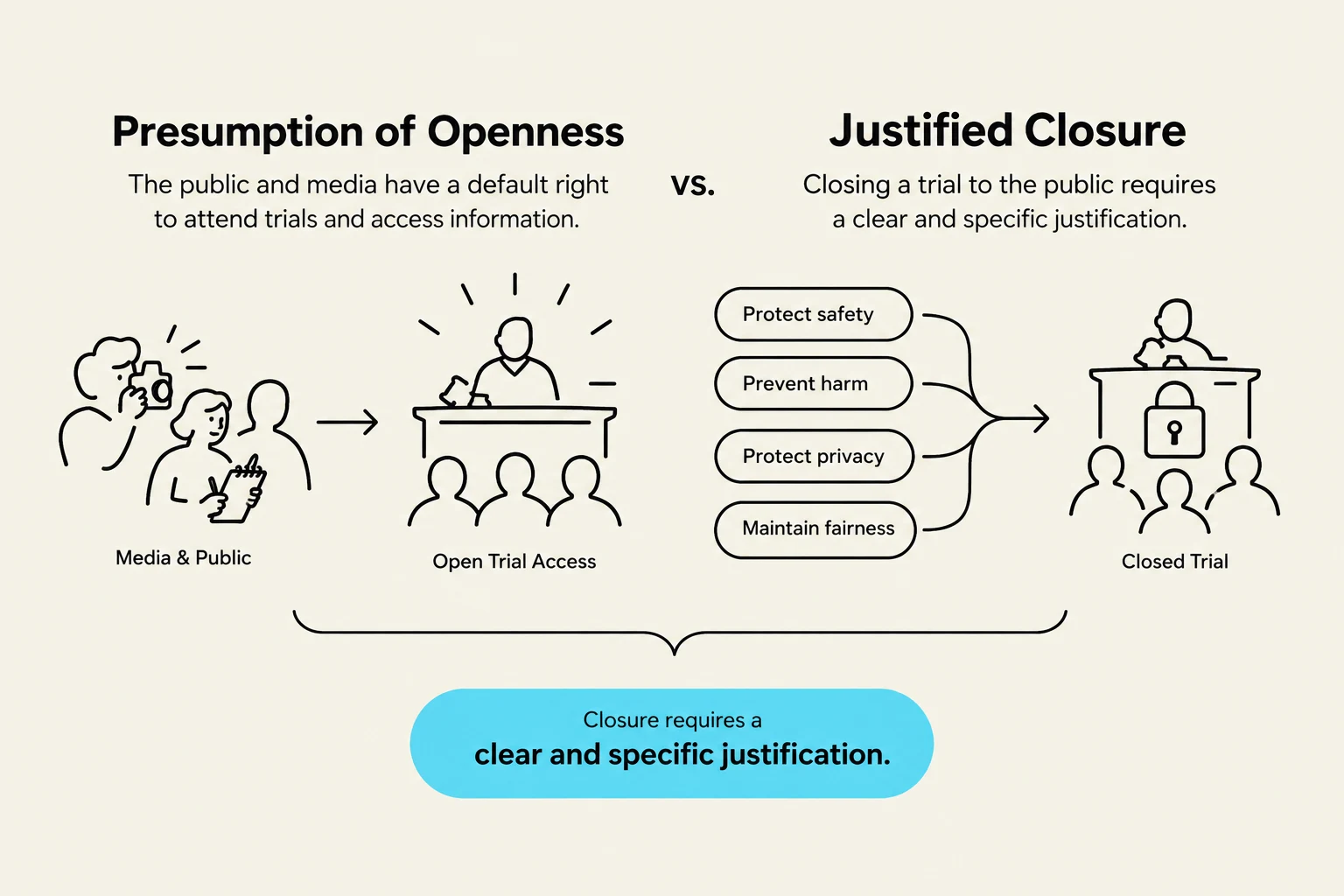
The right of access is not absolute. Just as the government can impose "time, place, and manner" restrictions on protests in a park, a judge can impose reasonable limitations on a courtroom to ensure order and safety.
The primary conflict arises when a defendant's right to a fair trial (avoiding prejudice) clashes with the public's right to access. To close a trial, a judge must typically demonstrate:
An overriding, compelling interest.
That no alternative exists (such as sequestering a jury or excluding specific witnesses).
For example, in Globe Newspaper Co. v. Superior Court (1982), the Court ruled that a law requiring the automatic closure of trials involving minor victims was unconstitutional. While protecting victims from trauma is a valid interest, the state cannot use "automatic closure" because it fails to consider whether the trial could remain open with less restrictive measures.
Summary Table: Constitutional Sources of Access
Amendment
Primary Function in Trial Access
First Amendment
Protects the public's right to receive information and the press's right to gather news.
Sixth Amendment
Protects the defendant's right to a public trial, but does not grant a public right of access.
Fourteenth Amendment
Incorporates First Amendment protections against state and local governments.
This diagram illustrates the difference between the presumption of openness in trials, where the public and media have a right to access information, and justified closure, which requires specific reasons like protecting safety, preventing harm, protecting privacy, or maintaining fairness.
In conclusion, the "appearance of justice" is as vital to a functioning democracy as the administration of justice itself. Through the lens of the First Amendment, the courtroom remains a public forum, ensuring that the legal process is transparent, accountable, and informed by the community it serves.
Keep reading for free.
Create an account to finish this reading and make it part of your study routine.