


In the study of dynamics, we seek to understand why objects move the way they do. The answer lies in the relationship between the forces acting on an object and its resulting motion. By mastering the use of Free-Body Diagrams (FBDs), you can transform complex physical scenarios into simple mathematical equations, allowing you to predict acceleration and motion with precision.
Understanding Newton's Laws
Newton’s laws of motion provide the fundamental framework for analyzing forces. To understand how an object behaves, we must distinguish between two primary states of motion:
- Newton’s First Law: If the net force acting on an object is zero (), the object is not accelerating. This means the object is either at rest or moving with a constant velocity ().
- Newton’s Second Law: If there is a net force acting on an object, it will undergo acceleration ().
The mathematical relationship is defined by the formula: In this equation, the net force is the vector sum of all individual forces acting on the object. It is crucial to remember that acceleration is determined solely by the forces acting on an object at that specific instant.
Exam Tip: Always distinguish between velocity and acceleration. An object can be moving downwards (negative velocity) but slowing down, which means its acceleration is directed upwards (positive acceleration).
The Power of Free-Body Diagrams (FBD)
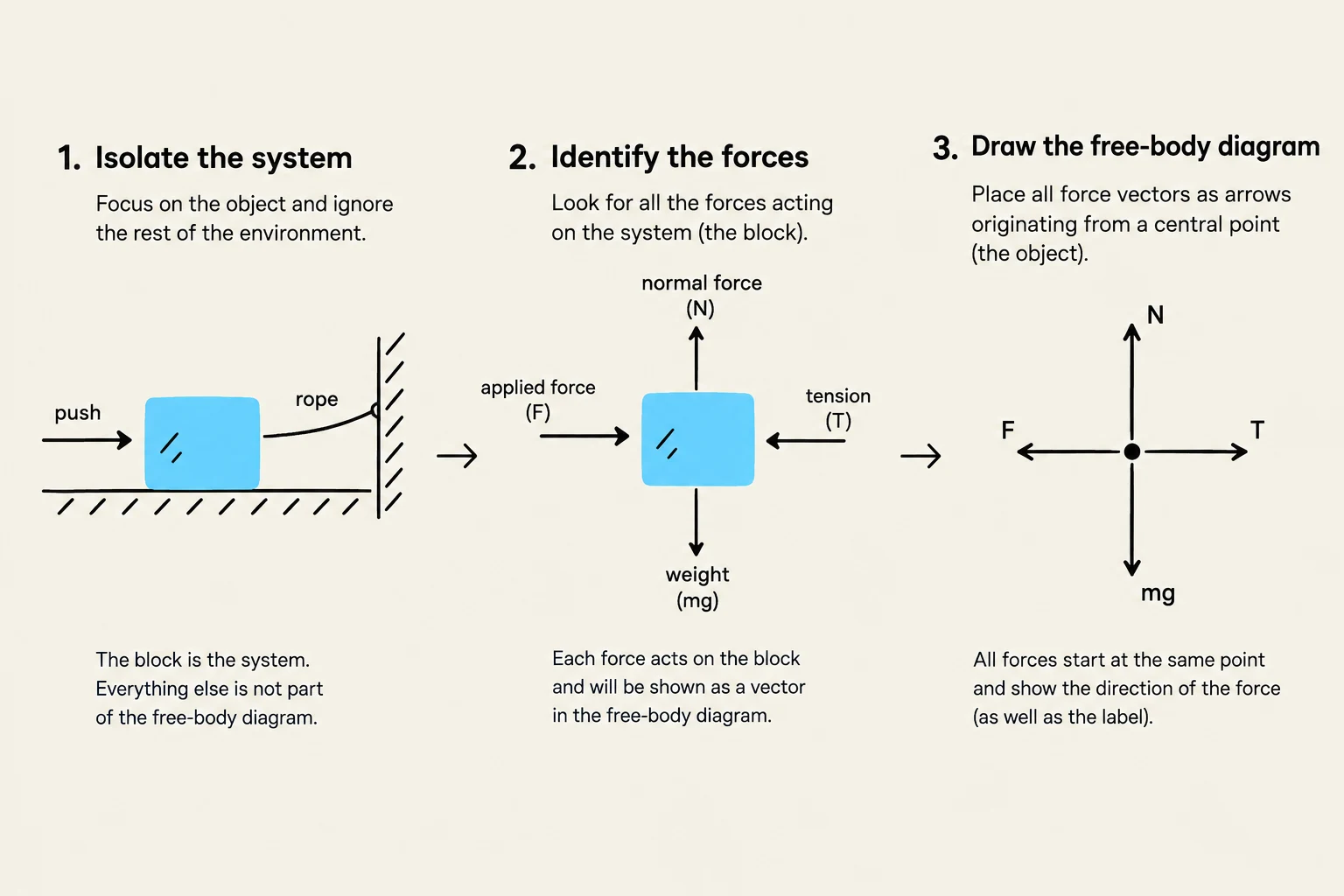
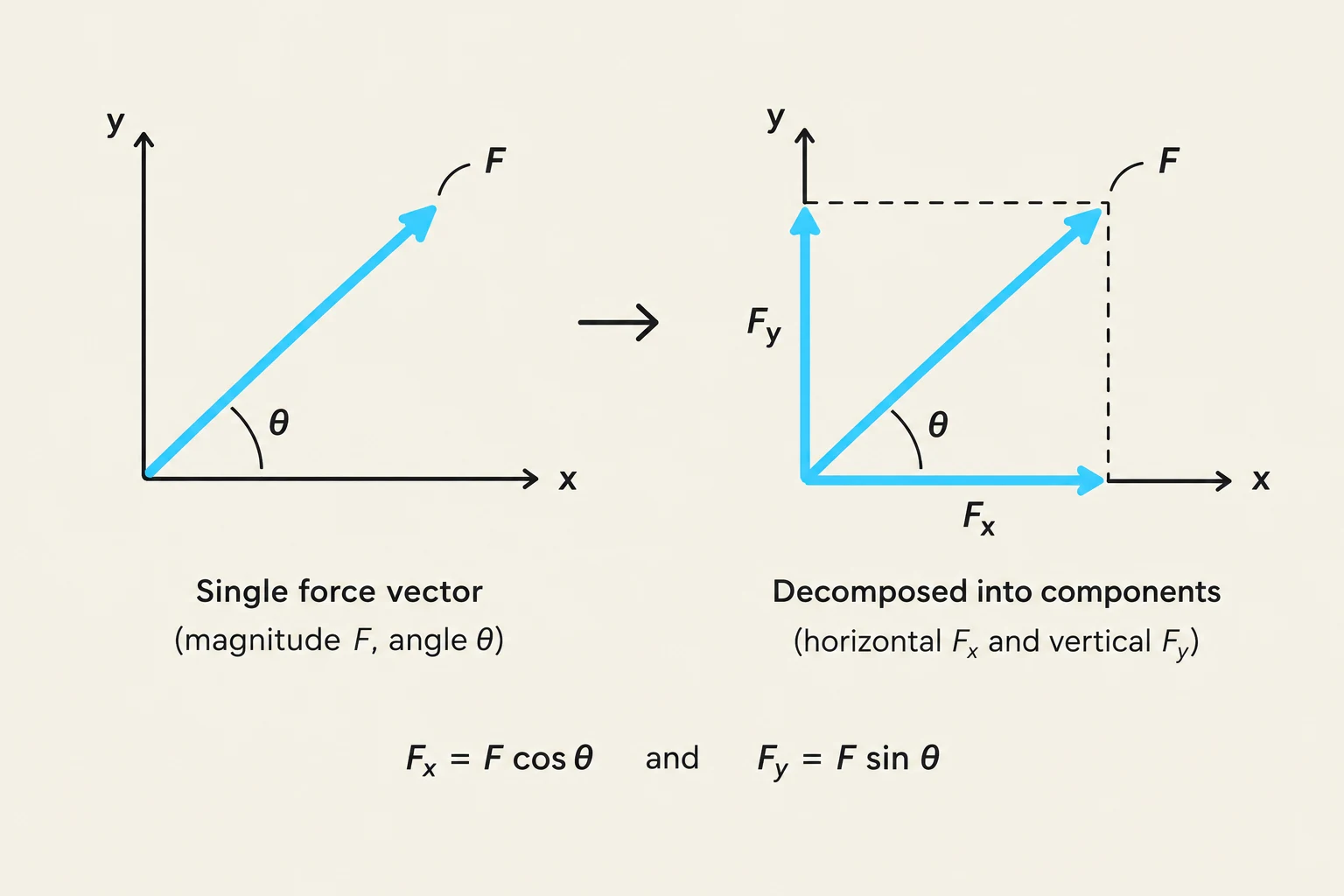
A Free-Body Diagram is a schematic representation used to visualize the forces acting on a specific "system"—the object whose motion we are studying. When drawing an FBD, we treat the system as a single point and represent all external forces as vectors.
Keep reading for free.
Create an account to finish this reading and make it part of your study routine.
Continue reading freeAlready have an account? Log in
Updated