This content explores the definition of culture, subcultures, and how cultural worldviews are transmitted across generations, emphasizing their importance in providing effective healthcare.
In the modern healthcare landscape, nurses encounter a diverse tapestry of patients, each bringing a unique set of beliefs, values, and practices to the clinical setting. To provide safe, effective, and compassionate care, nurses must move beyond mere tolerance and develop a deep understanding of transcultural nursing. This discipline focuses on the comparative study of cultures and the development of nursing care that is congruent with a patient's cultural values. At its core, this study requires us to deconstruct what "culture" actually means and how it shapes the human experience of health and illness.
Defining Culture and the Cultural Lens
Culture is not a monolithic entity; rather, it is a complex, integrated system of learned, shared, and transmitted values, beliefs, and norms that guide the behavior of a group of people. It encompasses everything from language and religious practices to dietary habits and perceptions of time. For a nurse, culture acts as a "lens" through which a patient views the world, including how they interpret pain, how they perceive the authority of a healthcare provider, and what they consider to be a "good" outcome for treatment.
Understanding culture requires recognizing that it is both learned and shared. It is not biological or genetic; instead, it is acquired through social interaction and environmental exposure. When a nurse understands a patient's cultural framework, they can better predict potential barriers to adherence and tailor interventions that respect the patient's dignity.
This diagram illustrates the layers of culture, distinguishing between visible elements like food, dress, language, and housing, and invisible elements such as values, beliefs, traditions, and attitudes, all of which shape individual and societal behavior.
Exam Tip: Remember that culture is learned, not innate. If a question asks whether a person's cultural dietary preference is a result of their genetics, the answer is typically that it is a learned behavior acquired through their social environment.
The Complexity of Subcultures
While we often speak of "cultures" in broad terms (e.g., Hispanic culture, Asian culture), it is a mistake to assume that every individual within that group is identical. This is where the concept of the subculture becomes vital. A subculture is a smaller group within a larger culture that shares specific traits, interests, or experiences that set them apart from the dominant group.
Subcultures can be formed based on several factors, including:
Age/Generational cohorts: (e.g., Gen Z vs. Baby Boomers)
Socioeconomic status: (e.g., urban vs. rural populations)
Occupational groups: (e.g., military culture)
Specialized interests or identities: (e.g., LGBTQ+ communities or specific religious sects)
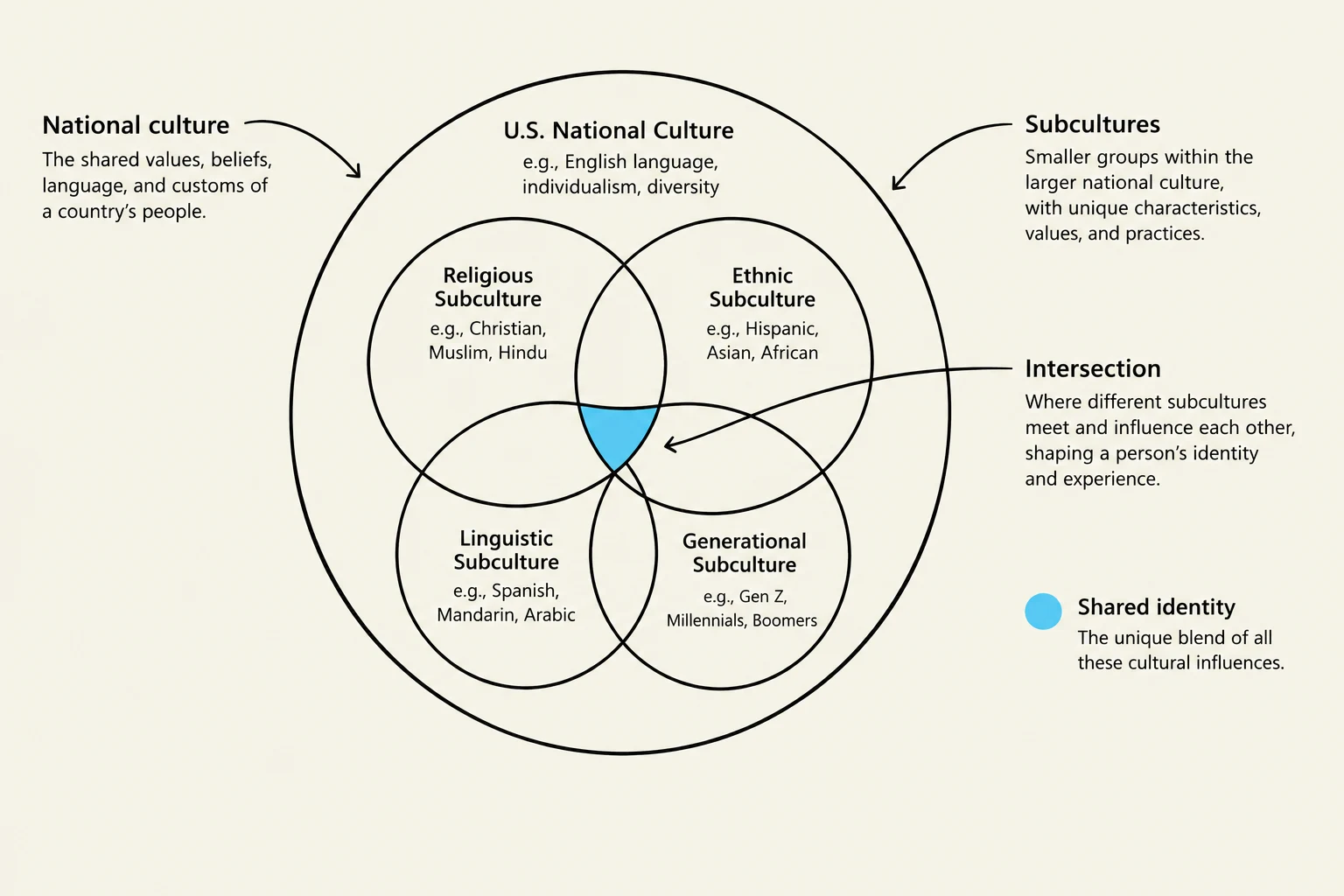
In a clinical setting, a nurse might be treating a patient who belongs to both a dominant ethnic culture and a specific religious subculture. The patient's health decisions may be influenced by the intersection of these two identities. Recognizing subcultures prevents "cultural stereotyping"—the error of assuming all members of a major culture behave in the exact same way.
This diagram illustrates the concept of national culture and its intersection with various subcultures such as religious, ethnic, linguistic, and generational influences, ultimately shaping an individual's shared identity.
Cultural Worldviews and Intergenerational Transmission
At the deepest level of human identity lies the cultural worldview. This is the most fundamental aspect of culture, representing the most basic assumptions a group holds about the nature of the universe, the meaning of life, and the relationship between humans and the divine. Worldviews provide the "why" behind the "what" of cultural practices.
For example, a worldview centered on collectivism might prioritize family consensus in medical decision-making, whereas a individualistic worldview might prioritize the patient's autonomy above all else.
How Culture is Passed Down
Cultural worldviews and practices are not static; they are dynamic processes that are passed through generations via several mechanisms:
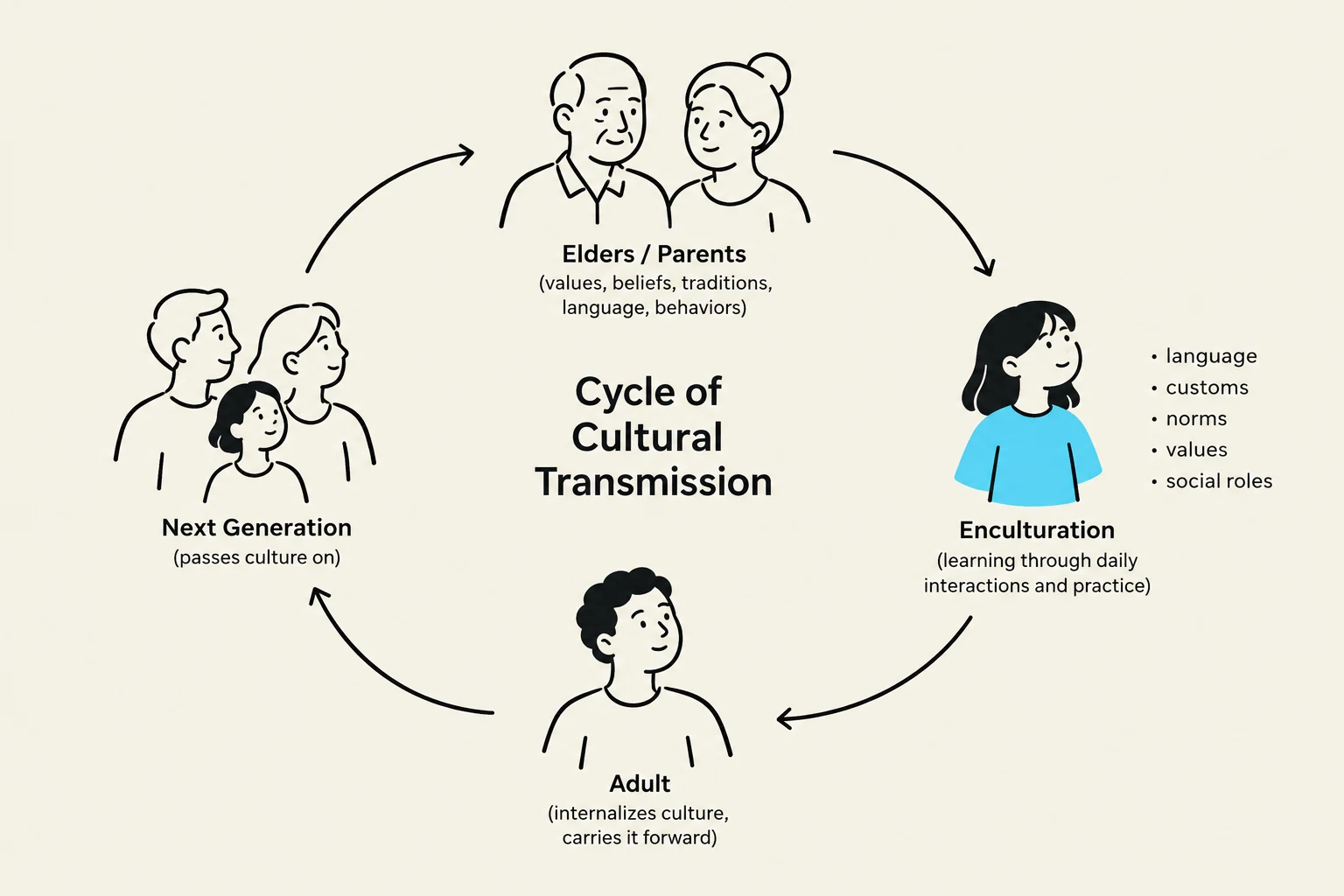
Enculturation: This is the process by which an individual learns the requirements of their surrounding culture and acquires values and behaviors appropriate or necessary in that culture. This often happens during childhood through observation and imitation of parents and elders.
Socialization: This involves the lifelong process of inheriting and disseminating norms and customs. In a healthcare context, this means that a patient's attitude toward Western medicine may have been shaped by how their parents spoke about doctors or traditional healers.
Language and Storytelling: Oral traditions, myths, and even the specific vocabulary used to describe illness are powerful tools for transmitting cultural knowledge from one generation to the next.
Diagram illustrating the cycle of cultural transmission, showing how elders/parents pass down values, beliefs, traditions, language, and behaviors to the next generation through enculturation, which is learned through daily interactions and practice.
Clinical Application: A Worked Example
To see these concepts in action, consider the following scenario:
Scenario: A nurse is caring for a 70-year-old male patient from a traditional collectivist culture. The patient’s adult children insist on being present for all discussions regarding his surgical risks and prognosis.
The Culture: The patient belongs to a culture that values family hierarchy and collective decision-making.
The Subculture: The patient may also belong to a specific religious subculture that views illness as a spiritual test.
The Worldview: The underlying worldview is that the individual is an extension of the family unit, rather than an isolated entity.
The Nursing Action: Instead of viewing the family's presence as an "interference" with patient autonomy (a Western-centric view), the nurse recognizes this as a cultural norm. The nurse facilitates a meeting with the family and the patient together, ensuring that the care plan respects the family's role in the decision-making process.
By applying the foundations of transcultural nursing, the nurse moves from being a mere technician to a culturally competent healer who respects the complex identity of the person in their care.
Summary for Study:
Culture: Learned, shared, and transmitted systems of meaning.
Subculture: Smaller groups within a culture with distinct traits.
Worldview: The fundamental assumptions about reality and existence.
Transmission: Occurs through enculturation and socialization across generations.
Keep reading for free.
Create an account to finish this reading and make it part of your study routine.