Foundations of Traditional Chinese Medicine Theory
An overview of the fundamental theoretical principles of Traditional Chinese Medicine (TCM), including Holism, Yin and Yang theory, the Five Element Theory, and Zang-fu organ theory, explaining their role in understanding human physiology and pathology.
Traditional Chinese Medicine (TCM) is not merely a collection of herbal remedies, but a sophisticated theoretical system used to explain the complexities of human physiology and pathology. Unlike Western medicine, which often focuses on localized disease entities, TCM views the human body through a lens of interconnectedness, balance, and constant transformation. By understanding the fundamental principles of Holism, Yin and Yang, and the Five Element Theory, practitioners can move beyond treating isolated symptoms to addressing the underlying patterns of disharmony.
The Concept of Holism
At the core of TCM is the principle of Holism. This concept posits that the human body is an organic whole where all constituent parts are structurally inseparable, functionally coordinated, and pathologically inter-influencing. A change in one part of the body inevitably affects the others. Furthermore, holism extends beyond the physical body; it suggests that humanity is closely related to its natural and social environments.
This holistic perspective leads to a unique clinical approach known as Syndrome Differentiation (or Pattern Differentiation). In TCM, a "disease" is a group of symptoms, but a "syndrome" is the specific pattern of disharmony within an individual. This allows for the clinical application of:
"Different treatments for the same disease" (addressing different patterns in patients with the same diagnosis).
"The same treatment for different diseases" (using the same pattern-based method to treat various ailments).
Exam Tip: When asked to differentiate between a "disease" and a "syndrome," remember that a disease is the specific location/organ group, while a syndrome is the underlying pattern of imbalance (the "root") that must be treated.
Yin and Yang Theory
Yin and Yang serves as the primary conceptual framework for observing and analyzing the material world, including the human body. It represents two separate, distinct, and opposite phenomena that are dynamic rather than fixed.
Yang (Moving/Warming)
Yin (Nourishing/Moistening)
Heat, Movement, Brightness
Coldness, Stillness, Dimness
Upward and Outward
Downward and Inward
Excitement, Potency, Day
Inhibition, Weakness, Night
Positive, Sun, Heaven, Active
Negative, Moon, Earth, Passive
The Four Dynamics of Yin and Yang
To understand how Yin and Yang function in the body, we must look at their four essential relationships:
Opposition of Yin and Yang: They struggle with, control, and balance each other. Relative physiological balance is maintained through this constant opposition.
Dependence of Yin and Yang: They are mutually dependent; neither can exist in isolation. For example, Yang (functional activities) is the manifestation of the interior (Yin/nutrient substances).
Inter-Consuming-Supporting Relationship: They exist in a state of mutual consumption and expansion to maintain equilibrium.
Inter-Transforming Relationship: They are in a constant state of change, where one can qualitatively transform into the other.
In clinical practice, Yin and Yang guide diagnosis (e.g., skin color, pulse, voice) and treatment. For instance, a deficiency in Yin can lead to "Heat" symptoms, while a deficiency in Yang leads to "Cold" symptoms.
Five Element Theory
The Five Element Theory generalizes the attributes of nature to explain the relationships between organs, tissues, and the environment. Each element represents a specific state of change:
Wood: Growth, flourishing, and bending.
Fire: Heat, burning, and ascending.
Earth: Sowing, reaping, and generating.
Metal: Change, descending, and clarity.
Water: Cold, flowing downwards, and moistening.
Cycles of Interaction
The elements interact through several complex cycles that ensure systemic balance:
Generation (Mother-Son) Cycle: A relationship of nourishment where one element promotes the growth of another.
Control Cycle: A "checks and balances" system that prevents any one element from becoming too powerful.
Overacting Cycle: Occurs when an element exerts an inappropriate or excessive amount of control over another.
Insulting Cycle: Occurs when the force of a "controlling" element is turned back upon itself.
Zang-fu Organ Theory
TCM categorizes organs into two main groups: Zang (Yin) organs, which are solid and store essence, and Fu (Yang) organs, which are hollow and responsible for moving, transporting, and passing substances.
The Zang Organs
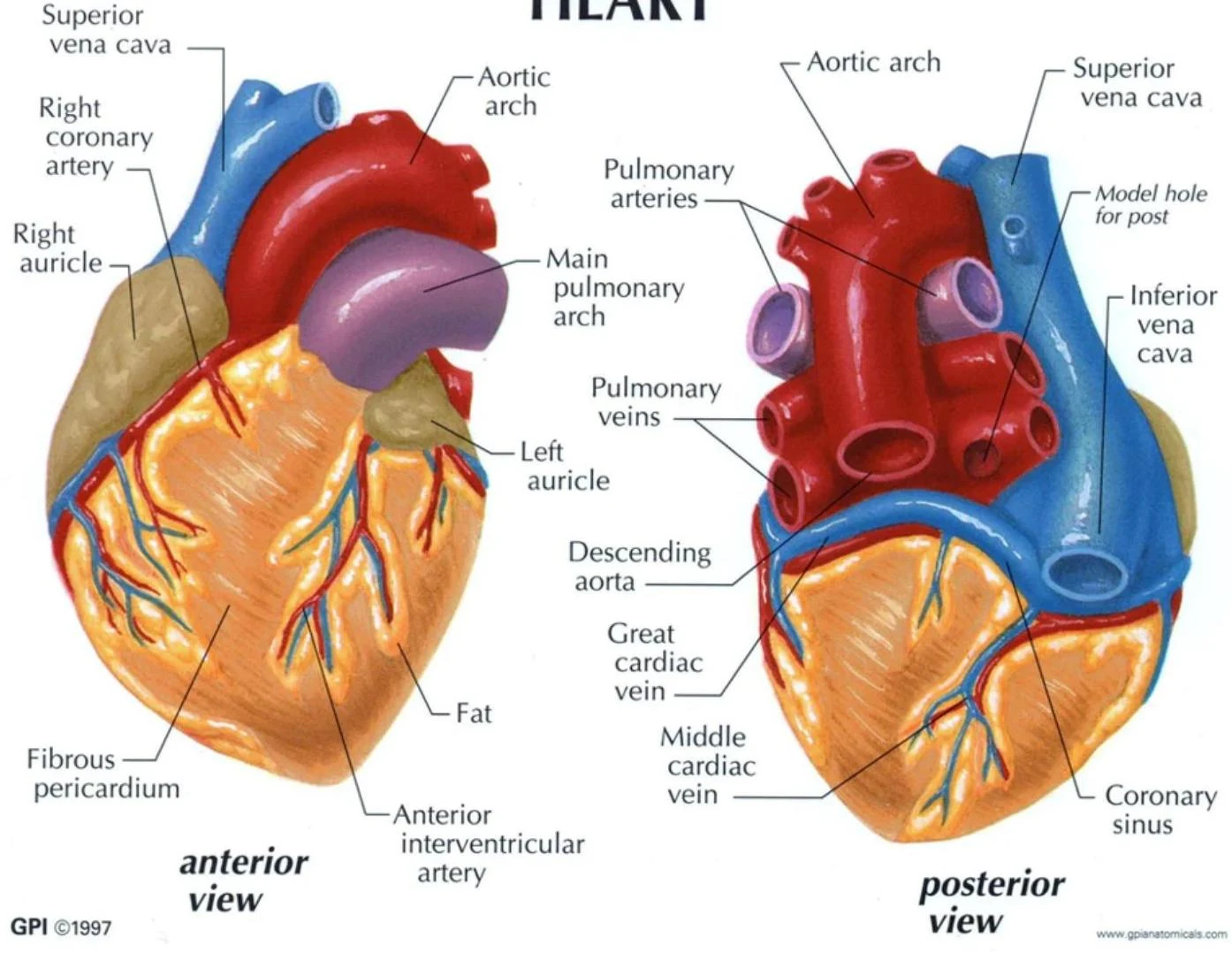
Heart (Zang): Governs blood and blood vessels, houses the mind (spirit), and manifests on the face.
Lungs (Zang): Rule Qi and respiration, regulate water passages, and control the skin and hair.
Spleen (Zang): Rules the transportation and transformation of food essence and Qi, and controls blood to prevent hemorrhage.
Liver (Zang): Ensures the smooth flow of Qi, stores blood, and regulates emotions.
Kidney (Zang): Stores essence (pre-natal and post-natal), governs reproduction, and controls water metabolism.
Anatomical illustration of the human heart showing anterior and posterior views with labels for major arteries, veins, and chambers.
The Fu Organs
The Fu organs include the Small Intestine, Large Intestine, Gallbladder, Stomach, Bladder, and Sanjiao. For example, while the Liver (Zang) produces bile, the Gallbladder (Fu) is responsible for storing it.
Therapeutic Principles and Diagnosis
The ultimate goal of TCM is to restore balance through specific therapeutic principles. Treatment is determined by the results of syndrome differentiation, considering the cause, location, nature, and the relationship between the body's vital Qi (Zheng Qi) and invading pathogenic Qi (Xie Qi).
Practitioners use the "Four Pillars of Diagnosis" to identify these patterns:
Looking: Observing complexion, tongue, and physical appearance.
Hearing and Smelling: Listening to the voice/breath and smelling odors.
Asking: Inquiring about symptoms and lifestyle.
Palpating: Feeling the pulse and physical structures.
Clinical Example: The Spleen and Stomach Relationship
The Spleen (Yin) likes dryness and warmth, while the Stomach (Yang) likes cold and wetness. If the Spleen's Qi fails to ascend, it can lead to symptoms like diarrhea or bloating. Conversely, if the Stomach's Qi fails to descend, it may cause nausea or vomiting.
By integrating these foundational theories, TCM provides a comprehensive framework for understanding the human body as a dynamic, self-regulating system in constant dialogue with the natural world.
Keep reading for free.
Create an account to finish this reading and make it part of your study routine.