


The study of American Government is more than just a collection of facts about politicians and laws; it is an investigation into the structures, processes, and principles that govern the United States. At the heart of this study lies the U.S. Constitution, the supreme law of the land that provides the blueprint for how the government operates and defines the relationship between the state and its citizens. By understanding the tension between individual liberty and collective security, students can better grasp how a democratic framework evolves over time.
The Core Principles of Constitutionalism
The American system is defined by constitutionalism, the fundamental principle that government power is not absolute but is limited by a set of established laws. This prevents the rise of arbitrary rule and ensures that the government must operate within specific boundaries.
To prevent the concentration of power—which often leads to tyranny—the Constitution establishes three critical mechanisms:
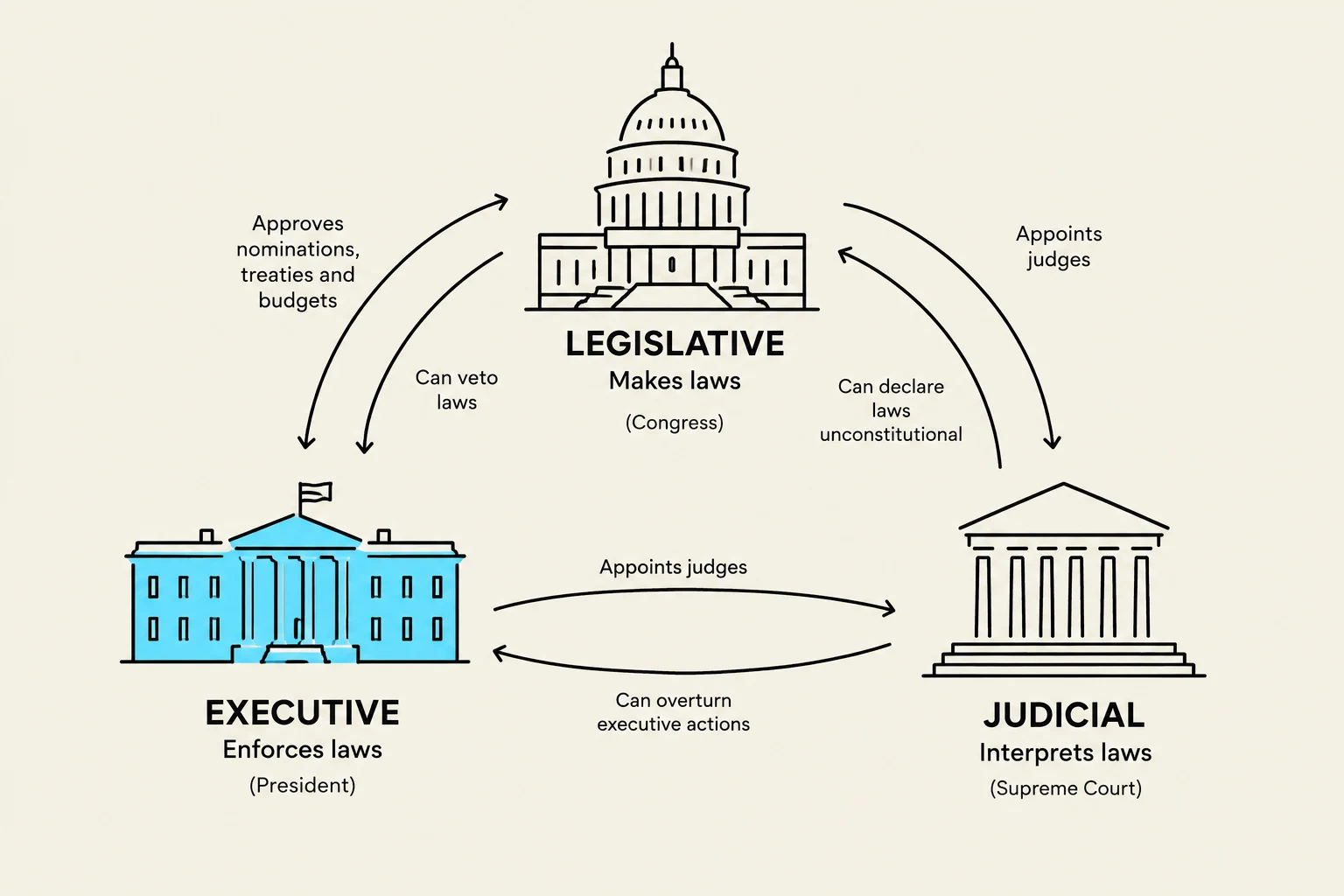
- Separation of Powers: Authority is divided into three distinct branches: the Legislative (responsible for making laws), the Executive (responsible for enforcing laws), and the Judicial (responsible for interpreting laws).
- Checks and Balances: This system ensures that no single branch becomes dominant. Each branch possesses specific tools to limit the powers of the others, creating a state of constant equilibrium.
- Federalism: Unlike a unitary system where the central government holds all power, the United States employs federalism, which divides sovereignty between the national (federal) government and various state governments.


Keep reading for free.
Create an account to finish this reading and make it part of your study routine.
Continue reading freeAlready have an account? Log in
Updated