Explores the nature of political power (coercion, influence, authority), the distinctions between state, nation, and government, and Aristotle's theories on regimes and the rule of law.
Politics is often misunderstood as merely the struggle for power, but it is more accurately described as the complex mechanism through which human societies organize, deliberate, and govern themselves. At its core, politics involves the exercise of power, the structure of institutions, and the pursuit of a "good life" within a community. To study politics is to study how authority is established, how states maintain order, and how different regimes attempt to balance the interests of the rulers with the needs of the ruled.
The Nature of Power: Coercion, Influence, and Authority
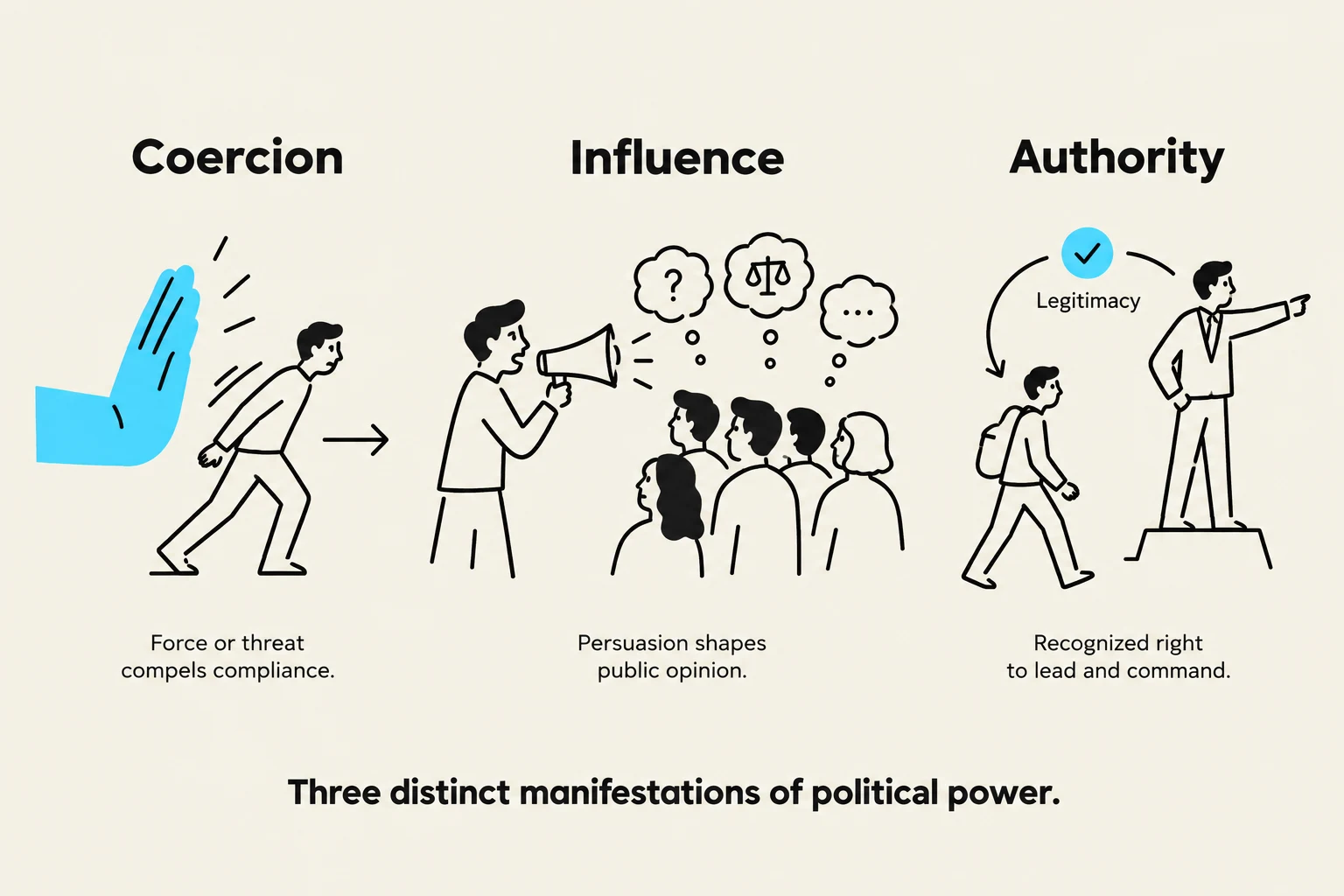
Three distinct manifestations of political power: coercion, influence, and authority.
Power is the fundamental currency of politics. However, power is not a monolithic concept; it manifests in three distinct ways that determine how a society functions:
Coercion (Force): This is the use of threats or actual physical violence to compel compliance. In the modern era, the state is unique because it claims a "monopoly on the legitimate use of physical force" within its territory.
Influence (Persuasion): This involves convincing people to act voluntarily through arguments, propaganda, or public relations. Unlike coercion, the individual retains the apparent ability to choose, making it a more subtle tool of political control.
Authority (Obedience): This is the most stable form of power. Authority exists when people follow commands because they recognize the legitimacy of the institution or person giving them.
Exam Tip: Distinguish between "power to" and "power over." Power to refers to empowerment and the ability to achieve collective goals, whereas power over refers to the capacity to constrain, prohibit, or disempower others.
Legitimacy is the bridge that transforms raw force into rightful authority. Without legitimacy, a government must rely constantly on coercion, which is unsustainable for long-term collective action.
Organizing Society: State, Nation, and Government
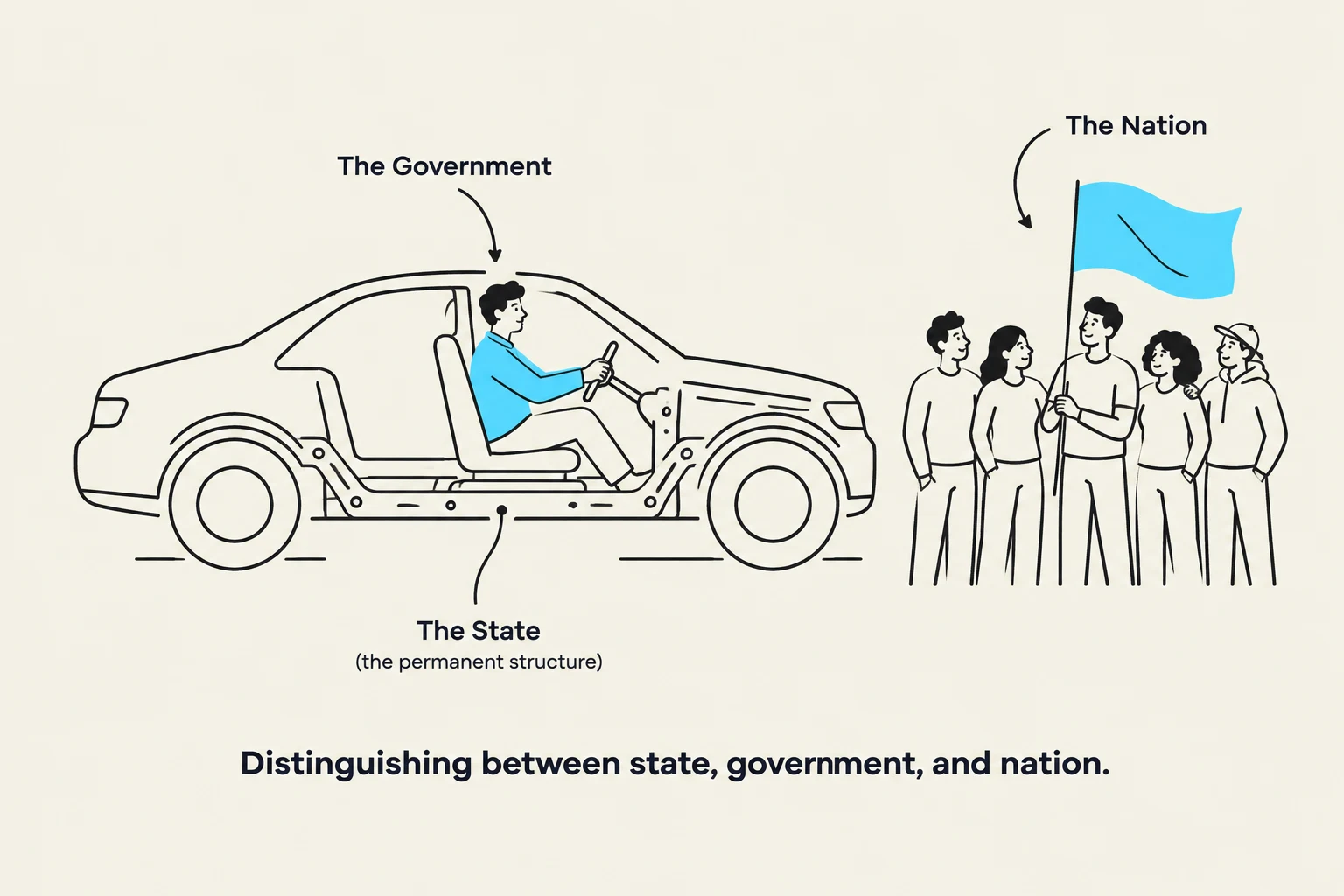
This illustration distinguishes between the concepts of state, government, and nation using a car analogy. The government is depicted as the driver, the state as the car's permanent structure, and the nation as the group of people holding a flag.
To understand how political power is housed, we must distinguish between three often-confused terms: the state, the government, and the nation.
The State: A permanent political entity characterized by a defined territory, a permanent population, a government, and sovereignty. Following the Treaty of Westphalia in 1648, the modern concept of the state as a sovereign entity became the global standard.
The Government: The temporary group of people and institutions that actually "drive" the state. While the state (the "car") remains constant, the government (the "driver") changes through elections or transitions.
The Nation: A community of people bound by a shared identity, such as language, culture, or history.
The Nation-State: A specific political arrangement where the boundaries of a state align with a dominant ethnic group.
The Four Pillars of the Modern State
Modern states function through four primary institutional roles:
Legislation: The process of making laws.
Executive: The implementation of laws. This includes specialized ministries such as Defense (military), Interior (police), Justice (enforcing court rulings), and Foreign Affairs (diplomacy).
Administrative: The management of complex relationships between citizens and the state. Note that many administrative functions (like healthcare or transportation) have shifted to the private sector, which can sometimes lead to issues regarding public accountability.
Judicial: The interpretation of laws to decide what is acceptable, especially when legal language is imprecise.
Typologies of Political Regimes
Political systems can be categorized by the level of freedom they afford their citizens and the degree of control the state exerts:
Regime Type
Characteristics
Liberal Democracy
Promotes free/fair elections, universal suffrage, and individual rights.
Illiberal Democracy
Holds elections, but lacks protections for liberties and limits opposition.
Authoritarian State
Lacks fair elections; rulers are generally unaccountable to the people.
Totalitarian State
Extreme intervention; eliminates the distinction between public and private life through repression.
Various theories attempt to explain how these states operate. Pluralists see the state as an arbiter between competing interest groups, while Elitists argue that all complex organizations eventually fall under the "Iron Law of Oligarchy," where a small, dominant group holds power. Other perspectives include Marxism (class-based analysis), Socialism (state responsibility for welfare), and the New Right (minimalist state intervention).
Aristotelian Theory: The Political Animal and the Polis
Centuries before modern political science, Aristotle provided a foundational philosophical framework for understanding politics. He argued that humans are inherently "political animals".
This is tied to the concept of telos (purpose). For Aristotle, the purpose of human beings is fulfilled through rational and political life within the polis (the community). What distinguishes humans from other animals is logos—the capacity for reasoned speech. While animals communicate sensations of pleasure or pain, humans use logos to deliberate on justice, morality, and "the Good".
Aristotle's Typology of Regimes
Aristotle categorized regimes based on two fundamental questions: Who rules? and Who benefits?.
One Ruler:
Monarchy: Rule by one for the common good (Just).
Tyranny: Rule by one for private interest (Unjust).
A Few Rulers:
Aristocracy: Rule by the few for the common good (Just).
Oligarchy: Rule by the few for private interest (Unjust).
Many Rulers:
Polity: Rule by the many under the law for the common good (Just).
Democracy: Rule by the many without being constrained by law (Unjust).
Aristotle suggests that modern constitutional democracies are most similar to a Polity, because they rely on the constraint of power through law rather than the whims of individuals.
The Rule of Law and Phronesis
A just regime is not defined merely by having laws, but by how those laws are applied. Because laws are general and life is complex, mechanical application is often insufficient. Aristotle introduced the concept of phronesis (practical wisdom or judgment) to address this.
To exercise phronesis, a leader or citizen must possess:
Reasoning: The ability to see how a general law applies to a specific, unique case.
Reasonableness: The ability to set aside personal emotions and interests in favor of sound logic.
Ethical Awareness: Understanding the "spirit" or purpose of a law, rather than just its literal text.
Ultimately, for Aristotle, justice requires more than just a written code; it requires virtuous people capable of applying those laws with intelligence and ethical depth.
Keep reading for free.
Create an account to finish this reading and make it part of your study routine.