Foundations of Pharmacology and Safe Medication Administration
A comprehensive guide to understanding pharmacokinetics, pharmacodynamics, medication nomenclature, safety protocols, error prevention, and medication reconciliation in nursing practice.
Medication administration is far more than the mechanical act of handing a patient a pill; it is a complex, high-stakes nursing process integrated into the ADPIE framework (Assessment, Diagnosis, Planning, Implementation, and Evaluation). To practice safely, a nurse must bridge the gap between pharmacological research and the unique physiological state of the patient. This requires a deep understanding of how drugs move through the body, how they interact with receptors, and how to navigate the systemic safeguards designed to prevent errors.
Pharmacology Fundamentals: Pharmacokinetics and Pharmacodynamics
To understand medication effects, we must distinguish between what the body does to the drug and what the drug does to the body.
Pharmacokinetics (ADME)
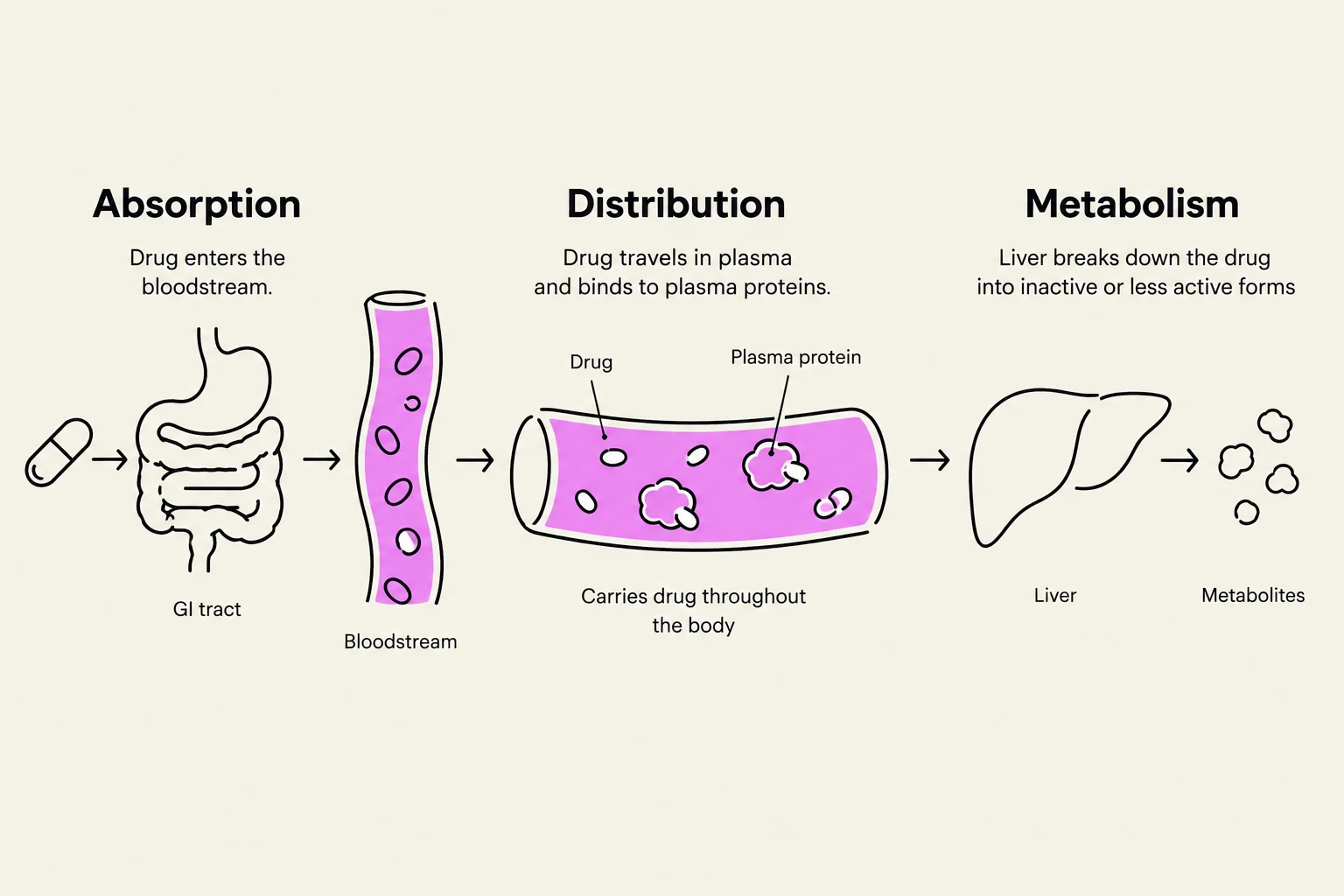
Pharmacokinetics describes the movement of a drug through the body via four primary processes: Absorption, Distribution, Metabolism, and Excretion (ADME).
Absorption: The movement of a drug from its administration site into the bloodstream. This is heavily influenced by bioavailability, which is the fraction of the administered dose that actually reaches systemic circulation. For oral medications, the "first-pass effect" in the liver can significantly reduce bioavailability before the drug reaches the rest of the body.
Distribution: The transport of the drug via the bloodstream to its site of action. A critical factor here is protein binding. Drugs that are highly protein-bound attach to plasma proteins, making them temporarily inactive; only the unbound fraction is free to exert a therapeutic effect.
Metabolism (Biotransformation): The biochemical alteration of a drug, often involving cytochrome P450 (CYP450) enzymes. This process can activate a drug, deactivate it, or create metabolites with varying levels of potency.
Excretion: The elimination of the drug from the body, primarily through the kidneys.
This diagram illustrates the pharmacokinetic processes of a drug in the body: absorption, distribution, and metabolism.
Half-life and Steady State: The half-life is the time required for the drug concentration in the body to decrease by 50%. When a drug is administered at regular intervals, it eventually reaches a steady state, where the rate of drug input matches the rate of elimination.
Pharmacodynamics
Pharmacodynamics focuses on the mechanism of action—how the drug interacts with receptors or enzymes to produce a response. Understanding these interactions allows nurses to predict both the desired therapeutic effect and potential side effects.
Exam Tip: The Therapeutic Range
Always monitor patients receiving drugs with a narrow therapeutic range. This refers to the small concentration window between the desired effect and the onset of toxicity.
Medication Nomenclature and Effects
When reviewing a medication order, you will encounter two types of names: the generic name (the nonproprietary, official name) and the trade name (the manufacturer's brand name).
It is equally vital to distinguish between different types of drug responses:
Side Effects: Secondary, often predictable effects that occur at usual therapeutic doses.
Adverse Effects: Harmful, undesirable, and often unpredictable reactions that may require medical intervention.
Adverse Drug Reactions (ADRs): These can be pharmacological, allergic, idiosyncratic, or caused by drug interactions.
Safety, Error Prevention, and Nursing Responsibilities
Medication errors (MEs) and Adverse Drug Events (ADEs) are major threats to patient safety. Nurses serve as the final checkpoint in the administration chain.
Preventing Errors
To minimize risks, nurses must adhere to strict protocols:
The Ten Rights: Use the specific "ten rights" of medication administration taught in your curriculum to verify the patient, prescription, dose, route, and timing.
Decimal Rules: To prevent dosing errors, always use a leading zero (e.g., 0.5 mg) and never use a trailing zero (e.g., write 5 mg, not 5.0 mg).
Clarification: Never attempt to decipher illegible handwriting or guess missing information. If an order is ambiguous, contact the prescriber immediately.
Managing an Error
If an error occurs, your priority is the patient, not the paperwork:
Assess the patient immediately.
Notify the healthcare provider and nursing management.
Continue to monitor the patient for adverse responses.
Report the incident (and any "near misses") through the appropriate agency channels to facilitate system learning.
A decision tree outlining the steps for managing medication errors, including assessing the patient, notifying a provider, and monitoring the patient's condition.
Medication Reconciliation
Medication reconciliation is a systematic review of all medications a patient is taking during transitions of care, such as admission, transfer, or discharge. This process involves three critical steps:
Verification: Establishing exactly what the patient is currently taking.
Clarification: Checking the suitability of those medications for the current clinical context.
Reconciliation: Resolving any discrepancies between the previous list and the new intended plan.
Clinical Alert: The Limits of Electronic Records
While tools like the Pharmaceutical Information Program (PIP) are helpful, they often do not capture over-the-counter (OTC) medications, herbal products, or physician-sampled products. Nurses must manually ask patients about these items to ensure a complete history.
Clinical Application: Connecting Research to the Patient
A nurse's expertise is demonstrated when they connect pharmacological principles to a patient's specific condition.
Example: Renal Impairment
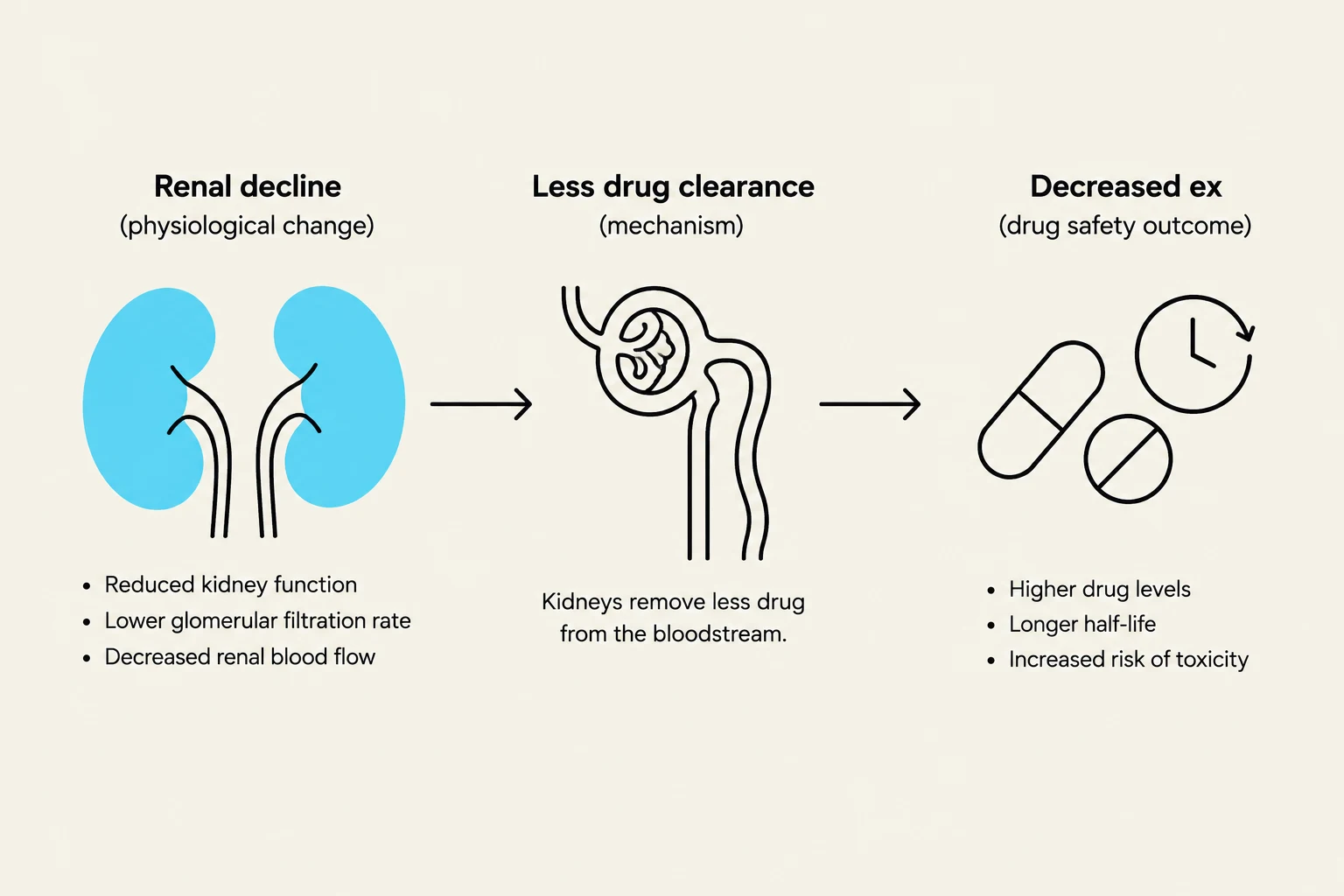
Consider a patient with reduced renal function (e.g., low eGFR or high creatinine) who is prescribed a drug primarily excreted by the kidneys. Because excretion is slowed, the drug may accumulate in the body, increasing the risk of toxicity even if the prescribed dose is "standard". The nurse must connect the medication research with the patient's current lab trends to decide if the dose is safe.
This diagram illustrates how renal decline leads to less drug clearance from the bloodstream, resulting in decreased drug excretion and potential toxicity.
Keep reading for free.
Create an account to finish this reading and make it part of your study routine.