Foundations of Job Analysis and Recruitment in I-O Psychology
This content explains the fundamental concepts of job analysis and recruitment within Industrial-Organizational (I-O) psychology. It details the process of job analysis, including its dimensions, the creation of job descriptions, and methods for conducting the analysis. It also covers job evaluation, strategic recruitm
In the field of Industrial-Organizational (I-O) psychology, building a successful organization begins long before an employee walks through the door. It starts with a deep, systematic understanding of what work actually needs to be done and who is best equipped to do it. This foundation is built upon two critical pillars: Job Analysis and Recruitment. While job analysis provides the technical blueprint of a role, recruitment serves as the strategic engine used to attract the right talent to fill that blueprint.
The Core of Job Analysis
Job analysis is the formal process of gathering and analyzing information regarding the tasks an employee performs, the conditions under which those tasks are executed, and the personal characteristics required to perform the work successfully. To understand this, consider the difference between an elementary school teacher and a university professor. While both are "teachers," they differ significantly in their required education, the age of their students, their teaching styles, and their daily work context.
A thorough job analysis focuses on three primary dimensions:
Work Activities: What the person actually does (the tasks and duties).
Job Context: The "where, how, and when" of the work, including physical demands, stress levels, or environmental conditions.
Personal Characteristics: The competencies, education, personality traits, and motivations needed to succeed.
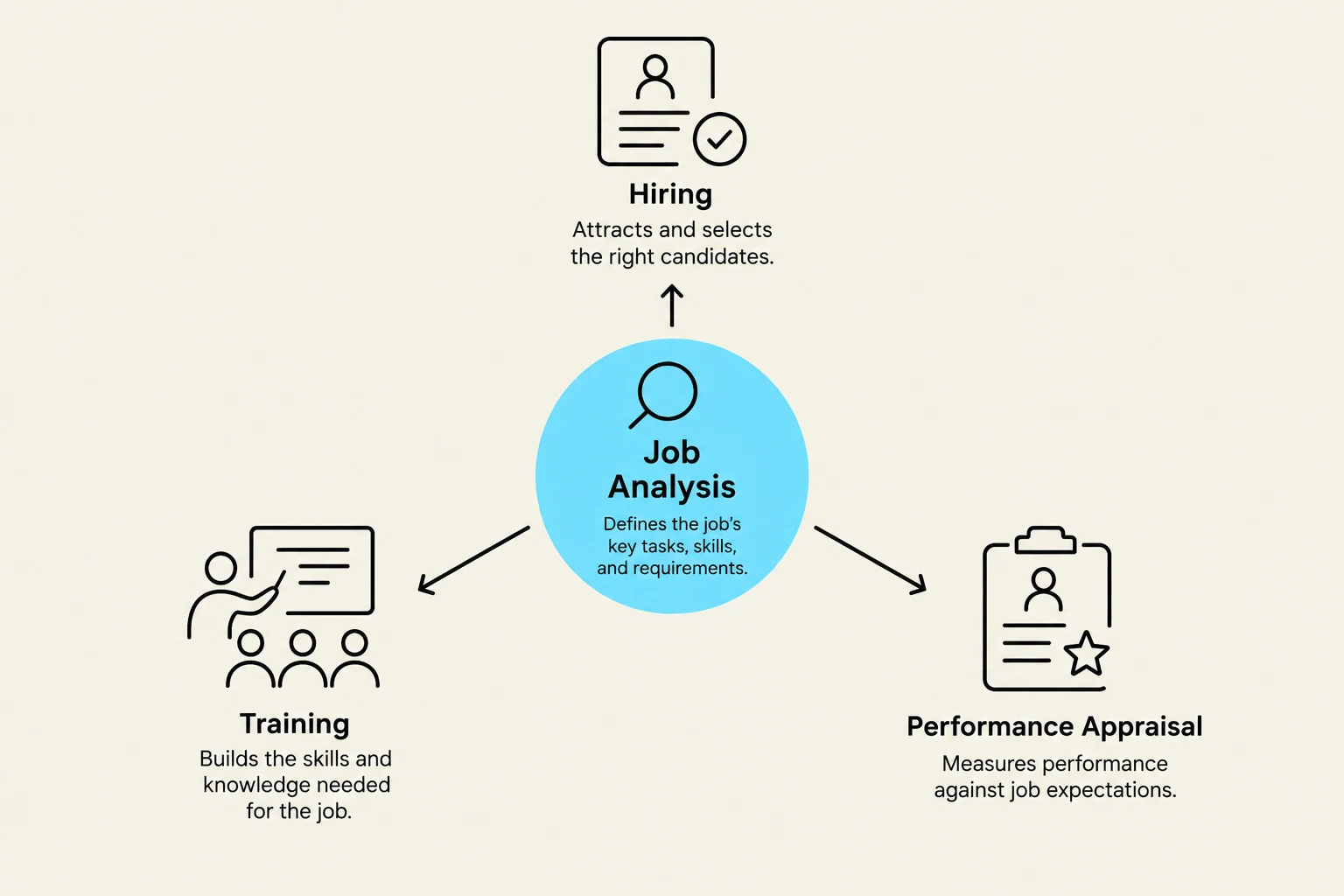
Exam Tip: Remember that job analysis is the "foundation" for almost all other I-O activities. Without it, you cannot effectively design training programs, conduct performance appraisals, or make legal hiring decisions.
This diagram illustrates the key components of a job analysis process, including hiring, training, and performance appraisal, all centered around defining job tasks, skills, and requirements.
The Job Description: The Written Output
The primary tangible result of a job analysis is the job description. A professional job description typically spans 2 to 5 pages and should be updated whenever the job changes significantly. A comprehensive description includes eight essential sections:
Job Title: Must be accurate to avoid confusion regarding prestige or role expectations.
Job Summary: A brief overview of the job's nature and purpose.
Work Activities: Detailed tasks and duties.
Specific Requirements: Necessary licenses or ability to operate specific machinery.
Job Context: Physical demands, stress, or environmental factors.
Performance Standards: How success is measured.
Compensation Information: Salary grades or bands.
Abilities/Characteristics: The KSAOs (Knowledge, Skills, Abilities, and Other characteristics) required.
To assist in this process, organizations often use the Occupational Information Network (O*NET), a database created by the US Department of Labor that provides detailed profiles for nearly 1,000 occupations.
Conducting the Analysis and Job Evaluation
The 5-Step Analysis Process
Conducting a job analysis involves a systematic approach to ensure the data is valid and representative:
Gather existing information: Review manuals or external sources like O*NET.
Identify tasks: Determine what is actually performed.
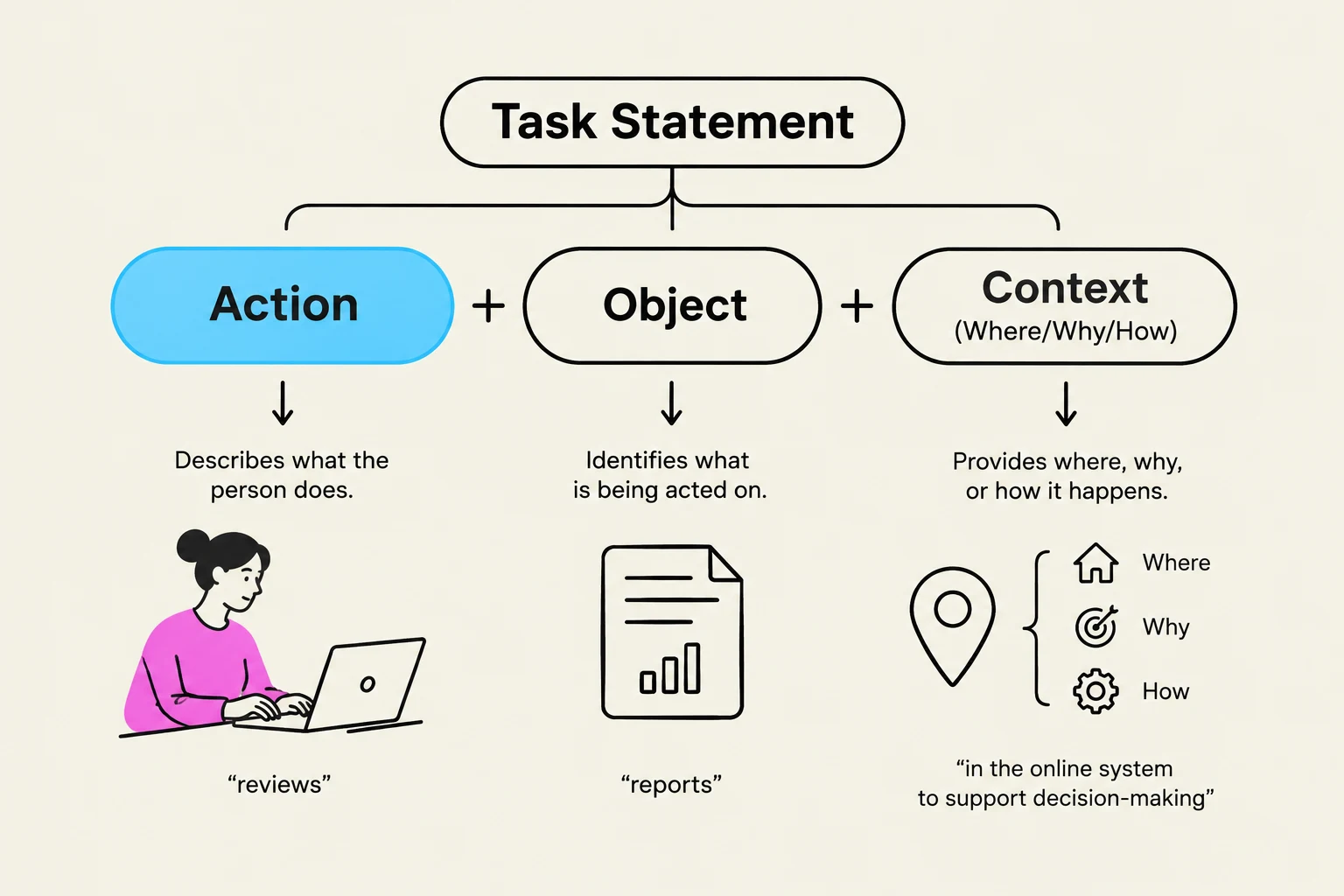
Write task statements: These should follow an "Action + Object" format (e.g., "Deliver mail [action] along specified routes [object]").
Identify KSAOs: Determine the Knowledge, Skills, Abilities, and Other characteristics needed to complete those tasks.
Determine importance: Decide which tasks are critical for the role.
Methods for gathering this data include interviewing Subject Matter Experts (SMEs)—people who currently do the job or supervise it—observing employees, or even having the analyst perform the job themselves.
This diagram illustrates the components of a task statement: Action, Object, and Context, along with their definitions and examples.
Job Evaluation: Determining Worth
While job analysis looks at the content of the work, job evaluation looks at its value. This is the process of determining a job's monetary worth. It involves two main perspectives:
Internal Equity: Ensuring employees within the same organization are paid fairly relative to one another.
External Equity: Ensuring pay is competitive compared to similar roles in the external labor market.
Strategic Recruitment
Once the job is defined and valued, the organization must engage in recruitment: the process of identifying and attracting the necessary talent.
Evaluating Recruitment Effectiveness
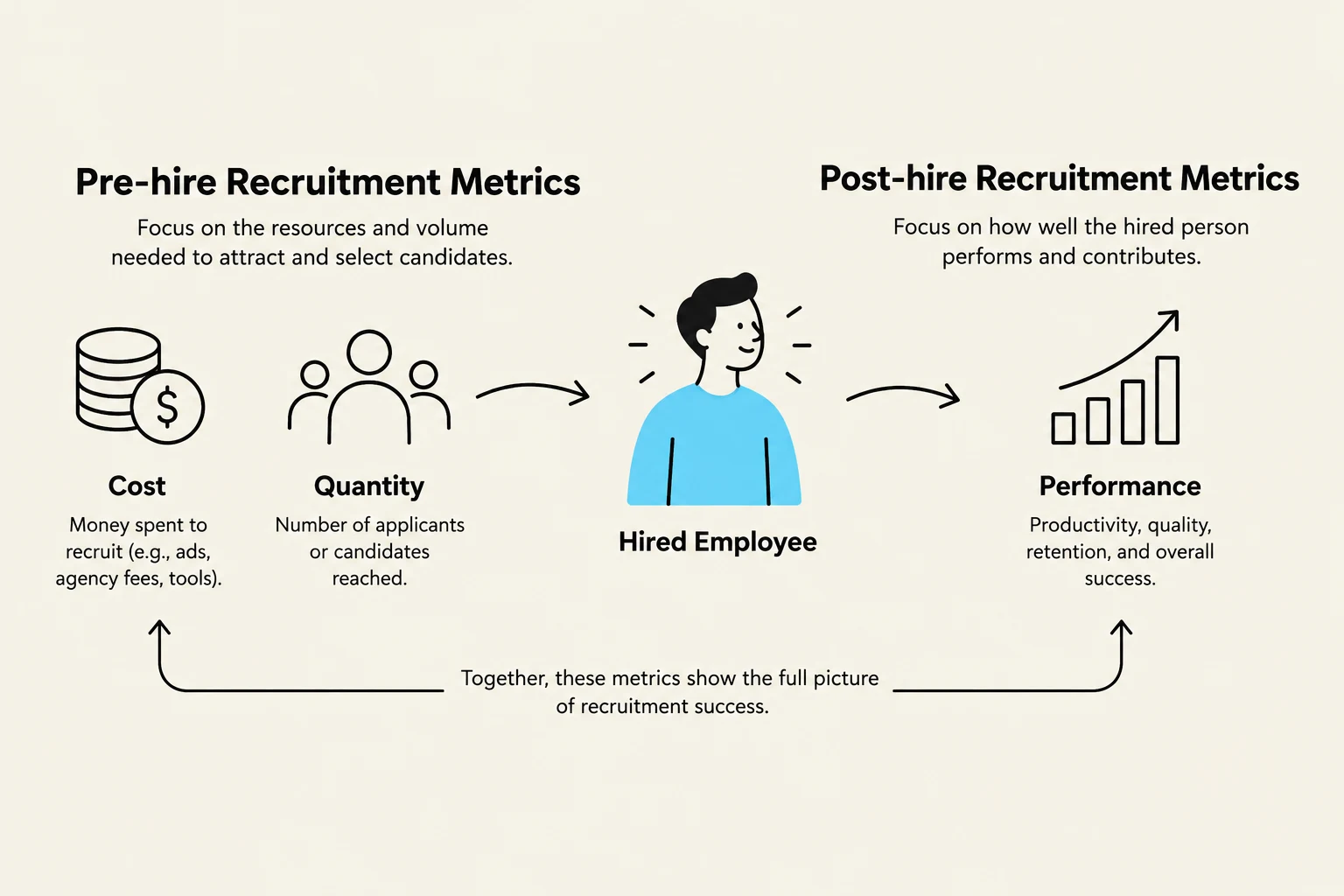
Organizations must decide which recruitment methods are most effective. Effectiveness can be measured at two stages:
Pre-hire metrics: These focus on the cost and quantity of applicants. A key metric is the cost per qualified applicant.
Post-hire metrics: These look at the quality of the hires, such as how long they stay with the company and how well they perform.
Interestingly, employee referrals are often cited as one of the most effective recruitment methods. This is because current employees act as a "pre-screening" mechanism, and applicants often have better "inside information" about the job, allowing them to self-select more accurately.
The Applicant's Perspective and Diversity
Recruitment is not just about the organization's needs; it is about the applicant's perception. The recruitment message must be carefully crafted regarding:
Amount of information: Too little creates uncertainty; too much can be overwhelming.
Specificity: Detailed messages help attract higher-quality candidates who know they fit the role.
Realism: A Realistic Job Preview (RJP) provides both the pros and cons of a job, which helps reduce turnover by ensuring people know what they are getting into.
Finally, modern recruitment must prioritize diversity. This involves targeting diverse audiences and ensuring the organization's reputation and workplace culture are inclusive and welcoming to all demographic groups.
This diagram illustrates pre-hire and post-hire recruitment metrics, including cost, quantity, and performance, to show the full picture of recruitment success.
Keep reading for free.
Create an account to finish this reading and make it part of your study routine.