Foundations of Health Assessment and Nursing Practice
A comprehensive guide to nursing assessment, including data collection, prioritization frameworks (ABC, Maslow's Hierarchy), levels of prevention, physical assessment techniques, pain assessment (nociception), therapeutic communication, cultural competence, vital signs, and functional assessments (ADLs).
Mastering the foundations of nursing practice requires more than just memorizing definitions; it requires understanding how to organize data, prioritize life-threatening situations, and communicate effectively with diverse populations. This guide serves as a structured review of the essential pillars of nursing assessment, from the initial data collection to the complex physiological processes of pain.
Assessment Fundamentals: Building the Database
The cornerstone of nursing care is the collection of data to form a database, which is an organized collection of information including health history, medications, allergies, and physical exam findings. Data is categorized into two distinct types:
Subjective Data: This is what the patient tells you. It includes their perceptions, feelings, and symptoms, such as "I feel nauseated" or "My pain is an 8 out of 10".
Objective Data: This is what the nurse observes or measures. It includes measurable findings like blood pressure, temperature, lung sounds, or visible edema.
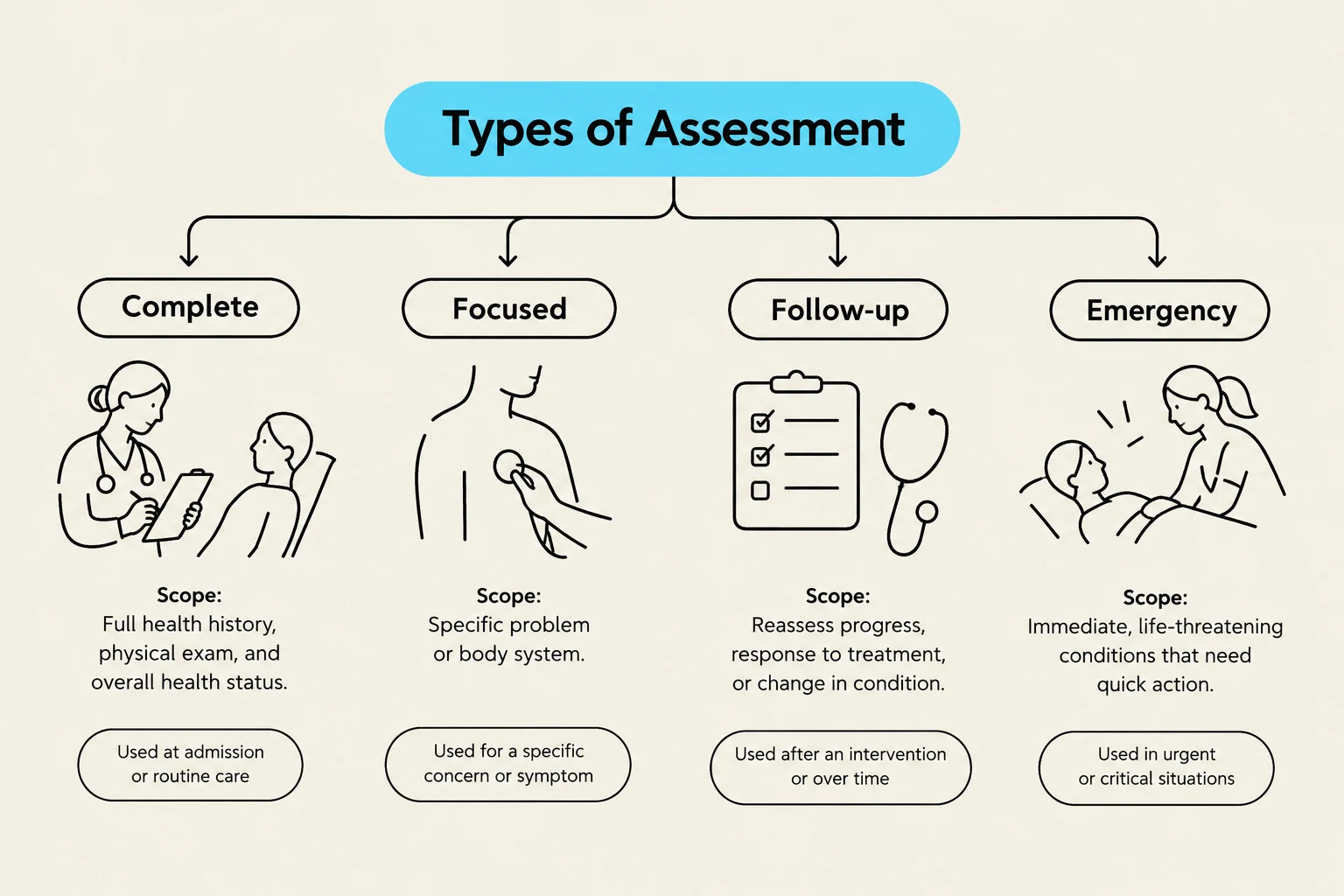
Nurses do not perform the same type of assessment in every scenario. The approach depends on the clinical context:
Complete/Comprehensive: A broad assessment providing a full picture of overall health, often used during initial admissions.
Focused: Targets a specific symptom or body system (e.g., assessing only the respiratory system for a patient with shortness of breath).
Follow-up: Evaluates a previously identified problem or the patient's response to a specific treatment.
Emergency: A rapid assessment used to identify immediate life-threatening issues.
This diagram illustrates four types of medical assessments: Complete, Focused, Follow-up, and Emergency, detailing their scope and typical usage.
Prioritization and Prevention Strategies
In a fast-paced clinical environment, nurses must decide which patient or which task requires immediate attention. Two primary frameworks guide this decision-making process:
The ABC Framework and Maslow’s Hierarchy
The ABC framework (Airway, Breathing, and Circulation) is the gold standard for addressing immediate life threats. A patient struggling to breathe always takes priority over a patient requesting pain medication. This aligns with Maslow’s Hierarchy of Needs, which dictates that physiological needs (like oxygen and nutrition) and safety must be met before higher-level needs like esteem or self-actualization.
Levels of Prevention
Nurses also play a critical role in public health through three levels of prevention:
Primary Prevention: Preventing disease before it starts (e.g., vaccinations, exercise, or smoking cessation).
Secondary Prevention: Early detection through screening (e.g., blood pressure checks or mammograms).
Tertiary Prevention: Managing established disease to prevent further complications (e.g., stroke rehabilitation or diabetes management).
Physical Assessment Techniques and Sequences
Physical examination involves four primary techniques: Inspection (looking), Palpation (feeling), Percussion (tapping), and Auscultation (listening).
While the standard sequence for most body systems is Inspection → Palpation → Percussion → Auscultation (IPPA), there is a critical exception for the abdomen:
Exam Tip: The Abdominal Exception
For abdominal assessments, always use the sequence Inspection → Auscultation → Percussion → Palpation (IAPP). You must listen (auscultate) before you touch (palpate) or tap (percuss), as these actions can physically alter bowel sounds and lead to inaccurate data.
Pain Assessment and the Physiology of Nociception
Pain is highly subjective, and the patient's self-report is the most reliable indicator of its intensity. To ensure a thorough analysis, nurses use frameworks like PQRST or OLDCARTS:
P/P: Provocation/Palliation (What makes it better or worse?)
Q: Quality (Is it sharp, dull, or burning?)
R: Region/Radiation (Where is it, and does it move?)
S: Severity (Scale of 0–10)
T: Timing (When did it start? Is it constant?)
Understanding how pain travels through the body is also essential. This process, known as nociception, occurs in four distinct stages:
Transduction: The stimulus is converted into an electrical signal.
Transmission: The signal travels through the nerves to the spinal cord and brain.
Perception: The brain becomes consciously aware of the pain.
Modulation: The nervous system attempts to dampen or amplify the signal.
Communication and Cultural Competence
Effective nursing requires a blend of therapeutic communication and cultural competence.
Therapeutic Communication
During the interview process—which moves from the Opening to the Working, Summary, and Closing phases—nurses should use techniques like facilitation ("Go on...") and reflection ("You're feeling frightened?") to encourage patients to share.
Avoid These Pitfalls:
Never use "false reassurance" (e.g., "Everything will be fine") or "why" questions, as they can sound accusatory and shut down communication.
Cultural Competence
Cultural competence is the ability to provide respectful care that considers a patient's culture (shared values/beliefs) and ethnicity (shared ancestry). Nurses should:
Use qualified medical interpreters rather than family members.
Inquire nonjudgmentally about traditional healers or "hot/cold" dietary theories.
Respect spiritual practices that may influence medical decisions.
Vital Signs and Functional Assessment
Vital Signs Reference Ranges
Monitoring vital signs provides a baseline for a patient's physiological status:
Pulse: 60−100 beats/min.
Respirations: 12−20 breaths/min.
Temperature: Approximately 36−38∘C (96.8−100.4∘F).
Blood Pressure: Generally considered normal if below 120/80 mmHg.
Note that pulse pressure is calculated as the difference between systolic and diastolic pressure:
Pulse Pressure=Systolic−Diastolic
For example, if a patient's BP is 120/80, the pulse pressure is 40 mmHg.
Functional Assessment (ADLs)
A functional assessment evaluates a patient's ability to perform Activities of Daily Living (ADLs), such as bathing, dressing, eating, toileting, transferring, and continence. This helps determine the level of independence and the type of support a patient may need for safe discharge.
This diagram illustrates the four stages of pain processing: transduction, transmission, perception, and modulation, involving nociceptors, sensory neurons, the spinal cord, and the brain.
Keep reading for free.
Create an account to finish this reading and make it part of your study routine.