Pharmacogenetics is the study of how an individual's genetic factors influence their response to drugs, aiming to optimize therapy and decrease adverse drug reactions. This field is crucial for the development of personalized medicine.
In the traditional model of medicine, drug dosing has often followed a "one size fits all" approach, where a standard dose is prescribed based on average population responses. However, clinicians frequently observe why two patients receiving the same dose of the same medication experience vastly different outcomes: one may find relief, while the other suffers from severe toxicity or no therapeutic effect at all. The answer often lies within the patient's DNA. Pharmacogenetics is the study of how an individual's genetic factors influence their response to drugs to optimize therapy and decrease adverse drug reactions (ADRs).
From Pharmacogenetics to Personalized Medicine
To understand the clinical impact of genetics, we must distinguish between two closely related fields. Pharmacogenetics focuses on how single gene variations affect drug response. In contrast, pharmacogenomics is a broader field that combines pharmacology and genomics to study how the entire genome influences drug response, aiming to develop safe, effective medications tailored to specific genetic profiles.
The ultimate goal of these disciplines is the realization of personalized medicine (or precision medicine). This approach moves away from trial-and-error prescribing and toward a model where the right patient receives the right drug at the right dose based on their unique biological makeup. This shift is a cornerstone of modern healthcare initiatives, such as the Precision Medicine Initiative, which seeks to use genetic, environmental, and lifestyle data to improve health outcomes.
The image contrasts traditional medicine, where one medication is given to everyone, with personalized medicine, where genetic testing guides tailored treatment and medication dosage.
The Genetic Basis of Variation
The variation in drug response is driven by differences in our genetic code. To navigate this field, students must master several foundational terms:
Allele: A gene can exist in different versions; each version is called an allele.
Polymorphisms: These are natural variations in DNA sequences that occur frequently within a population. When these polymorphisms occur in genes responsible for drug metabolism, they change how a person responds to medication.
Genotype vs. Phenotype: The genotype refers to the specific collection of genes an individual possesses (the "blueprint"), while the phenotype is the observable clinical presentation (the "result"), such as how quickly a patient's liver processes a drug.
Understanding Metabolizer Status
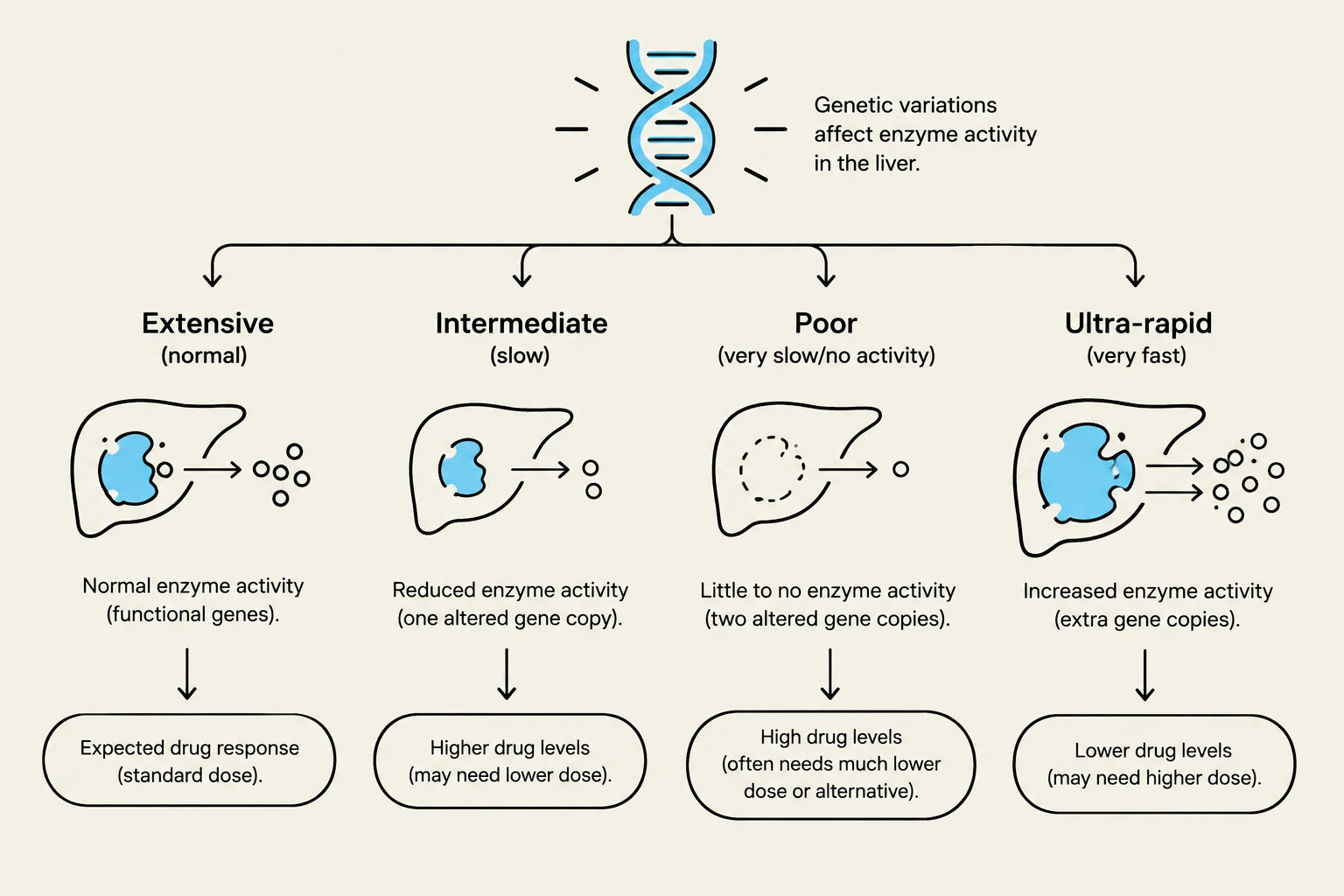
Most drug metabolism is governed by the CYP450 enzymes, a superfamily of enzymes primarily located in the liver. Genetic variations in the genes encoding these enzymes lead to different metabolizer statuses. Understanding a patient's status is critical for preventing adverse drug reactions (ADRs) and treatment failures.
Extensive Metabolizers: These individuals have "normal" enzyme activity and typically experience the expected therapeutic response at standard doses.
Intermediate Metabolizers: These patients have decreased enzymatic efficiency. This can lead to higher-than-expected concentrations of the parent drug in the bloodstream, potentially increasing side effects.
Poor Metabolizers: These individuals have a significant decrease or total lack of enzyme activity. This creates a high risk for toxicity because the drug accumulates in the body, unable to be broken down.
Ultrarapid Metabolizers: These patients possess extra copies of a gene or highly efficient versions of an enzyme. They process drugs so quickly that the medication may never reach therapeutic levels, leading to treatment failure.
Exam Tip: When evaluating a patient's response, always distinguish between a "prodrug" and an "active drug." For a prodrug (like Clopidogrel), an ultrarapid metabolizer might experience toxicity, whereas a poor metabolizer will experience treatment failure because they cannot convert the drug into its active form.
This diagram illustrates how genetic variations can affect enzyme activity in the liver, leading to different drug responses based on enzyme activity levels (extensive, intermediate, poor, or ultra-rapid) and the number of altered gene copies.
Clinical Applications and Drug-Gene Interactions
The practical application of pharmacogenetics involves identifying specific drug-gene interactions to prevent harm. Clinical testing is increasingly used to guide prescribing decisions in several critical areas:
1. Preventing Hypersensitivity
One of the most striking examples is the use of the HLA-B*5701 allele test. Before prescribing Abacavir (an antiretroviral medication), patients should be screened for this specific allele. Patients carrying this variant are at a high risk for a severe, potentially fatal hypersensitivity reaction.
2. Ensuring Prodrug Activation
Clopidogrel is a common antiplatelet medication used to prevent blood clots. However, it is a prodrug that requires the CYP2C19 enzyme to convert it into its active form. Patients who are "poor metabolizers" of CYP2C19 will not receive the protective benefits of the drug, leaving them at risk for cardiovascular events.
3. Managing Opioid and Chemotherapy Safety
CYP2D6 and Opioids: The metabolism of codeine (and other opioids) is heavily dependent on the CYP2D6 enzyme. Ultrarapid metabolizers can convert codeine into morphine much faster than normal, leading to life-threatening respiratory depression.
TPMT and Thiopurines: Testing for TPMT (thiopurine methyltransferase) enzyme activity is vital for patients prescribed thiopurine drugs (used in leukemia and autoimmune diseases). Poor metabolizers are at extreme risk for severe bone marrow toxicity.
Challenges in Implementation
While the science of pharmacogenetics is robust, its integration into routine clinical practice faces several hurdles:
Logistics and Cost: Genetic testing can be expensive, and the "turnaround time"—the time between ordering a test and receiving results—is often too slow for acute clinical decisions.
Informatics: There are significant issues with interoperability, meaning genetic data from one laboratory may not easily integrate into a hospital's Electronic Health Record (EHR) system.
Legal and Ethical Issues: The ability to "read" a patient's genetic code brings complex concerns:
Privacy: Who has access to a patient's genetic data? There are fears that employers or insurers might use this information unfairly.
Autonomy: Patients have the right to self-determination, including the right to refuse genetic testing.
Justice: Ensuring equitable access to these advanced technologies is essential to prevent a "genetic divide" where only wealthy populations benefit from personalized medicine.
The Role of the Healthcare Provider
For nurses and physicians, pharmacogenetics adds a new layer to the clinical judgment process. When performing an assessment, recognizing cues about a patient's history—such as unusual reactions to previous medications—can provide vital clues to their genetic profile.
Effective implementation requires genetic counseling to help patients understand the implications of their test results. Healthcare providers must be prepared to explain not just the "what" (the test result) but the "why" (how it affects their specific medication plan), ensuring that patients are empowered to participate in their own care through informed decision-making.
Keep reading for free.
Create an account to finish this reading and make it part of your study routine.