Forensic Toxicology: Analyzing Samples in Death Investigations
This content explains the principles of forensic toxicology, focusing on the analysis of various biological and non-biological samples (matrices) to aid in death investigations. It details the roles of coroners and toxicologists, common sample types like blood and urine, and challenges in interpreting results such as p
Forensic toxicology is a specialized branch of science that applies toxicological methods to the investigation of crime and death. While a criminal investigation might focus on a specific act, a death investigation seeks to answer five fundamental questions: who was the deceased, and how, when, where, and by what means did the death occur?. This process requires a multidisciplinary approach involving coroners, pathologists, and forensic toxicologists to piece together the "puzzle" of a person's final moments.
The Framework of Death Investigation
In Ontario, death investigations are structured through specific governmental bodies to ensure transparency and public safety. The Office of the Chief Coroner (OCCO) serves the living by ensuring no death is overlooked or concealed, often using inquest findings to generate recommendations for public safety. Their motto, "We speak for the dead to protect the living," encapsulates the purpose of these proceedings.
The technical and medical aspects of these investigations are handled by the Ontario Forensic Pathology Services (OFPS). Within this framework, two key roles emerge:
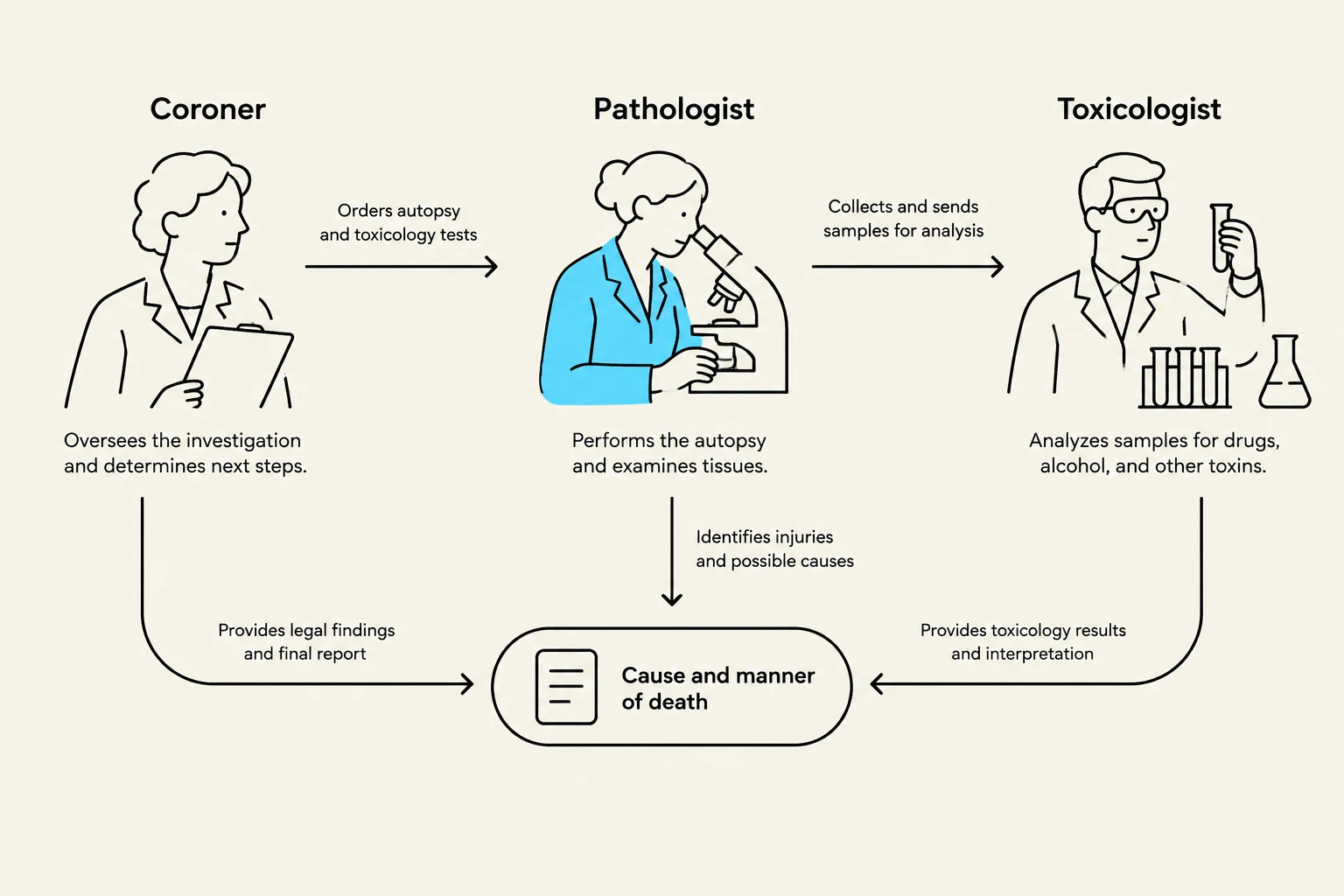
Coroners: Medical doctors with specialized training in death investigation principles. They investigate sudden, unexpected, or suspicious deaths.
Pathologists: Specialized medical doctors who have completed five years of additional training after medical school in the study of disease.
When a death is suspicious, accidental, or involves foul play, a pathologist performs an autopsy (also known as a post-mortem examination). This is a detailed physical examination of the body, involving both visual and microscopic inspection of tissues and organs to determine the medical cause of death.
This diagram illustrates the roles of a coroner, pathologist, and toxicologist in determining the cause and manner of death.
Forensic Toxicology: The Role of the Scientist
It is a common misconception that the toxicologist determines the cause of death. In reality, the Forensic Toxicologist interprets drug and poison findings and provides an expert opinion to the Pathologist and Coroner. The toxicologist's role is to determine the physiological or behavioral effects of substances at the time of death.
Toxicology is triggered in various scenarios, such as:
Drug-related deaths: Where no clear anatomical cause is found during autopsy.
Exclusionary testing: To rule out drugs/alcohol as a factor in deaths caused by injury or drowning.
Specific case types: Such as fire-related deaths (checking for Carbon Monoxide), motor vehicle collisions, or deaths in custody.
Analyzing Sample Matrices
To provide these answers, toxicologists analyze various biological and non-biological samples, known as matrices. Each matrix offers different advantages and challenges.
Blood: The Gold Standard
Blood is the most useful specimen for determining the effect of a drug at the time of death because its concentration can be directly correlated to pharmacological effects.
Exam Tip: When selecting blood for analysis, always prioritize peripheral blood (e.g., femoral or iliac) over central blood (e.g., heart blood). Central blood is highly susceptible to Postmortem Redistribution (PMR), where drugs diffuse from organs like the liver into the heart, artificially inflating the concentration.
Other Biological Matrices
Urine: Useful for detecting that a drug was present in the body at some point, but because it is a "pooled" sample, it does not correlate well with the drug's effect at the exact moment of death.
Vitreous Humour: The fluid in the eye is sequestered from decomposition and trauma, making it excellent for ethanol analysis in advanced decomposition cases.
Liver: Since the liver is the site of metabolism, drugs may be found in higher concentrations here, making it useful when other samples are unavailable.
Stomach Contents: Can reveal undissolved tablets or drugs recently ingested orally.
Challenges in Postmortem Interpretation
Interpreting results is not as simple as comparing a number to a textbook. Several biological phenomena can complicate the data:
1. Postmortem Redistribution (PMR)
After death, cellular membranes break down, and drugs can diffuse from high-concentration areas (like the liver or stomach) into the blood. This can lead to an increase in measured drug concentrations that does not reflect what was actually in the blood while the person was alive. Drugs highly susceptible to PMR include fentanyl, digoxin, and tricyclic antidepressants (TCAs).
2. Decomposition
Decomposition occurs in two stages: Autolysis (self-digestion by enzymes) and Putrefaction (destruction by bacteria). Decomposition can create "dirty" samples and produce "false" ethanol through putrefactive processes.
3. Drug Stability and Metabolism
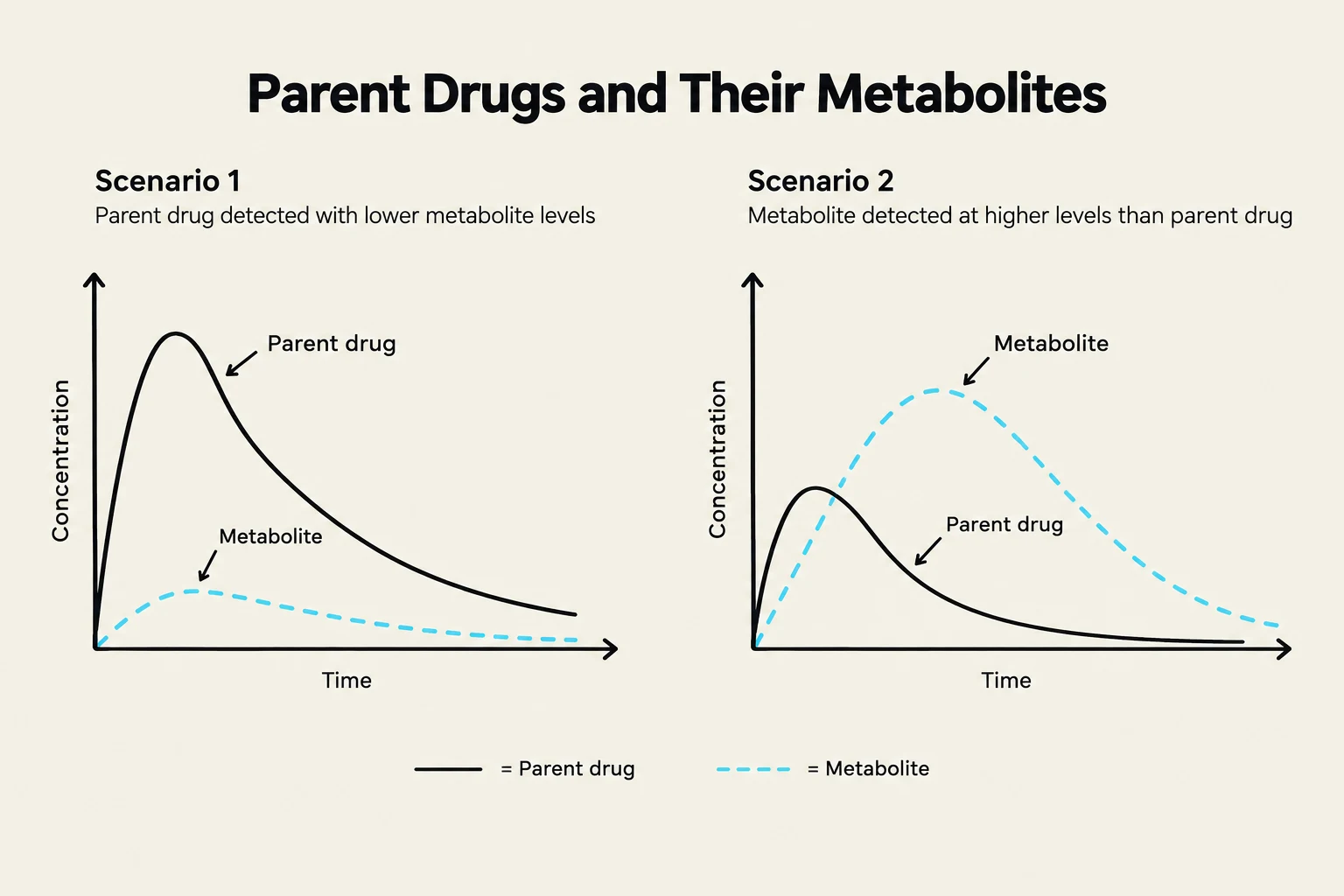
Some drugs break down quickly after death or during storage. Furthermore, toxicologists look at the ratio between a parent drug and its metabolite to distinguish between acute and chronic use.
For example, consider the antidepressant Amitriptyline and its metabolite Nortriptyline:
Acute Overdose: Parent drug concentration is much higher than the metabolite (Parent≫Metabolite).
Chronic Use/Slow Death: Metabolite concentration is higher than the parent drug ($Parent < Metabolite$).
Graphs illustrating two scenarios of parent drug and metabolite concentration over time, showing different metabolic profiles.
The Coroner's Inquest
In certain cases—such as deaths in custody, deaths involving police force, or deaths at construction sites—a mandatory Coroner's Inquest is held. This is a public hearing where a jury of five citizens hears evidence to answer the five fundamental questions of death.
The inquest is not a criminal trial; it is not adversarial. The goal is to inform the public and make recommendations to prevent future deaths. When a toxicologist testifies at an inquest, they must explain complex scientific concepts in simple, non-jargon terms to ensure the jury can understand the evidence.
Keep reading for free.
Create an account to finish this reading and make it part of your study routine.