Forensic Toxicology: Analytical Methodology and Quality Assurance
This article explores the pillars of forensic toxicology, including Quality Assurance (QA), Quality Control (QC), method validation, and the standards that govern professional practice. It details analytical methodologies from screening to quantitation, emphasizing the role of internal standards and instrumental techni
In the field of forensic toxicology, the ability to identify and quantify drugs or poisons is only half the battle. The legal weight of a laboratory result depends heavily on the rigor of the processes used to obtain it. Because forensic results are often used in criminal proceedings or to determine cause of death, laboratories must implement a robust framework of planned and systematic actions to ensure accuracy, reliability, and legal defensibility. This article explores the pillars of forensic toxicology: Quality Assurance (QA), Quality Control (QC), method validation, and the standards that govern professional practice.
Quality Assurance and Accreditation
Quality Assurance (QA) is the overarching management system designed to demonstrate that specified requirements for quality are met. Unlike individual tests, QA encompasses the entire lifecycle of a specimen, from the initial receipt of samples and the maintenance of a strict chain of custody to the final reporting of results and providing expert testimony in court.
To ensure that the laboratory operates at an international standard, many organizations seek accreditation. A primary benchmark is the ISO/IEC 17025 standard, which provides a framework for the competence of testing and calibration laboratories. Accreditation involves regular assessments that report any findings; serious deficiencies can result in the loss of accreditation.
Key components of a QA program include:
Standard Operating Procedures (SOPs): Written, step-by-step instructions for every analytical process. Following SOPs exactly ensures consistency and compliance.
Training and Competency Testing: Processes to ensure an individual is capable of performing a specific method.
Proficiency Testing: Regular external testing (e.g., through the College of American Pathologists) to ensure that analysts maintain their competence over time.
Exam Tip: Remember the distinction: QA is the system (the "big picture" of documentation and management), while QC is the operational technique (the actual monitoring of data during testing).
Quality Control and Measurement Uncertainty
While QA manages the system, Quality Control (QC) involves the operational techniques used to monitor analytical data in real-time. This is achieved by running positive and negative controls alongside case samples to ensure the equipment and reagents are performing as expected.
One critical aspect of quantitative results is Measurement Uncertainty (MU). In science, no measurement is perfectly exact; it is always an estimate of a true value. MU expresses the range of values that can reasonably be expected when a measurement is repeated. For example, a blood concentration might be reported as 5.4±0.6 ng/mL.
Sources of uncertainty can stem from several areas:
Instrumental: Calibration of pipettes, balances, or software algorithms.
Process: Matrix effects, reagent purity, or the stability of standards.
Personnel: Variations in manual pipetting or weighing techniques.
Environmental: Fluctuations in temperature, humidity, or air pressure.
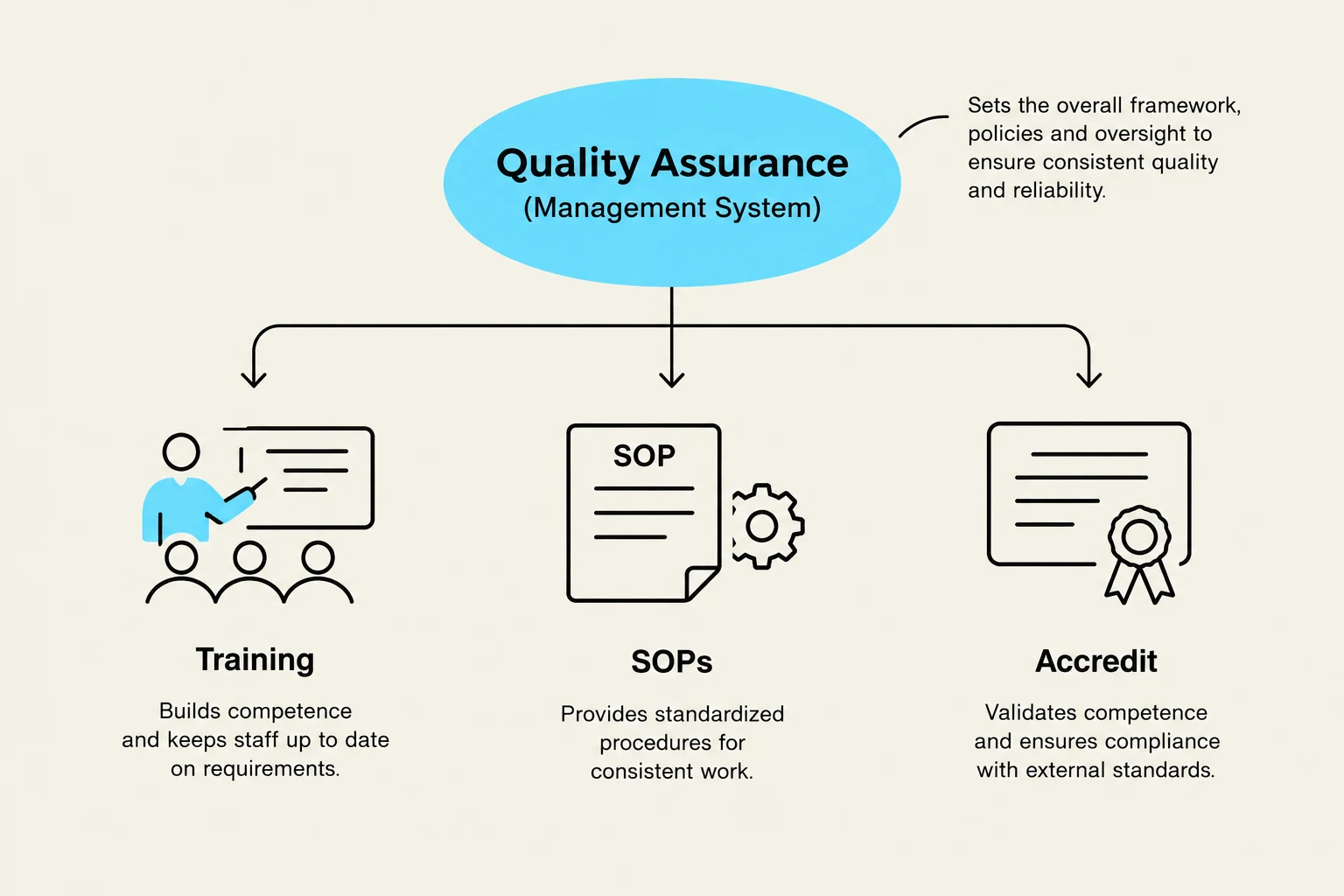
This diagram illustrates the key components of a Quality Assurance Management System, including Training, Standard Operating Procedures (SOPs), and Accreditation, which collectively ensure consistent quality and reliability.
Method Validation: Ensuring Analytical Rigor
Before a new method can be used for legal casework, it must undergo Method Validation. This is a formal process to prove the method is fit for its intended purpose. Validation must be performed for both antemortem (living) and postmortem (deceased) samples.
During validation, toxicologists must establish several critical parameters:
Accuracy and Precision: Accuracy refers to how close a result is to the true value, while precision refers to the reproducibility of the results. Precision is often evaluated through intra-assay (within a single run) and inter-assay (between different runs) studies to test the "ruggedness" of the method.
Limit of Detection (LOD) and Low Cut Off (LCO): The LOD is the lowest concentration that can be reliably detected, while the LCO is a specific threshold used in screening.
Extract Stability: Ensuring the drug remains stable in the sample throughout the extraction and analysis process.
Linearity: The ability of the method to provide results that are directly proportional to the concentration of the analyte within a given range.
Analytical Methodology: From Screening to Quantitation
Forensic analysis typically follows a two-step progression: General Screening followed by Targeted Analysis.
General Screening: Often the first step, especially when the substance is unknown. These methods (like Immunoassays or ELISA) are designed to be sensitive and can detect broad classes of drugs.
Targeted Analysis: Once a class of drug is suspected, targeted methods (like GC-MS or LC-MS/MS) are used to identify and quantitate specific molecules with high specificity.
The Role of Internal Standards
To ensure accurate quantitation, toxicologists use Internal Standards (IS). An internal standard is a reference compound—chemically similar to the analyte but distinct—added to the sample before processing. It compensates for variations in extraction efficiency or instrument response. For mass spectrometry, the "ideal" internal standard is a deuterated version of the drug (e.g., THC-d3 for THC), where hydrogen atoms are replaced by deuterium to provide a distinct mass signature.
This diagram illustrates the process of sample preparation involving the addition of an internal standard, extraction using LLE or SPE, and collection of the extract for analysis.
Instrumental Techniques
Modern laboratories rely on sophisticated instrumentation to separate and identify compounds:
Gas Chromatography-Mass Spectrometry (GC-MS): Used for volatile or semi-volatile compounds. The GC separates the mixture, and the MS provides a "fingerprint" mass spectrum for identification.
Liquid Chromatography-Tandem Mass Spectrometry (LC-MS/MS): The gold standard for many drugs, especially those that are polar or thermally unstable. It uses "Multiple Reaction Monitoring" (MRM) to achieve extreme sensitivity by selecting specific precursor and product ions.
Note on Specificity vs. Sensitivity:Sensitivity is the ability to measure very small quantities of a drug.
Specificity is the ability to distinguish the drug of interest from other similar substances (avoiding "cross-reactivity").
Summary of Analytical Workflow
The following table summarizes the relationship between the analytical goals and the methodologies used:
Goal
Method Type
Example Technology
Key Feature
Screening
Qualitative/Semi-quantitative
Immunoassay (ELISA)
High throughput, detects drug classes
Confirmation
Quantitative
GC-MS / LC-MS/MS
High specificity, definitive identification
By integrating strict QA/QC protocols, rigorous method validation, and advanced instrumentation, forensic toxicologists ensure that the data they provide can withstand the highest levels of scientific and legal scrutiny.
Keep reading for free.
Create an account to finish this reading and make it part of your study routine.