Food Safety: Temperature Control and Inspection Protocols
Learn about essential food safety practices, including proper temperature control for storage, receiving inspection protocols, and accurate temperature measurement techniques to prevent foodborne illnesses.
In the food service industry, safety is not merely a suggestion; it is a rigorous discipline of monitoring, measuring, and managing biological hazards. The most common cause of foodborne illness is improper temperature control, which allows pathogens to multiply to dangerous levels. To prevent this, food handlers must master three core competencies: understanding specific temperature thresholds for different food types, performing meticulous inspections during the receiving process, and executing precise measurement and recall procedures.
Temperature Requirements for Food Storage
This graphic illustrates the required temperature thresholds for various food categories, including cold TCS food, milk, and shellfish, for food safety and inspection protocols.
Different foods possess different biological vulnerabilities. Therefore, a "one size fits all" approach to refrigeration is insufficient. Food safety standards categorize items based on their risk levels and required thermal environments.
Cold TCS Foods and Milk
Time/Temperature Control for Safety (TCS) foods are those that require specific temperature controls to limit the growth of pathogenic bacteria.
Cold TCS Food: These must be maintained at 41∘F (5∘C) or lower.
Milk: While milk is a critical dairy product, it requires an air temperature of 45∘F (7∘C) or lower.
Shellfish and Shucked Shellfish
Shellfish require much more stringent monitoring due to their high risk of contamination.
Air Temperature: The environment surrounding shellfish must be kept at 45∘F (7∘C) or lower.
Internal Temperature: Shellfish must reach an internal temperature of ≤50∘F (10∘C).
Cooling Requirements: If shellfish are being cooled, they must reach an internal temperature of 41∘F (5∘C) or lower within a strict 4-hour window.
Frozen Foods
Frozen foods are categorized by their physical state. To ensure quality and safety, they must be kept frozen solid.
Exam Tip: When calculating cooling times for shellfish, always remember the "4-hour rule." The goal is to move from the initial internal temperature to 41∘F (5∘C) within that specific timeframe to prevent bacterial bloom.
Receiving and Inspection Protocols
The safety of your kitchen begins at the loading dock. The receiving process is your first line of defense against contaminated or damaged goods.
Rejecting Packaged Items
During inspection, staff must be vigilant for any sign of compromise. You should immediately reject any delivery that exhibits the following:
Packaging Integrity: Look for tears, dents, punctures, or broken seals and cartons.
Sanitation: Reject items with dirty or discolored packaging.
Safety & Security: Any evidence of tampering or signs of pest damage (such as droppings or gnaw marks) must result in an immediate rejection.
Expiration: Always check use-by or expiration dates; expired products must never enter the inventory.
Temperature Measurement Techniques
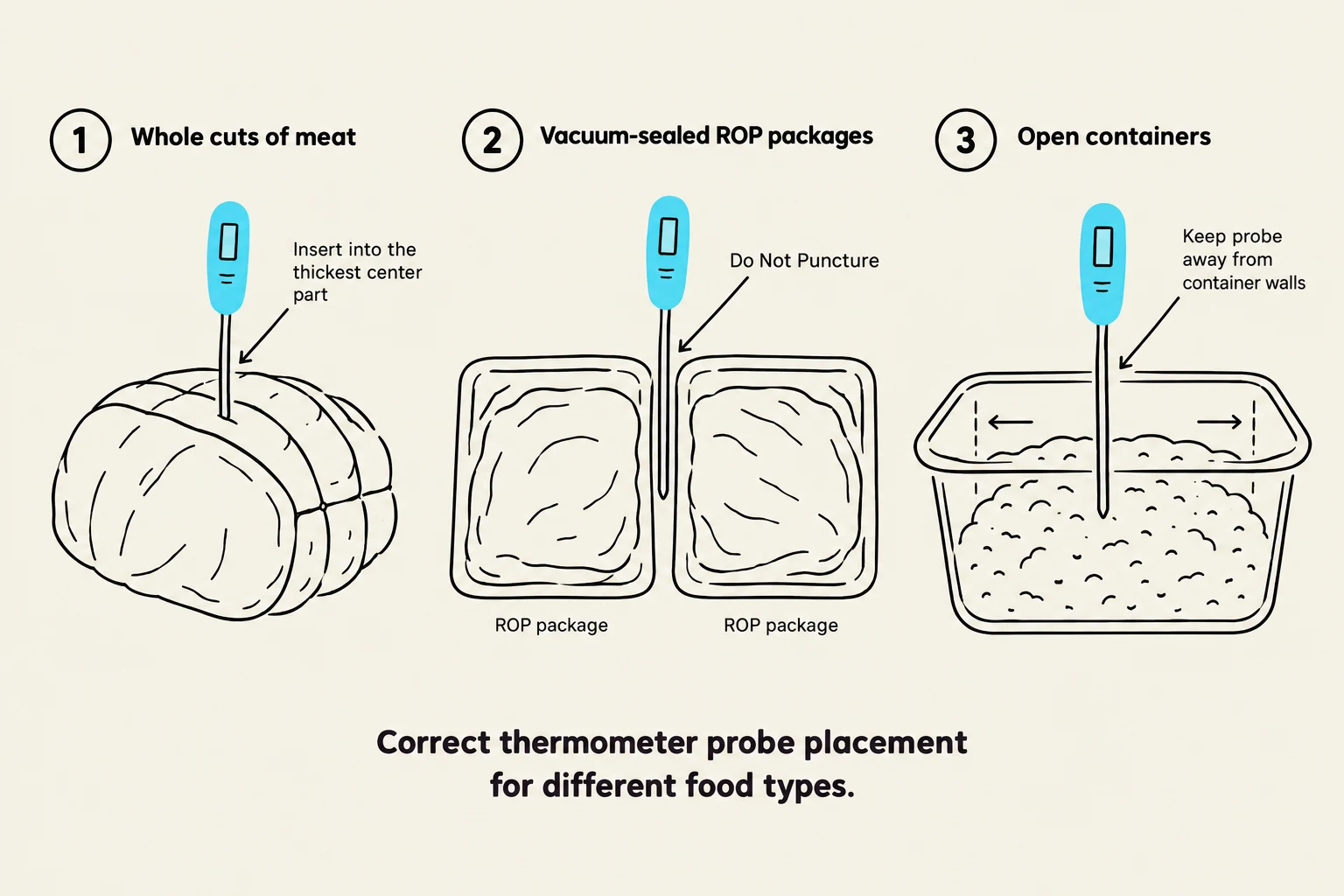
Correct thermometer probe placement for different food types, including whole cuts of meat, vacuum-sealed ROP packages, and open containers.
Even if packaging looks intact, you must verify the internal temperature of the food. However, the method of measurement changes depending on how the food is packaged.
Food Type
Measurement Instruction
Meat, Poultry, and Fish
Insert the thermometer probe into the thickest part (the center) of the food.
Reduced-Oxygen Packaged (ROP)
Insert the probe between two packages or fold the packaging around the probe. Do not puncture the package.
Other Packaged Foods
Open the package and insert the probe. Ensure the sensing area is fully immersed without touching the packaging itself.
Critical Warning: Never puncture a Reduced-Oxygen Packaged (ROP) item to take a temperature. Puncturing the seal destroys the modified atmosphere and can lead to the growth of dangerous bacteria like Clostridium botulinum.
Recall Procedures
Illustration showing the process of moving recalled food items from general inventory to a secure isolation zone, with a label indicating 'DO NOT USE'.
Despite the best precautions, a vendor may issue a recall for a product already in your facility. In such an event, speed and organization are vital to prevent accidental use.
Immediate Cessation: Stop using the item immediately.
Isolation: Remove the item from your general inventory and place it in a secure, appropriate location.
Labeling: Clearly label the item "Do not use" to ensure no staff member accidentally uses it.
Segregation: Keep the recalled item separate from other food, equipment, or linens.
Communication: Inform all relevant staff members about the recall so they are aware of the danger.
Vendor Consultation: Do not simply throw the item away; consult with your vendor to receive specific instructions on how to handle the disposal or return of the recalled product.
Keep reading for free.
Create an account to finish this reading and make it part of your study routine.