Fluid and Electrolyte Transport Processes in the Body
This content explains the distribution of body fluids, mechanisms of transport across cell membranes and capillary walls, and the role of Starling forces in fluid exchange. It also summarizes key electrolytes and their functions.
Maintaining homeostasis requires the body to keep a relatively stable internal environment, which is fundamentally dependent on the precise balance of body fluids and electrolytes. This balance involves managing the total volume, distribution, and concentration of solutes across various compartments. Understanding how water and solutes move between these compartments is essential for grasping how the body responds to changes in blood pressure, hydration, and electrolyte levels.
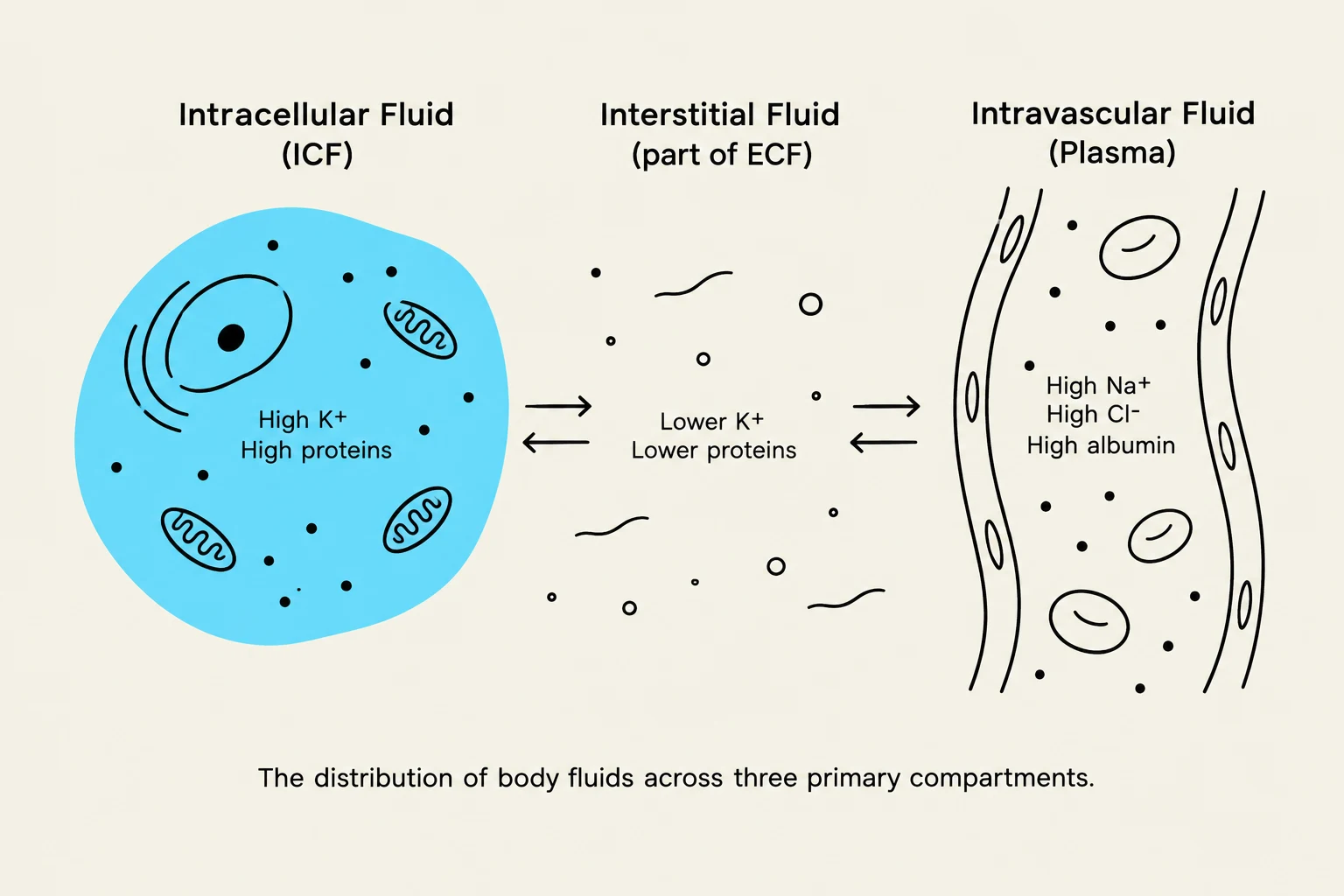
The distribution of body fluids across three primary compartments: intracellular fluid (ICF), interstitial fluid, and intravascular fluid (plasma), highlighting key ion and protein concentrations in each.
The Distribution of Body Fluids
Body water is not a single, uniform pool; rather, it is distributed among three primary compartments:
Intracellular Fluid (ICF): This is the fluid located inside the cells, making up approximately two-thirds of total body water. It is characterized by high concentrations of potassium ($K^+$), magnesium (Mg2+), phosphate, and negatively charged proteins.
Extracellular Fluid (ECF): This fluid is located outside the cells and is further divided into two sub-compartments:
Interstitial Fluid: This fluid surrounds and bathes the tissue cells, accounting for about three-quarters of the ECF. It has a composition similar to plasma but contains very little protein.
Intravascular Fluid (Plasma): This is the liquid portion of the blood found within the vessels. While its electrolyte concentrations (like Na+ and $Cl^-$) are similar to interstitial fluid, it contains significantly higher levels of proteins, most notably albumin.
While the specific concentrations of solutes differ—for example, sodium (Na+) is high in the ECF while potassium ($K^+$) is high in the ICF—the compartments maintain approximately equal osmolarity because water moves continuously between them to reach equilibrium.
Memory Tip: Potassium is inside the cell; Sodium is outside the cell; Plasma has the proteins.
Mechanisms of Movement
Fluid and solute exchange occurs at two specific sites: across cell membranes (exchanging material between the ICF and interstitial fluid) and through capillary walls (exchanging material between the interstitial fluid and plasma). These movements are driven by two distinct processes: passive and active transport.
Passive Transport Processes
Passive transport does not require metabolic energy (ATP) because substances move along their existing concentration or electrochemical gradients. This movement is driven by diffusion pressure and includes several types:
Simple Diffusion: The net movement of particles from an area of higher concentration to an area of lower concentration.
Osmosis: The specific movement of water across a selectively permeable membrane. Water moves from an area of lower solute concentration toward the side with a higher concentration of non-penetrating solutes.
Facilitated Diffusion: A process where molecules move down their concentration gradient, but only by attaching to a specific carrier protein to cross the membrane.
Filtration: The movement of water and small solutes across a barrier (like a capillary wall) driven by differences in hydrostatic pressure.
Active Transport
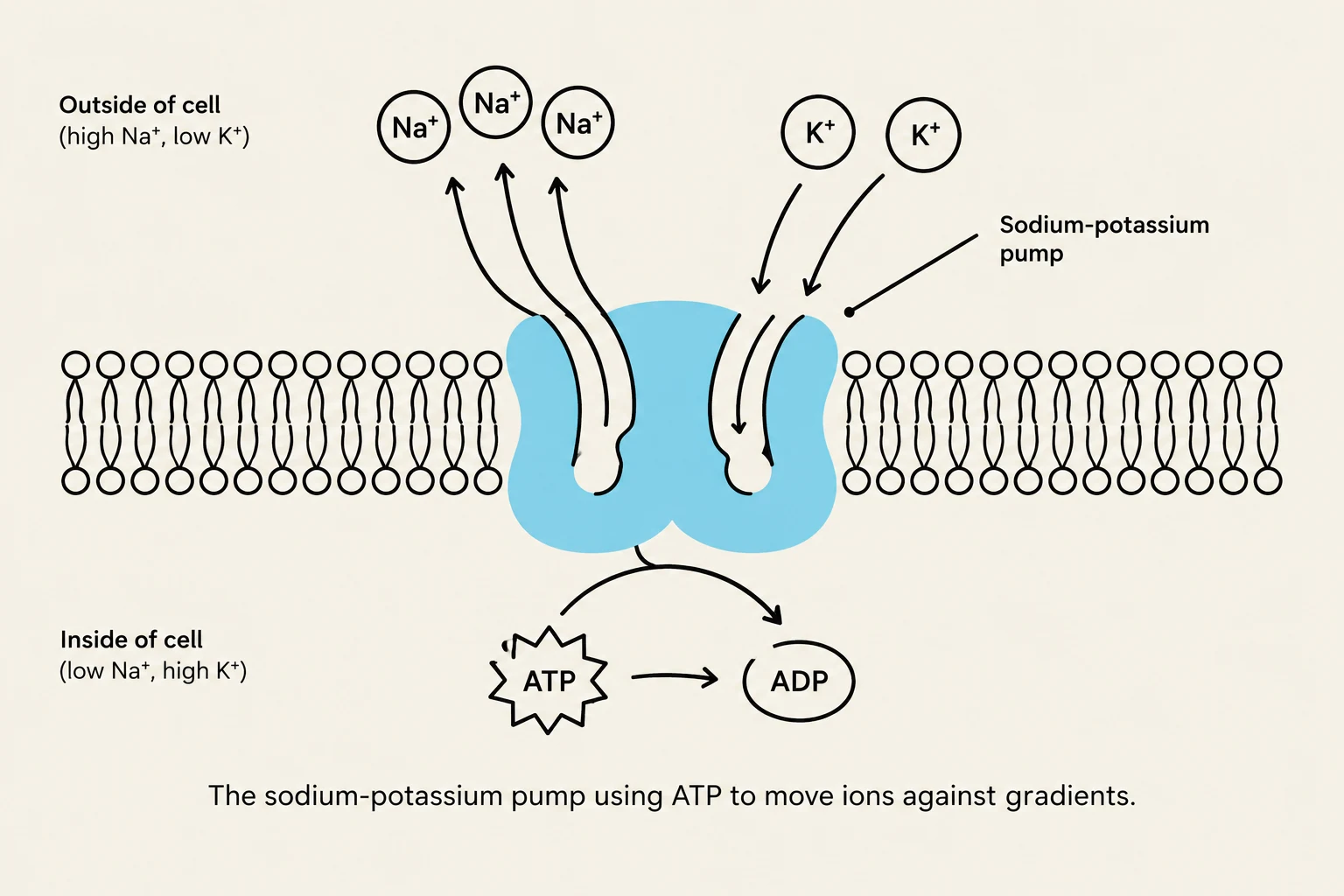
Diagram illustrating the sodium-potassium pump, which uses ATP to transport sodium and potassium ions across the cell membrane against their concentration gradients.
Unlike passive processes, active transport requires metabolic energy (ATP) to move substances against their concentration or electrochemical gradient. This process relies on specialized carrier molecules or transport proteins to "pump" solutes across the membrane.
A critical example of active transport is the sodium–potassium pump (Na+-K+ pump). This pump uses ATP to move:
3Na+ ions out of the cell
2K+ ions into the cell
This constant pumping is vital for maintaining the specific electrolyte gradients that allow cells to function.
Capillary Exchange and Starling Forces
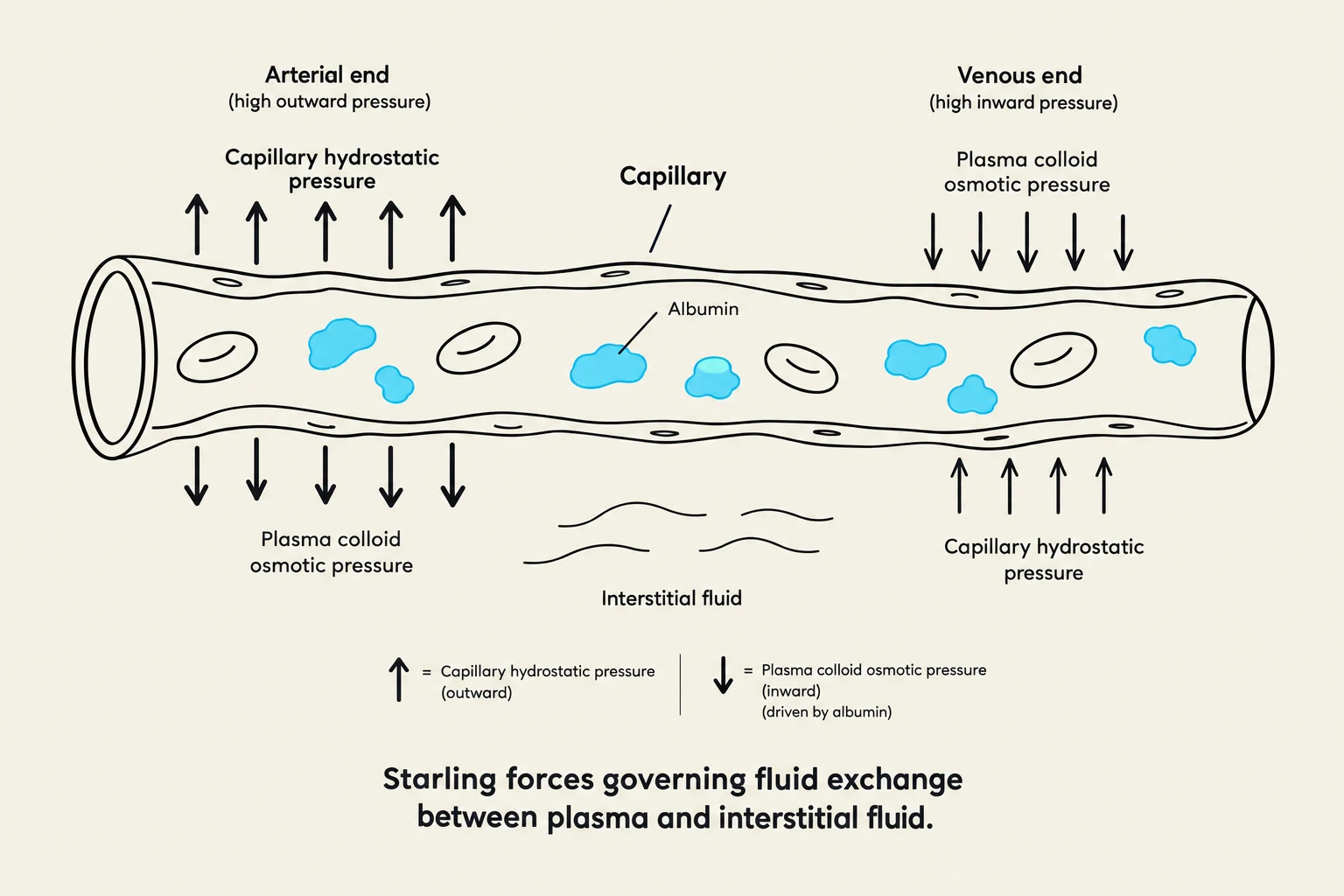
Diagram illustrating Starling forces governing fluid exchange between plasma and interstitial fluid, showing capillary hydrostatic pressure and plasma colloid osmotic pressure at the arterial and venous ends of a capillary.
The movement of fluid between the blood (plasma) and the interstitial space is governed by Starling forces. These forces represent a tug-of-war between pressures that push fluid out of the vessel and pressures that pull fluid back in.
Force
Effect on Fluid Movement
Capillary Hydrostatic Pressure
Pushes fluid OUT of the capillary
Plasma Colloid Osmotic Pressure
Draws fluid IN toward the capillary (primarily via albumin)
In traditional models, it is taught that at the arterial end of a capillary, hydrostatic pressure is high, causing filtration (fluid moving from blood to tissue). At the venous end, the pressure drops, allowing reabsorption (fluid moving from tissue back to blood) to occur, driven by the osmotic pull of plasma proteins like albumin.
However, modern refinements suggest that most tissues actually experience a net filtration. Because of this, lymphatic vessels play a crucial role by collecting excess filtered fluid and proteins from the tissues and returning them to the bloodstream.
Summary of Key Electrolytes
Electrolytes are substances that dissociate in solution to form ions (charged particles). They are categorized as cations (positively charged, e.g., Na+, $K^+$, Ca2+) or anions (negatively charged, e.g., $Cl^-$, HCO3−).
Sodium (Na+): The most abundant cation in the ECF; essential for maintaining ECF fluid balance and nerve/muscle function.
Potassium ($K^+$): The most abundant cation in the ICF; vital for intracellular enzyme reactions and nerve/muscle function.
Chloride ($Cl^-$): The most abundant extracellular anion; helps balance anions between compartments.
Bicarbonate (HCO3−): Plentiful in the ECF and plasma; plays a major role in transporting CO2.
Calcium (Ca2+): Important for blood clotting, neurotransmitter release, and muscle tone.
Keep reading for free.
Create an account to finish this reading and make it part of your study routine.