Federalists vs. Anti-Federalists: The Great Constitutional Debate
Explore the fundamental disagreements between the Federalists and Anti-Federalists regarding the U.S. Constitution, focusing on the balance of power between the national and state governments, and the importance of individual liberties.
In 1787, a group of 55 delegates gathered in Philadelphia to revise the Articles of Confederation. Instead of a simple revision, they created a brand-new framework for governing the United States: the Constitution. However, the creation of this document was not a moment of universal agreement. The nation was deeply divided over how much power the new national government should hold and how much freedom should be guaranteed to individual citizens. This tension gave rise to two distinct political factions: the Federalists and the Anti-Federalists.
The Federalists: Advocates for a Strong Union
The Federalists were the supporters of the new Constitution. Led by influential figures such as Alexander Hamilton, James Madison, and John Jay, they argued that the previous system under the Articles of Confederation was too weak to maintain order.
The Federalists believed that a strong central government was essential to prevent the country from splitting apart. They argued that a large republic was actually a better way to protect liberty than small, local governments, because it would prevent any single selfish group from seizing total control. To ensure the national government did not become tyrannical, they pointed to the structural safeguards built into the Constitution:
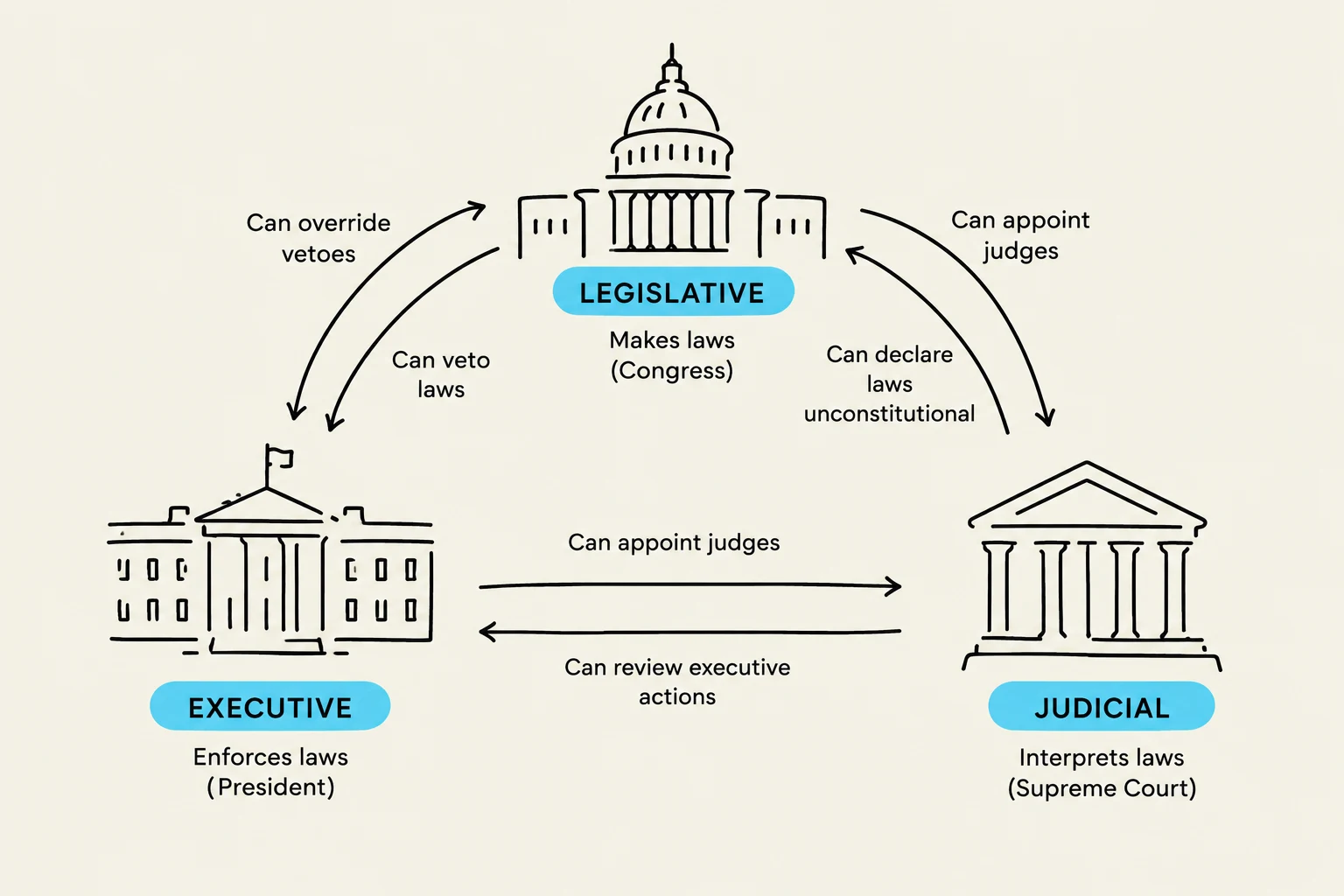
Separation of Powers: Dividing the government into three branches—Legislative, Executive, and Judicial—to ensure no single entity held all the power.
Checks and Balances: A system where each branch has the ability to limit the powers of the others.
Diagram illustrating the separation of powers and checks and balances between the legislative, executive, and judicial branches of the U.S. government.
The Anti-Federalists: Defenders of State Power and Liberty
While the Federalists looked toward national unity, the Anti-Federalists looked toward local autonomy and individual rights. Supporters like Samuel Adams and Patrick Henry feared that the Constitution created a national government that was far too powerful.
The Anti-Federalists had several specific concerns regarding the legal language of the Constitution:
The Supremacy Clause: They worried that because this clause makes national laws superior to state laws, the state governments would eventually be destroyed.
The Necessary and Proper Clause: They viewed this clause as too vague and general, fearing it would give the national government unlimited power to pass any law it wanted.
The Executive Branch: Some feared the President would eventually become a monarch, much like a King.
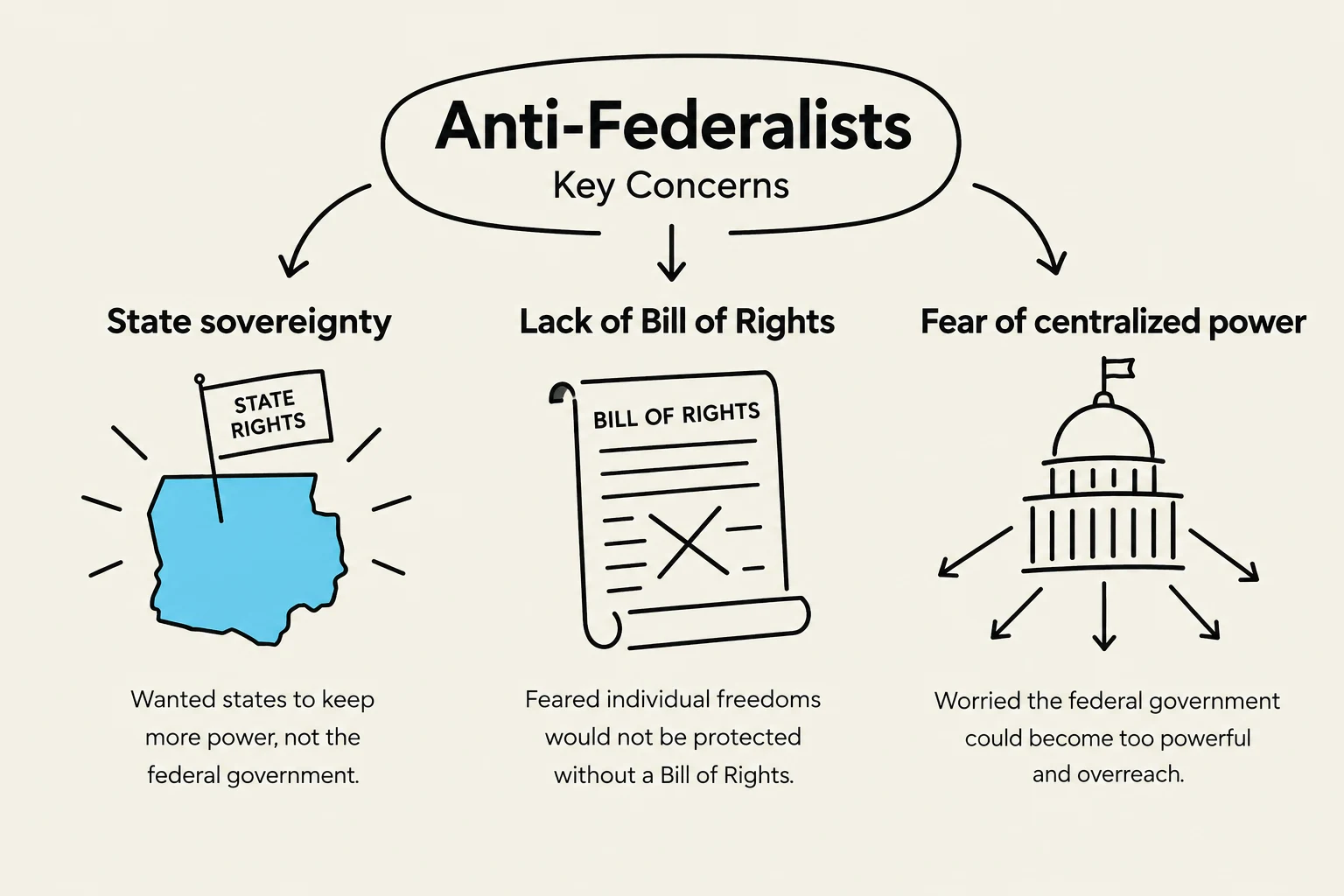
For the Anti-Federalists, the most significant flaw was the absence of a Bill of Rights. They believed that without a specific list of protected individual liberties, the national government would inevitably infringe upon the freedoms of the people.
This diagram outlines the key concerns of the Anti-Federalists, including state sovereignty, the lack of a Bill of Rights, and the fear of centralized power.
Federalism and the Power Struggle
At the heart of this debate was the concept of Federalism. Federalism is a system where power is shared between the national (federal) government and the state governments.
The Federalists argued that the Constitution established a healthy balance of power. However, the Anti-Federalists remained skeptical, believing the "balance" was heavily tilted in favor of the national government. This debate wasn't just about theory; it was about the practical reality of how much control a distant government in a capital city should have over the daily lives of people living in far-off states.
The Federalist Papers and the Role of Media
To win the argument, the Federalists turned to the press. James Madison, Alexander Hamilton, and John Jay wrote a series of essays known as The Federalist Papers. These essays were designed to explain the Constitution in detail and persuade the public to support its ratification.
Interestingly, the debate was influenced by what we might today call "political bias". During the ratification period, many newspapers in New York and other states were more sympathetic to the Federalist cause, publishing their essays more frequently than those of the Anti-Federalists. This gave the Federalists an advantage in shaping public opinion.
Study Tip: When analyzing historical debates, look for "bias." In 1787, bias wasn't just in social media algorithms; it was in which political essays a newspaper chose to print!
The Compromise: The Bill of Rights
The standoff between these two groups eventually led to a historic compromise. To ensure the Constitution would be adopted, the Federalists promised to add a series of amendments specifically designed to protect individual liberties.
Once the Constitution was adopted in 1789, these amendments were proposed. Out of the 12 originally proposed, 10 were passed and became known as the Bill of Rights. This addition addressed the primary fear of the Anti-Federalists and helped solidify the new American government.
Feature
Federalist View
Anti-Federalist View
Central Government
Should be strong to maintain order
Should be weak to prevent tyranny
State Governments
Should share power via federalism
Should retain most power to protect liberty
Bill of Rights
Not strictly necessary due to checks and balances
Essential to protect individual freedoms
By combining the strength of a national government with the explicit protections of the Bill of Rights, the United States attempted to bridge the gap between these two competing visions of liberty and order.
Keep reading for free.
Create an account to finish this reading and make it part of your study routine.