An overview of federal laws and regulations designed to combat financial crimes, including money laundering, with a focus on the Bank Secrecy Act (BSA), the USA PATRIOT Act, and key reporting requirements.
In the modern financial landscape, the integrity of the economy relies heavily on the ability of institutions to detect and prevent criminal activity. Federal financial crime laws are specifically designed to combat money laundering, which is the process of transforming proceeds from criminal activity into funds that appear to have a legal source. To maintain order and prevent the flow of illicit funds, several key pieces of legislation and regulatory bodies work in tandem to monitor transactions and verify identities.
The Regulatory Framework: FinCEN, BSA, and AML
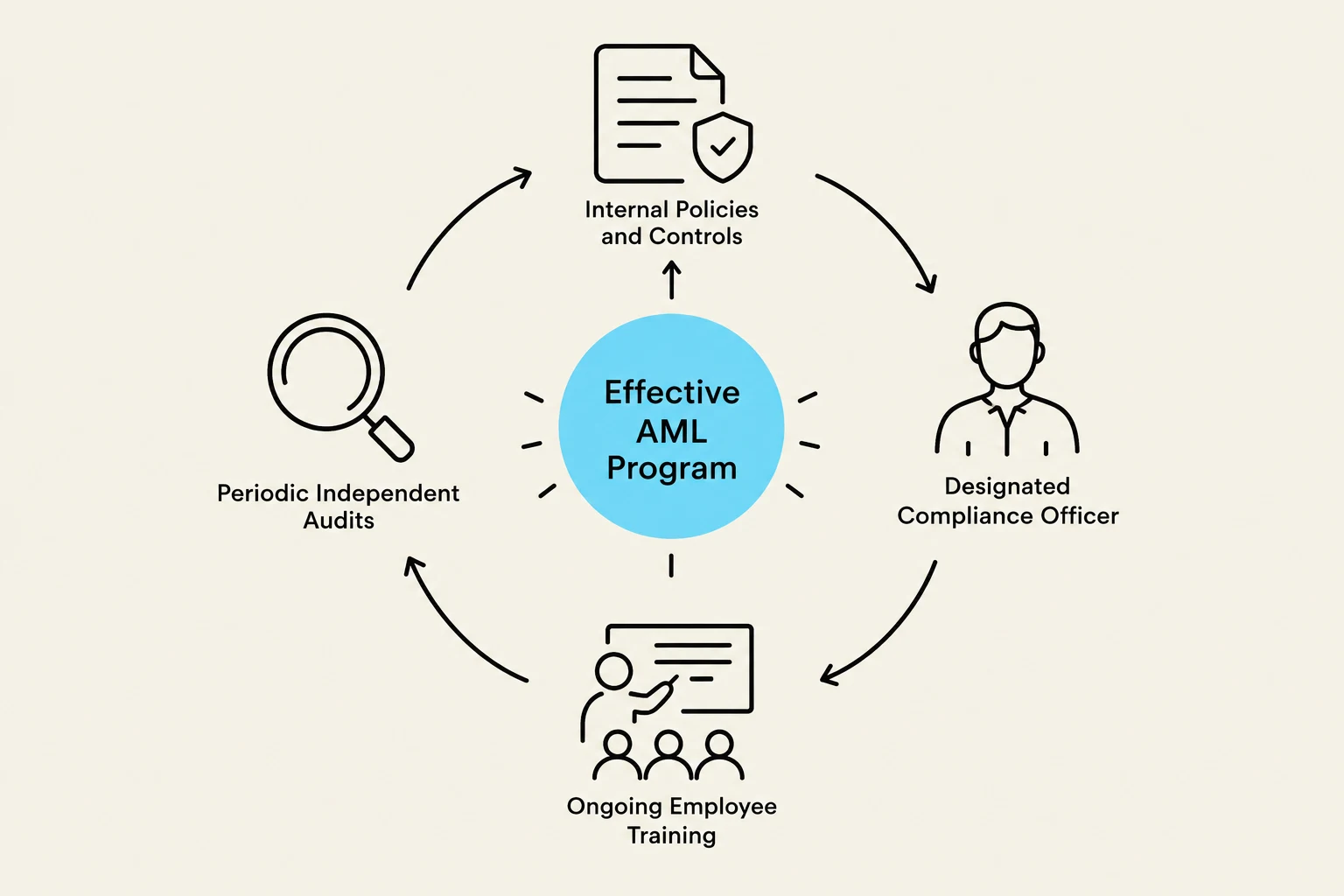
Diagram illustrating the key components of an effective AML (Anti-Money Laundering) program, including internal policies and controls, a designated compliance officer, ongoing employee training, and periodic independent audits.
At the center of the fight against financial crime in the United States is the Financial Crimes Enforcement Network (FinCEN), a bureau of the U.S. Department of the Treasury. FinCEN serves as the primary administrator for much of the regulatory oversight regarding financial crimes.
The foundational law in this area is the Bank Secrecy Act (BSA), which is often referred to as Anti-Money Laundering (AML) law. The BSA requires financial institutions to implement robust programs to detect and report criminal activities, such as tax evasion and money laundering.
To remain compliant with AML laws, a financial institution must maintain a formal AML program. According to regulatory standards, an effective program must include the following four pillars:
Internal Policies and Controls: Systems for maintaining accurate records and reporting suspicious activities.
A Designated Compliance Officer: A specific individual responsible for managing the daily operations of the AML program.
Ongoing Employee Training: Regular programs to ensure staff can recognize red flags and follow reporting protocols.
Periodic Independent Audits: Regular reviews conducted by an outside party to test the effectiveness of the program.
Exam Tip: If you are asked what is required for a compliant AML program, remember the four pillars: Policies, a Compliance Officer, Training, and Independent Audits.
The USA PATRIOT Act and Identity Verification
Following the terrorist attacks of September 11, 2001, the U.S. government enacted the USA PATRIOT Act to strengthen the nation's ability to fight terrorism and intercept the financing of illegal activities.
For mortgage professionals, Title III of the USA PATRIOT Act is of critical importance. It mandates two primary requirements that impact how lenders interact with borrowers:
1. Enhanced Anti-Money Laundering Programs
The Act strengthens the ability of institutions to track and report suspicious activity, making the AML requirements even more rigorous to prevent the movement of terrorist funds.
2. Customer Identification Program (CIP)
The Customer Identification Program (CIP) is a mandatory process used to verify the identity of a customer. Under CIP, institutions must collect specific information, including:
Full Name
Date of Birth
Social Security Number (SSN)
Physical Address
Furthermore, institutions must maintain these records for at least five years after an account is closed and are required to notify customers of these identity verification requirements.
Key Reporting Documents
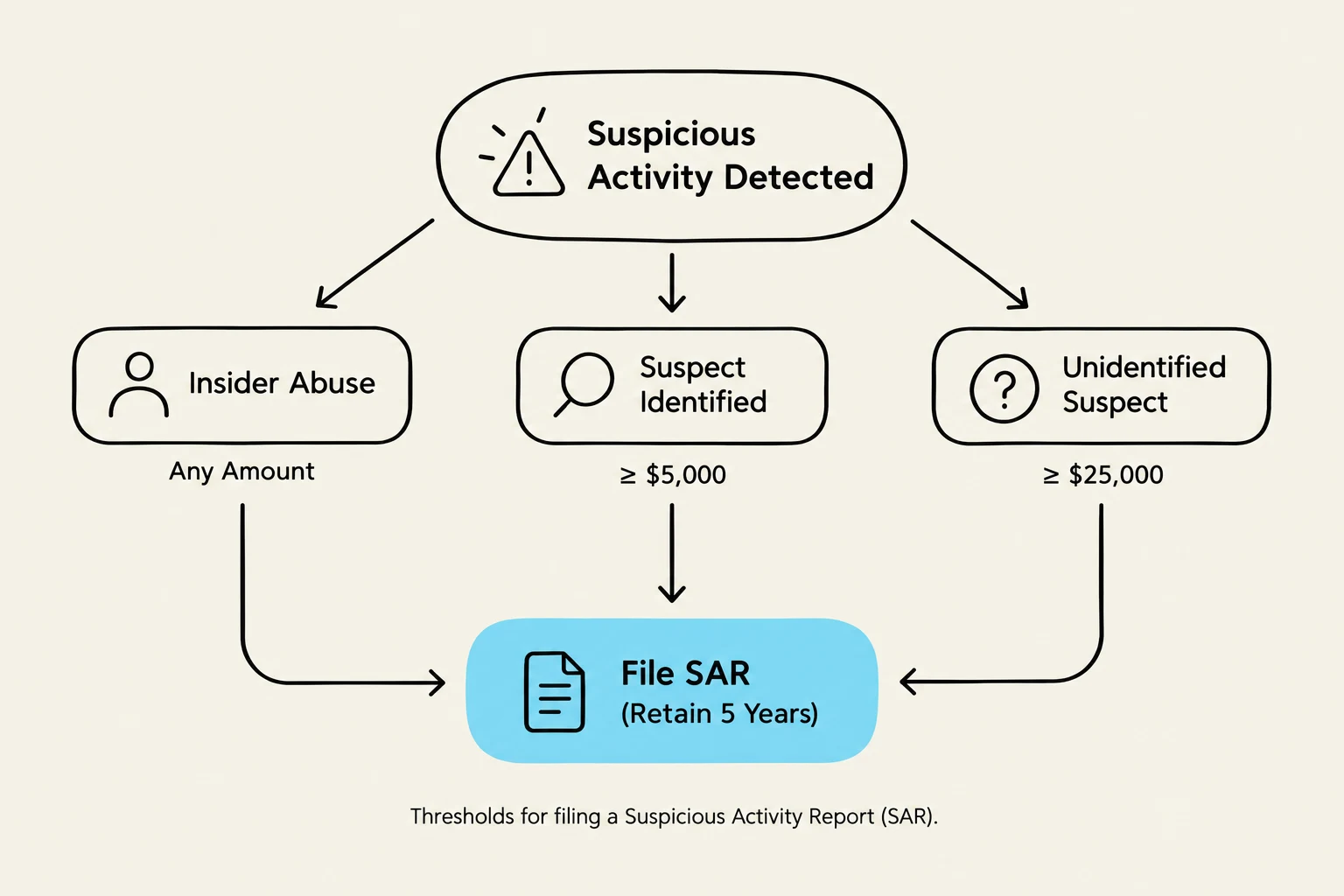
This flowchart illustrates the process for filing a Suspicious Activity Report (SAR), detailing different scenarios of suspicious activity detection, suspect identification, and the associated financial thresholds that trigger the reporting requirement.
To ensure transparency, federal law requires the filing of specific documents when certain financial thresholds or suspicious patterns are met.
Currency Transaction Report (CTR)
A Currency Transaction Report (CTR) must be filed for any single transaction involving more than $$10,000$ in currency. This is a standard tool used to track large movements of physical cash.
Report of International Transportation of Currency or Monetary Instruments (CMIR)
When an individual physically transports or mails monetary instruments exceeding $$10,000$ into or out of the United States, they must file a Report of International Transportation of Currency or Monetary Instruments (CMIR).
Suspicious Activity Report (SAR)
The Suspicious Activity Report (SAR) is one of the most important tools for detecting fraud and criminal intent. A SAR must be filed under the following circumstances:
Insider Abuse: Any amount of violation involving an insider.
Identified Suspects: Violations that aggregate to $$5,000$ or more when a suspect is identified.
Unidentified Suspects: Violations that aggregate to $$25,000$ or more, regardless of whether a suspect has been identified.
All SAR filings must be retained for a period of five years.
Report of Foreign Bank and Financial Accounts (FBAR)
In addition to the reports mentioned above, individuals must be aware of the Report of Foreign Bank and Financial Accounts (FBAR), which is used to report financial interests in, or signature authority over, foreign financial accounts.
Note: While the specific retention for CTR and CMIR is not listed in the primary text, the SAR retention period is a critical detail for compliance and testing.
Keep reading for free.
Create an account to finish this reading and make it part of your study routine.