This content explains price elasticity of demand, including its classification (inelastic, elastic, unit elastic), factors determining it, and its relationship with total revenue. It also covers cross-price elasticity and income elasticity of demand.
In economics, understanding how much consumers react to changes in the market is essential for predicting behavior and market outcomes. While we know that price and quantity demanded generally have an inverse relationship, the "Law of Demand" doesn't tell us the magnitude of that change. To answer "how much" quantity changes when price or income shifts, economists use the concept of elasticity.
Price Elasticity of Demand
Price elasticity of demand measures how responsive the quantity demanded of a good is to a change in its price. It is calculated as the percentage change in quantity demanded divided by the percentage change in price:
Price elasticity of demand=% change in price% change in quantity demanded
Because price and quantity move in opposite directions, the result is typically negative; however, economists usually drop the minus sign and look at the absolute value ∣Ed∣.
Classifying Elasticity
We categorize demand into three main types based on the absolute value of the elasticity coefficient:
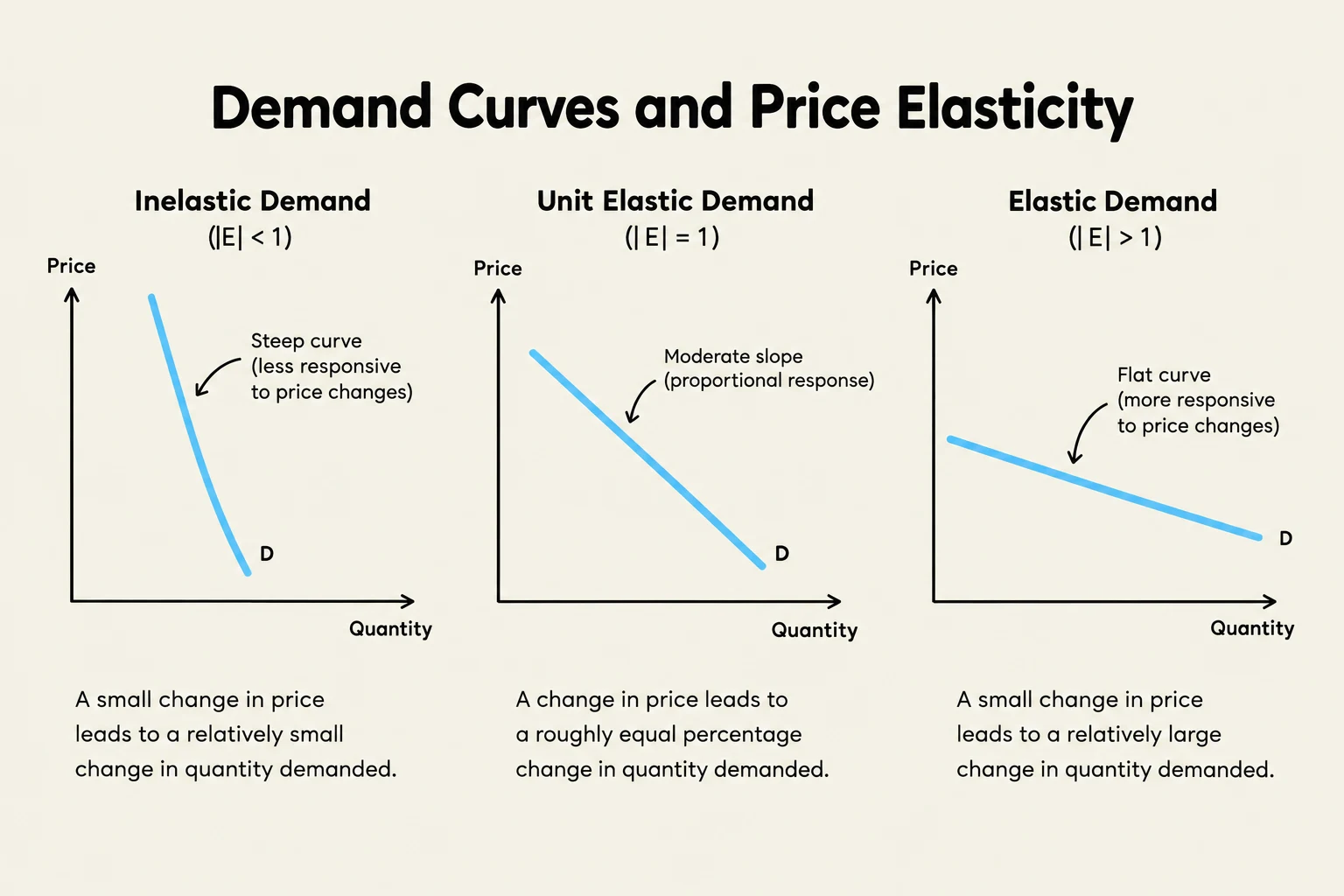
Inelastic Demand (∣Ed∣<1): A change in price causes a relatively small change in quantity demanded.
Elastic Demand (∣Ed∣>1): A change in price causes a relatively large change in quantity demanded.
Unit Elastic Demand (∣Ed∣=1): The percentage change in quantity is exactly equal to the percentage change in price.
There are also extreme cases: Perfectly Inelastic demand (Ed=0), where quantity demanded does not change regardless of price, and Perfectly Elastic demand (Ed=∞), where any price increase causes demand to drop to zero.
This illustration shows three types of demand curves: inelastic, unit elastic, and elastic, each with a corresponding explanation of how price changes affect quantity demanded.
Exam Tip: The Midpoint Method
When calculating elasticity between two points, using simple percentage changes can give different results depending on whether you are moving from Point A to B or B to A. To avoid this, always use the Midpoint Formula, which uses the average of the starting and final values as the base.
Elasticity and Total Revenue
For sellers, understanding elasticity is vital for managing Total Revenue (TR), which is calculated as Price × Quantity (P⋅Q).
Inelastic Demand: The "price effect" dominates. If you raise the price, the slight drop in quantity sold is outweighed by the higher price per unit, so Total Revenue rises.
Elastic Demand: The "quantity effect" dominates. If you raise the price, the significant drop in quantity sold outweighs the higher price per unit, so Total Revenue falls.
Unit Elastic Demand: The price and quantity effects exactly balance each other, leaving Total Revenue unchanged.
Factors Determining Price Elasticity
Why are some goods more sensitive to price than others? Four primary factors determine the price elasticity of demand:
Availability of Close Substitutes: This is perhaps the most important factor. If many substitutes exist, consumers can easily switch brands if one price rises, making demand elastic. If there are few substitutes, demand is inelastic.
Necessity vs. Luxury: Necessities (like medicine) tend to have inelastic demand because consumers must buy them regardless of price. Luxuries (like designer clothing) have elastic demand because consumers can easily forgo them if prices rise.
Share of Income: Goods that take up a large portion of a consumer's budget (expensive items) tend to have more elastic demand. Small, inexpensive items (like salt) often have inelastic demand because price changes feel negligible.
Length of Time: Demand becomes more elastic over time. In the short run, consumers may not be able to change their habits immediately, but over time, they can find substitutes or adjust their behavior.
Cross-Price Elasticity of Demand
Cross-price elasticity of demand measures how sensitive the quantity demanded of one good (Good A) is to a change in the price of another good (Good B):
Cross-price elasticity of demand=% change in price of Good B% change in quantity demanded of Good A
This metric allows us to identify the relationship between two products:
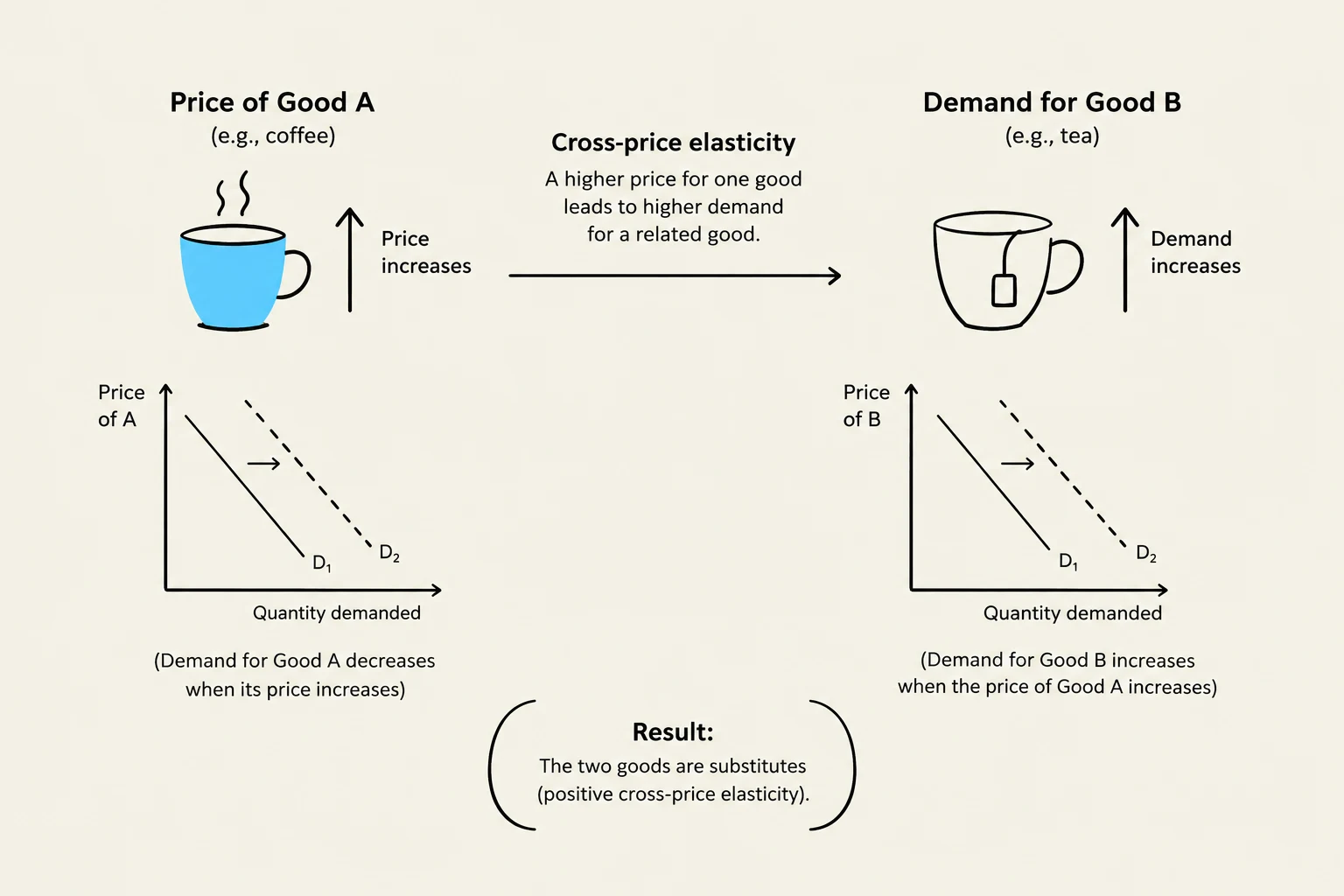
Substitutes: These have a positive cross-price elasticity. If the price of Brand X cookies rises, the demand for Brand Y cookies will increase.
Complements: These have a negative cross-price elasticity. If the price of milk rises, the demand for Oreos (which are often eaten with milk) will decrease.
This diagram illustrates the concept of cross-price elasticity, showing how an increase in the price of one good (coffee) leads to an increase in the demand for a related substitute good (tea).
Income Elasticity of Demand
Income elasticity of demand measures how sensitive the quantity demanded of a good is to changes in consumer income:
Income elasticity of demand=% change in income% change in quantity demanded
We use this to distinguish between two types of goods:
Normal Goods: These have a positive income elasticity. As income rises, demand increases.
Income-elastic normal goods: Demand increases significantly as income rises (e.g., vacations).
Income-inelastic normal goods: Demand increases, but at a slower rate than income.
Inferior Goods: These have a negative income elasticity. As income rises, consumers switch to better alternatives, causing the demand for the inferior good to fall (e.g., fast food or ramen noodles).
Keep reading for free.
Create an account to finish this reading and make it part of your study routine.