Extractive Institutions and the Vicious Circle of Power
This content explains the concept of extractive political institutions and how they create a self-perpetuating cycle of concentrated power and wealth, leading to inequality and stagnation. It details the mechanisms of institutional persistence, such as elite adaptation and continuity of structure, and discusses how che
In the study of political economy, one of the most challenging phenomena to overcome is the self-perpetuating nature of inequality and authoritarianism. Why do certain societies remain trapped in cycles of poverty and exploitation despite revolutions or regime changes? The answer often lies in the relationship between political institutions and economic rules. When power is concentrated in the hands of a few, they create systems designed to extract wealth from the rest of society, which in turn provides them with the resources necessary to maintain that very power.
Extractive Political Institutions and the Vicious Circle
At the heart of institutional stagnation are extractive political institutions. These are systems designed to concentrate power in the hands of a narrow elite, allowing them to establish economic rules that enrich themselves at the expense of the broader population.
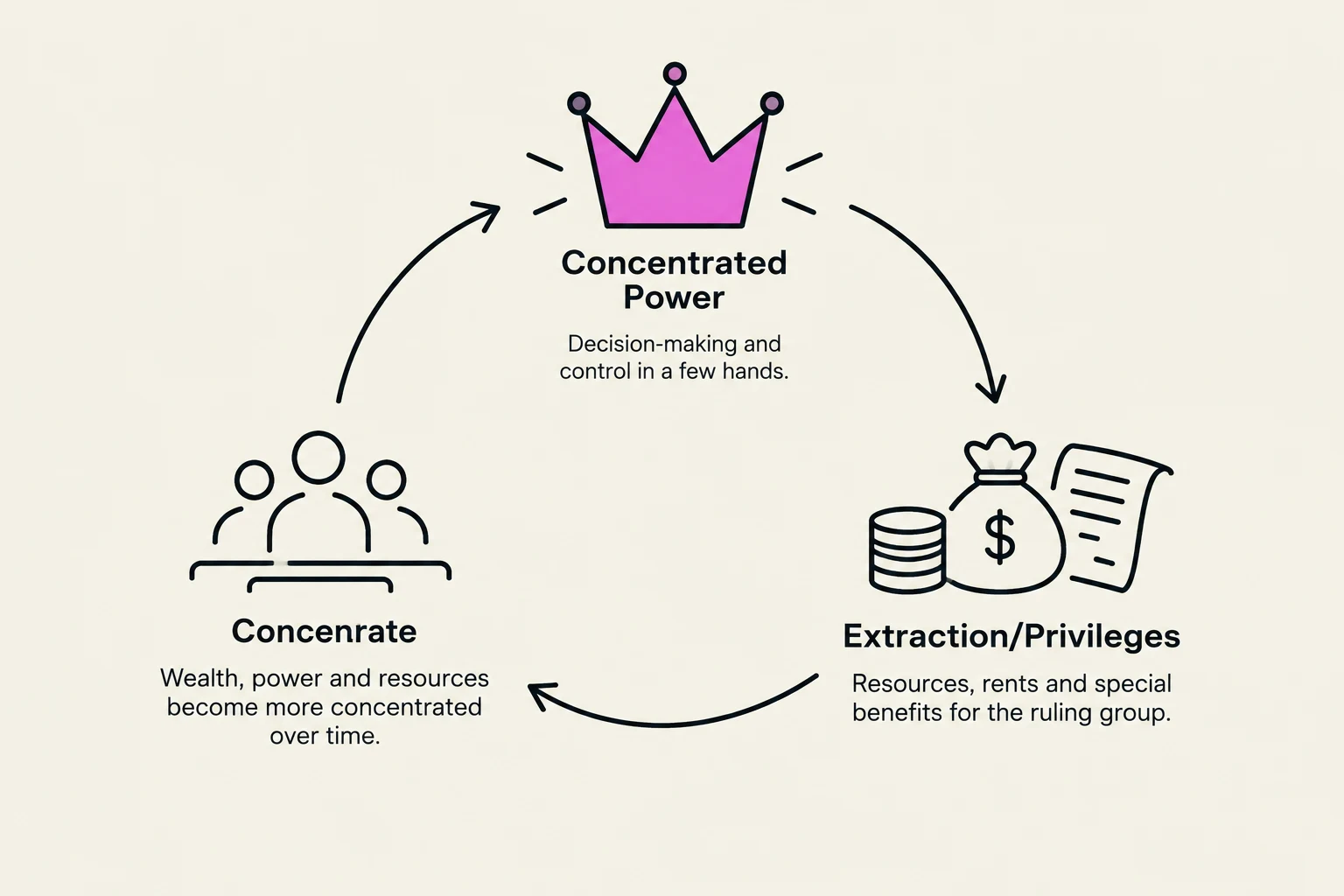
This process is not a one-time event but a self-reinforcing loop known as a vicious circle. The logic of the cycle can be broken down into a repeating sequence:
Concentrated Power: A small group gains control over the state.
Extraction and Privileges: This group implements laws and economic policies that grant them special privileges and allow them to extract resources from the public.
Concentrated Wealth: The extraction process leads to a massive accumulation of wealth within the elite class.
Greater Political Control: This wealth is reinvested into the political system to further strengthen the elite's grip on power, completing the loop.
Mathematically, we can view this as a positive feedback loop where the output of one stage becomes the input for the next, leading to exponential growth in inequality:
This diagram illustrates the cyclical relationship between concentrated power, resource extraction, and the further concentration of wealth and power over time.
Exam Tip: If asked to define a "vicious circle" in a political context, focus on the feedback mechanism. It is not just that power leads to wealth, but that wealth is used specifically to protect the power that created it.
The Mechanisms of Institutional Persistence
One might assume that a change in leadership or a shift in the global economy would break these cycles. However, history shows that institutional persistence—the ability of certain structures to survive despite external changes—is remarkably high. This persistence typically manifests in three distinct ways:
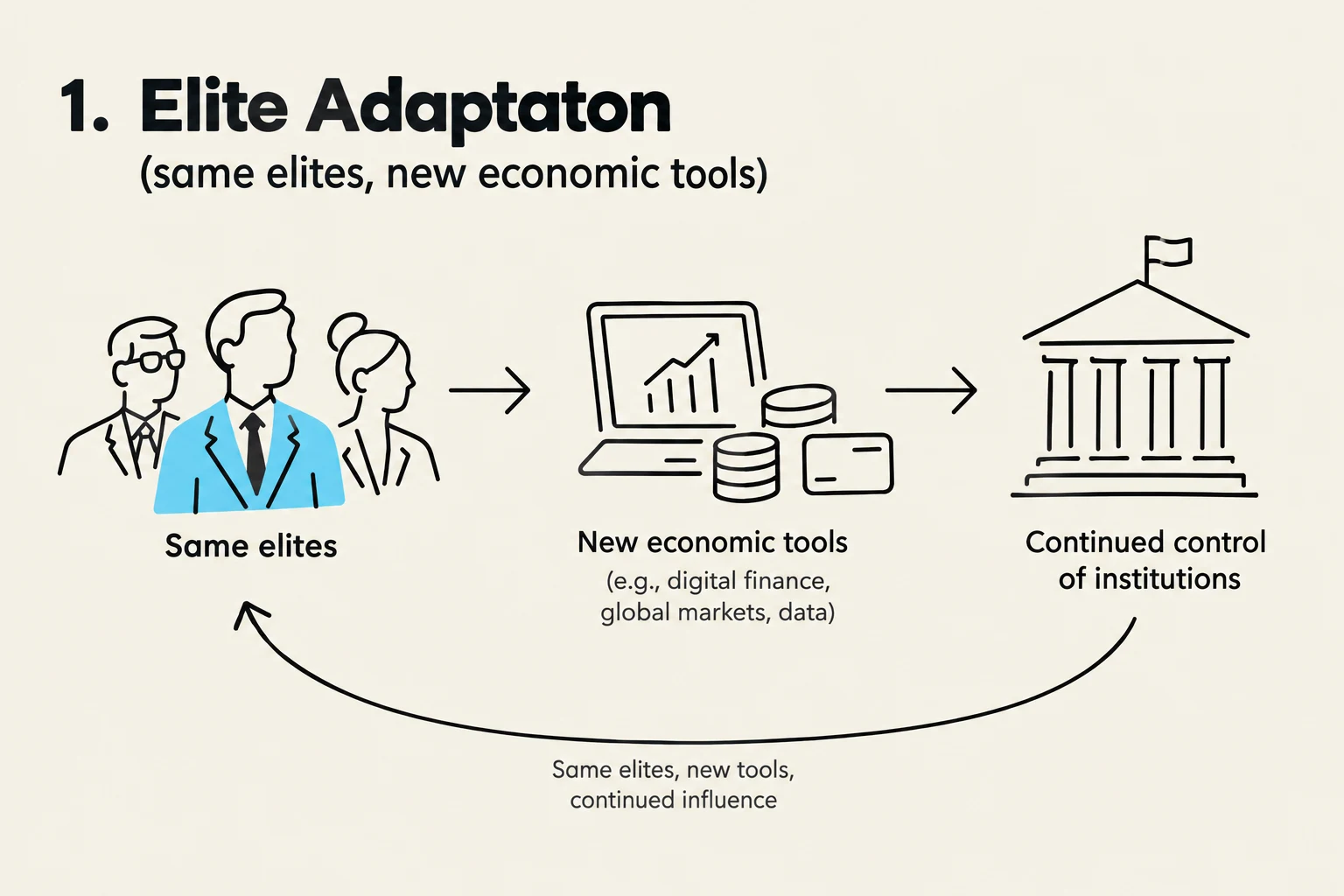
1. Adaptation of Elites
Sometimes, the people in power change, but the underlying logic of extraction remains. The dominant groups simply adapt their methods to new economic opportunities. For example, in Guatemala, dominant groups successfully transitioned their methods of exploitation to coincide with new economic booms, such as the rise of the coffee industry.
2. Continuity of Structure
In other cases, even a total change in the type of government does not dismantle the structures of domination. A classic example is Ethiopia: even after the monarchy was overthrown, the subsequent leader, Mengistu, was able to utilize the existing institutional framework to concentrate power and privileges for himself.
3. Conflict over State Rents
A third form of persistence occurs when different factions fight to control "state rents" (wealth generated by the state). This struggle often results in extreme violence and the destruction of state capacity, which paradoxically makes the state even more susceptible to being captured by whoever is strongest.
This diagram illustrates how elites adapt to new economic tools to maintain control of institutions, leading to continued influence.
The Iron Law of Oligarchy and Negative Feedback
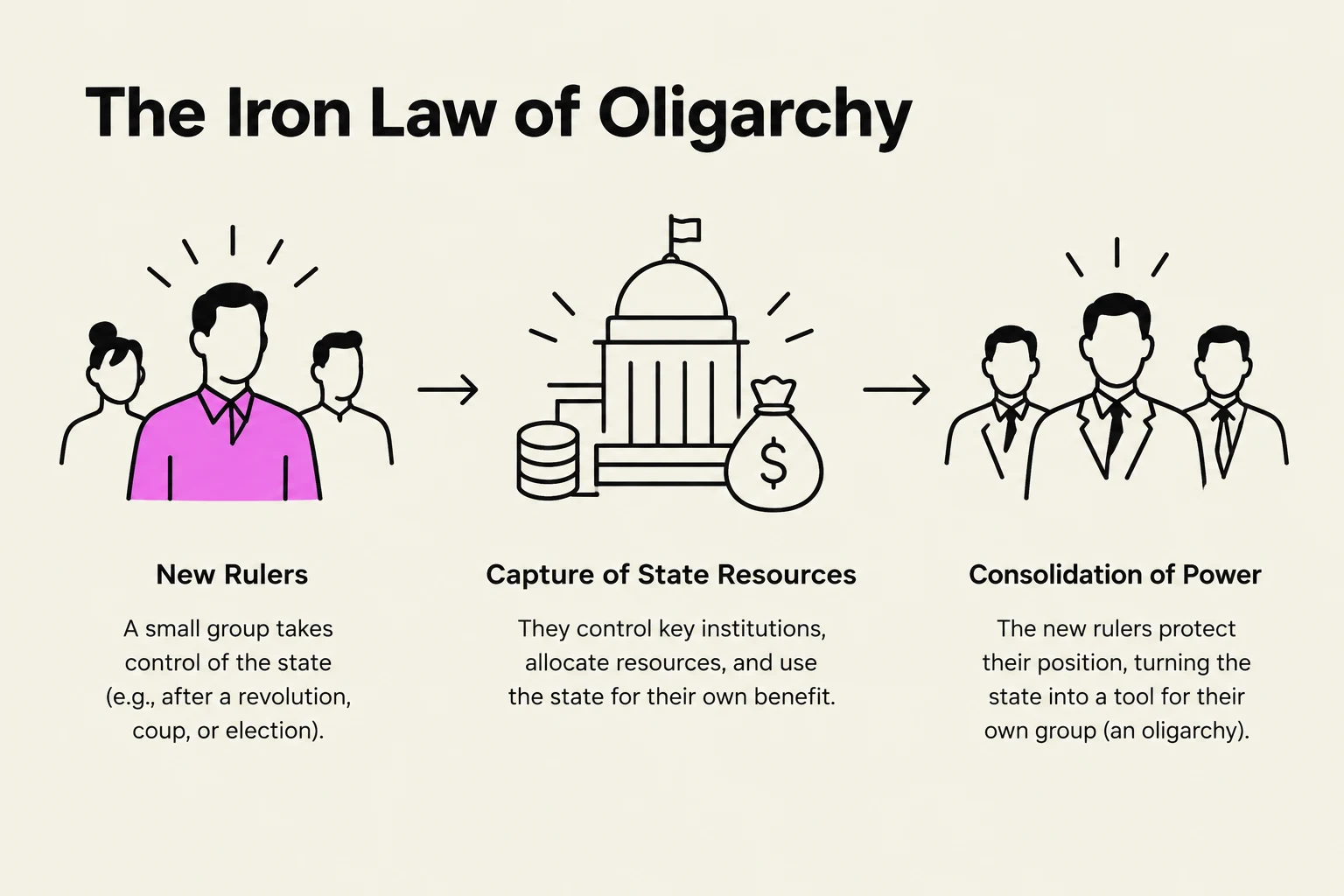
A sociological concept often used to explain this phenomenon is the Iron Law of Oligarchy. This describes the tendency of new political movements or rulers—even those who rise to power promising to dismantle old, corrupt systems—to eventually reproduce the very structures of domination they intended to eliminate.
In political science, the harmful effects that perpetuate this extraction are sometimes referred to as negative feedback. While "negative feedback" in engineering often implies stabilization, in this political context, it refers to the "negative" or harmful outcomes that feed back into the system to reinforce the status quo.
A diagram illustrating the Iron Law of Oligarchy, showing the progression from new rulers to capture of state resources and consolidation of power.
Breaking the Cycle: Checks and Balances
Is the concentration of power inevitable? The literature suggests it is not an "iron law" in the sense of being unchangeable. To prevent a single faction from monopolizing power and entering the vicious circle, societies must implement mechanisms that disrupt the feedback loop.
The primary tools for this disruption are:
Broad Coalitions: Ensuring that political power is shared among diverse interest groups rather than a single narrow elite.
Checks and Balances: Establishing institutional rules that allow different branches of government or independent bodies to limit the power of any one individual or group.
By creating institutional "friction," these mechanisms prevent the seamless flow from concentrated power to concentrated wealth, thereby preventing the vicious circle from closing.
Keep reading for free.
Create an account to finish this reading and make it part of your study routine.