This content explains the economic concepts of externalities and public goods, including negative and positive externalities, the Coase Theorem, public goods, the free-rider problem, and the tragedy of the commons.
In a perfect market, the price of a good reflects its true cost to society. However, real-world markets often fail to account for the impact that production and consumption have on others. When these "hidden" costs or benefits enter the equation, we encounter externalities. Understanding these phenomena is crucial for policymakers attempting to solve environmental crises and manage shared resources like clean air, water, and public infrastructure.
Understanding Externalities
An externality occurs when the production or consumption of a good imposes costs or benefits on a third party who is not part of the market transaction. This creates a "third-party problem" because the market price does not reflect the true social cost or benefit.
There are two primary types of externalities:
Negative Externalities: These occur when an activity imposes a cost on others. Because the producer does not pay for this cost, they tend to produce more than the socially optimal amount. A classic example is pollution.
Positive Externalities: These occur when an activity provides a benefit to others. Because the producer isn't compensated for this extra benefit, they tend to produce less than the socially optimal amount. An example might be education or vaccinations.
Exam Tip: When analyzing externalities, always distinguish between Private Cost/Benefit (what the buyer/seller experiences) and Social Cost/Benefit (the total impact on society). Market failure occurs when these two differ.
This graph illustrates a negative externality in economics, where the market outcome (Qmarket, Pmarket) differs from the socially optimal outcome (Qsocial, Psocial) due to external costs. The deadweight loss from overproduction is also depicted.
Correcting Negative Externalities
To fix a negative externality, we must "internalize" the cost. This can be done through:
Regulations: Government mandates on how much pollution can be emitted.
Taxes: Implementing a tax (like a carbon tax) to shift the supply curve upward toward the social cost.
Private Negotiation: Using the Coase Theorem, which suggests that if property rights are clearly defined and transaction costs are low, private parties can negotiate an efficient outcome regardless of who holds the rights.
The Real-World Cost of Pollution
The consequences of failing to account for negative externalities can be devastating. A landmark case is the hexavalent chromium contamination in Hinkley, California. In this instance, PG&E used hexavalent chromium to prevent rust in cooling towers but improperly disposed of the chemical, allowing it to seep into the local groundwater.
The health impacts were severe, with exposure linked to various cancers, respiratory harm, and reproductive damage. Even decades after the legal settlements, the environmental cost persists; as of 2024, testing found chromium-6 levels 2,500 times higher than the public health goal, turning much of the area into a "ghost town".
The Complexity of Policy Interventions
Sometimes, well-intentioned policies intended to reduce negative externalities can lead to unintended consequences. For example, grocery bag bans aimed at reducing plastic waste can trigger shifts in consumer behavior that offset the benefits:
Increased Trash Bag Sales: Following bag bans, sales of plastic trash bags (such as 13-gallon and 30-gallon bags) have seen significant jumps, sometimes exceeding 100%.
Life-Cycle Discrepancies: While paper or cotton bags are often seen as "greener," they require a massive number of re-uses to match the environmental performance of a single-use LDPE shopping bag. A paper bag may need to be reused 52 times, while a cotton bag might require between 131 and 7,100+ re-uses to achieve the same impact.
Finding the Optimal Quantity of Pollution
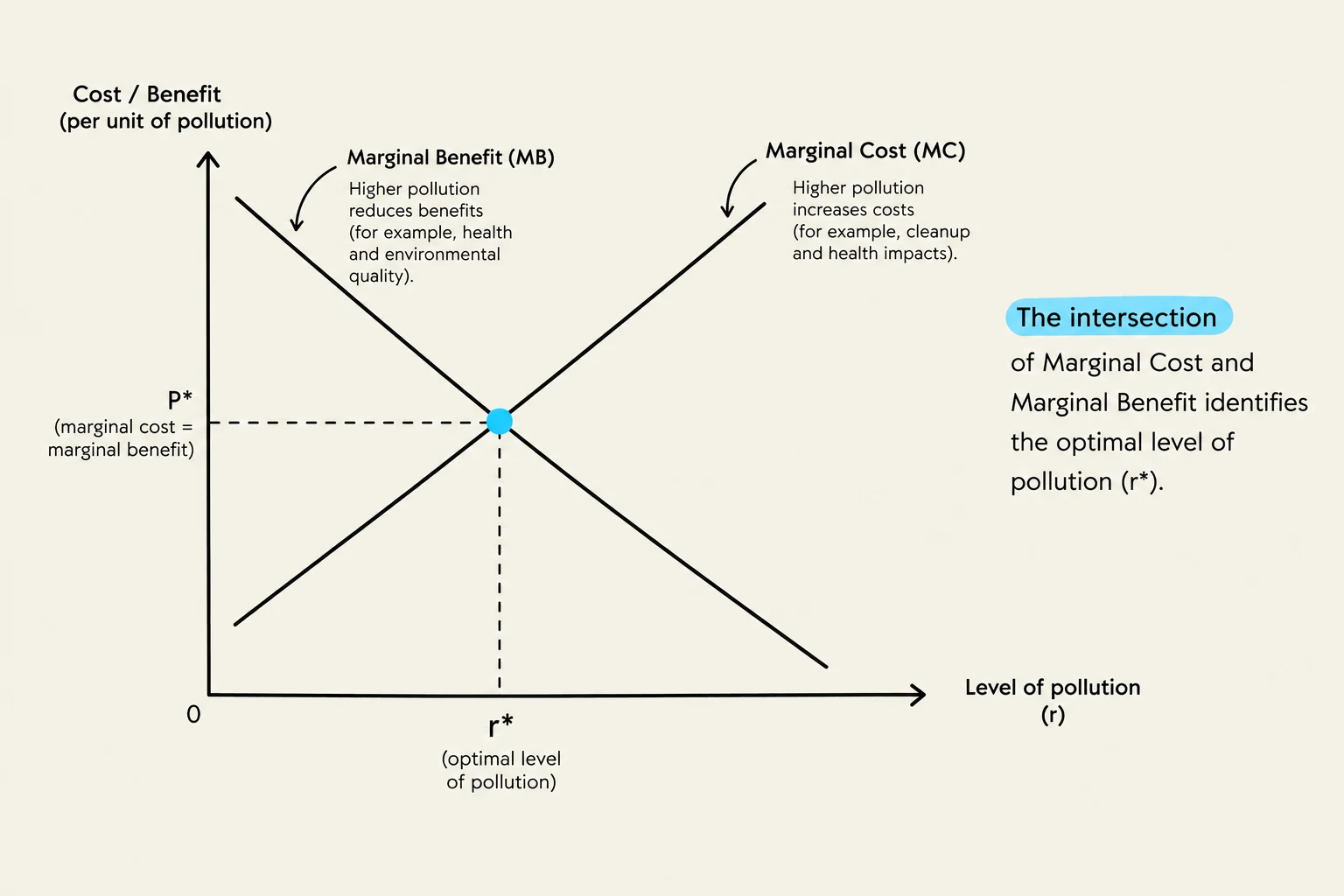
A common misconception is that the goal of environmental policy is to reach "zero pollution." In economics, however, the goal is to find the optimal quantity of pollution.
To find this point, we balance the cost of reducing pollution against the benefits gained from that reduction. The equilibrium is reached when the Marginal Cost (MC) of abatement equals the Marginal Benefit (MB) of abatement:
MC=MB
At this point, society maximizes its welfare. If we reduce pollution beyond this point, the cost of the extra reduction would be greater than the benefit we receive from it.
This graph illustrates the economic concept of the optimal level of pollution, where the marginal cost of pollution equals the marginal benefit.
Public Goods and the Tragedy of the Commons
While externalities involve "spillover" effects, public goods are resources characterized by two specific traits:
Non-rival: One person's consumption does not prevent others from consuming it.
Non-excludable: It is impossible (or very costly) to prevent people who haven't paid for the good from using it.
The Free-Rider Problem
Because public goods are non-excludable, they suffer from the free-rider problem. A free-rider is someone who enjoys the benefits of a good without contributing to its cost. This lack of incentive to pay leads to the under-provision of public goods; the market will provide less of the good than is socially optimal.
The Tragedy of the Commons
When a resource is rival (one person's use reduces availability for others) but non-excludable (anyone can access it), we face the Tragedy of the Commons. This is the tendency for shared resources—like oceans, forests, or even a shared office fridge—to be used excessively until the resource is depleted. Examples include the "Great Pacific Garbage Patch" or the depletion of local water supplies.
To combat this, governments often use tiered pricing (where costs increase as consumption increases) to encourage more efficient use of shared resources like water.
This diagram illustrates the four types of goods: private, club, common resource, and public, categorized based on excludability and rivalrousness.
Keep reading for free.
Create an account to finish this reading and make it part of your study routine.