Exponentials and Logarithms: A Comprehensive Guide
This article explores the relationship between exponential functions and logarithms, covering their definitions, properties, laws, and applications in solving equations.
In mathematics, we often encounter situations where quantities do not change at a constant rate, but rather accelerate or decelerate rapidly. These are described by exponential functions. When we need to work backward from these rapid changes to find an unknown exponent, we turn to logarithms. This article explores the relationship between these two mathematical tools, the laws that govern them, and how to use them to solve complex equations.
Exponential Functions
An exponential function is generally represented in the form y=ax, where a>0. Unlike linear functions that grow by adding a constant value, exponential functions change at an increasing or decreasing rate.
A defining characteristic of all such functions is that they pass through the point (0,1), because any non-zero number raised to the power of 0 is equal to 1. Furthermore, these functions are always positive; the graph will never drop below the x-axis (y=0).
The behavior of the graph depends on the value of the base a:
Growth: If a>1, the function increases as x increases.
Decay: If 0<a<1, the function decreases as x increases.
Interestingly, the graph of y=(21)x is a perfect reflection of the graph y=2x across the y-axis.
This graph illustrates exponential growth and decay functions, showing their behavior and key characteristics like passing through (0,1) and having a horizontal asymptote at y=0.
Logarithms and the Base
Logarithms are the inverse of exponential functions. They are used specifically to solve problems where the unknown value is an exponent. The relationship between the two forms is defined as follows:
x=an⟺logax=n
In this notation, 'a' is known as the base of the logarithm. Essentially, a logarithm asks the question: "To what power must I raise the base a to get the value x?".
Examples of conversion:
32=9 can be written as log39=2.
103=1000 can be written as log101000=3.
Calculator Tip: Most scientific calculators have a "log" button that defaults to base 10. If you type log20, the calculator is finding the power to which 10 must be raised to get 20 (log1020≈1.30).
The Three Laws of Logarithms
To manipulate complex mathematical expressions, we use three fundamental laws. These laws allow us to expand a single logarithm into multiple terms or condense multiple terms into one.
1. The Multiplication Law
The logarithm of a product is the sum of the logarithms of the individual factors:
logaxy=logax+logay
This is derived from the exponent rule ab×ac=ab+c. Since multiplying numbers with the same base results in adding their exponents, the logarithms (which are the exponents) are added.
2. The Division Law
The logarithm of a quotient is the difference between the logarithm of the numerator and the denominator:
loga(yx)=logax−logay
3. The Power Law
The logarithm of a number raised to a power is the power multiplied by the logarithm of the number:
logaxk=klogax
Solving Equations with Logarithms
One of the most powerful applications of logarithms is solving equations where the variable is in the exponent.
Basic Exponential Equations
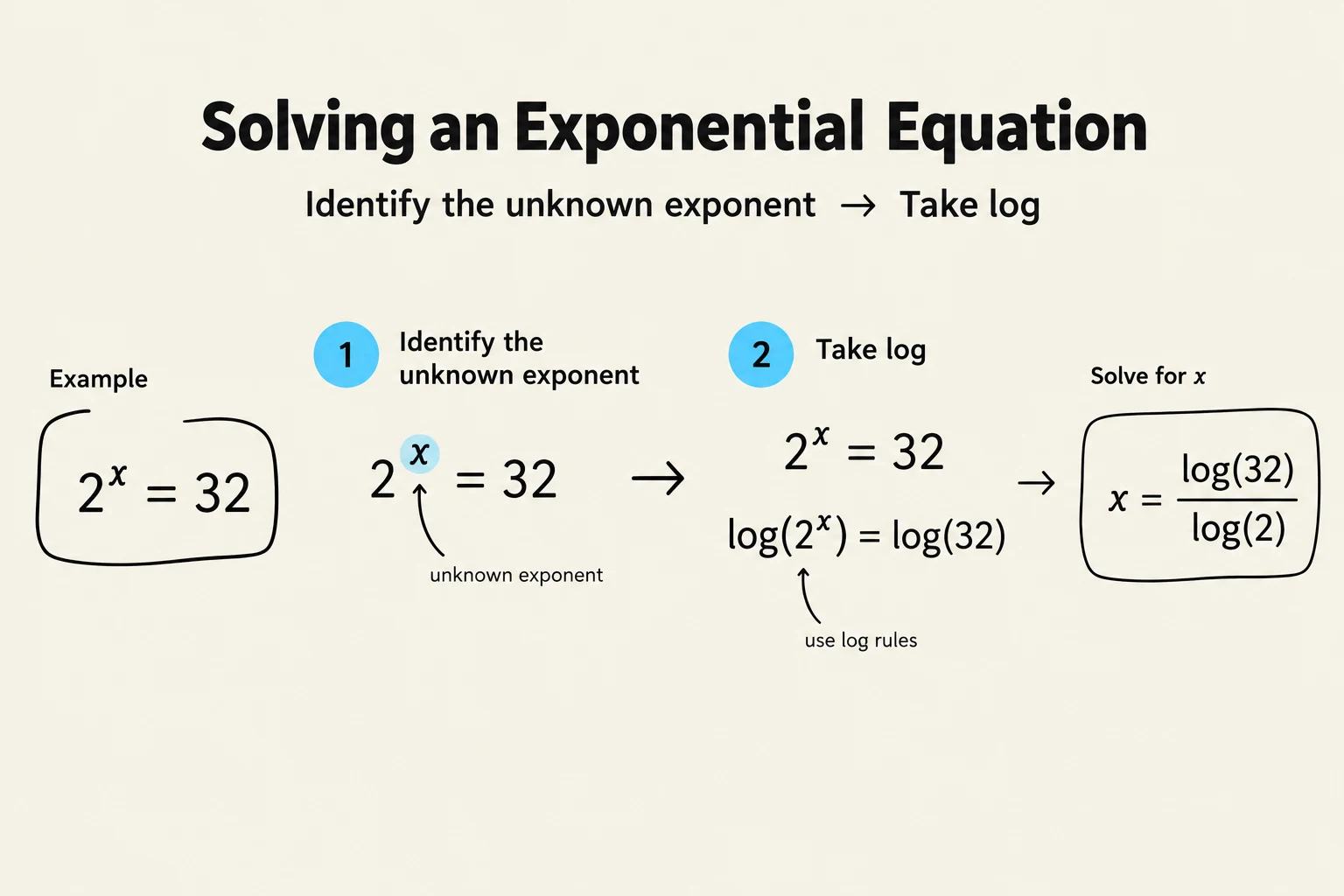
To solve an equation like 3x=20, you can "take logs" of both sides:
Apply log10 to both sides: log10(3x)=log1020
Use the Power Law to bring x down: xlog103=log1020
Isolate x by dividing: x=log103log1020
Calculate: x≈2.73.
Exam Tip: When using a calculator to solve these, always use the full decimal values provided by the calculator rather than rounded numbers to avoid significant rounding errors in your final answer.
Advanced Techniques: Substitution and Changing Base
For more complex equations, such as those that resemble quadratic equations (e.g., 7(5x)2−30(5x)+10=0), you can use substitution. By letting y=5x, the equation becomes a standard quadratic: 7y2−30y+10=0.
If your calculator does not have a specific base button, you can use the Change of Base formula to calculate any logarithm using base 10:
logax=log10alog10x
For example, to find log811, you would calculate log108log1011≈1.15.
This illustration demonstrates the process of solving an exponential equation by taking the logarithm of both sides.
Keep reading for free.
Create an account to finish this reading and make it part of your study routine.