Evolutionary Physiology and Behavioural Adaptations
Explore the fundamental concepts of evolution, including adaptation, natural selection, and descent with modification. This content details structural and behavioral adaptations, the role of homeostasis and hormones in physiological responses, and the distinction between natural and artificial selection.
In the study of biology and animal behavior, understanding why an organism looks, acts, or functions a certain way requires an exploration of evolution. Evolution is not merely a historical concept but a continuous process that shapes the physiological and behavioral traits of every living species. By examining how organisms adjust to their environments through various forms of adaptation, we can better understand the complex relationship between an animal's biology and its survival strategies.
Defining Adaptation and the Mechanisms of Change
At its core, an adaptation is an alteration or adjustment in structure or habits—often hereditary—by which a species or individual improves its condition in relation to its environment. These changes are driven by the fundamental principles of evolution, which include natural selection and descent with modification.
Natural selection serves as the primary mechanism for evolution. It operates at the level of the individual, while evolution (descent with modification) occurs at the level of the population. For natural selection to occur, three specific criteria must be met:
There must be variation within a population.
The traits in question must be heritable (passed from parent to offspring).
There must be limits on population growth, leading to competition for limited resources.
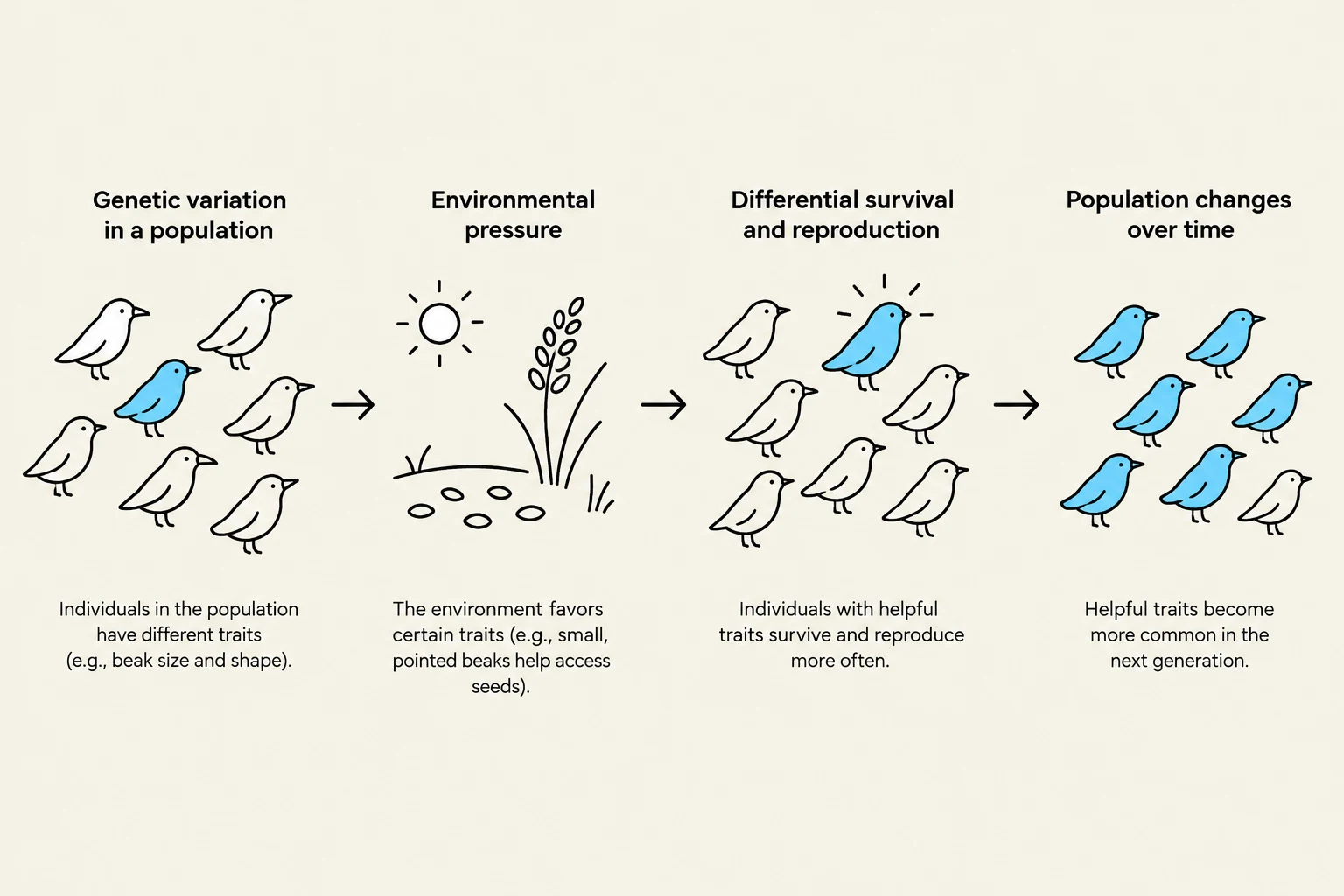
When certain individuals possess heritable traits that provide a survival advantage, they are more likely to reach reproductive age and leave more offspring than their peers. Over many generations, these beneficial traits become more common, and the population becomes increasingly adapted to its environment.
This diagram illustrates the process of natural selection, showing how genetic variation within a population, environmental pressures, and differential survival and reproduction lead to changes in the population over time.
Exam Tip: Remember the distinction between the levels of operation: Natural selection acts on the individual, but evolution (descent with modification) is observed in the population over time.
Structural Adaptations: The Physical Toolkit
Structural adaptations are physical changes to an organism's body that enhance its ability to survive. These often manifest as specialized body parts or physical features that provide defense, camouflage, or thermal regulation.
Common examples of structural adaptations include:
Camouflage: Blending into the environment to avoid detection.
Specialized Body Parts: Physical structures evolved for specific tasks, such as specialized limbs or mouthparts.
Protective Coverings: The use of fur, hair, or feathers to regulate temperature or provide protection.
Predation Defense: Physical structures like shells or spines that deter predators.
Behavioural Adaptations: Survival Through Action
While structural adaptations are about what an animal is, behavioural adaptations are about what an animal does. These are changes in behavior used by organisms to survive in new or changing environments, usually occurring in response to an external stimulus.
Behavioural adaptations can include complex social structures or survival rhythms. For instance, nocturnality—the adaptation of being active at night—may develop in a species if there is a higher probability of survival during the dark hours, perhaps due to lower predator activity or different food availability.
Other notable examples include:
Migration: Moving to different areas to find resources or better climates.
Communal Living: Social structures that provide safety or efficiency in finding food.
Defense Behaviours: Specific actions taken to ward off threats.
Hibernation: A state of inactivity to conserve energy during harsh conditions.
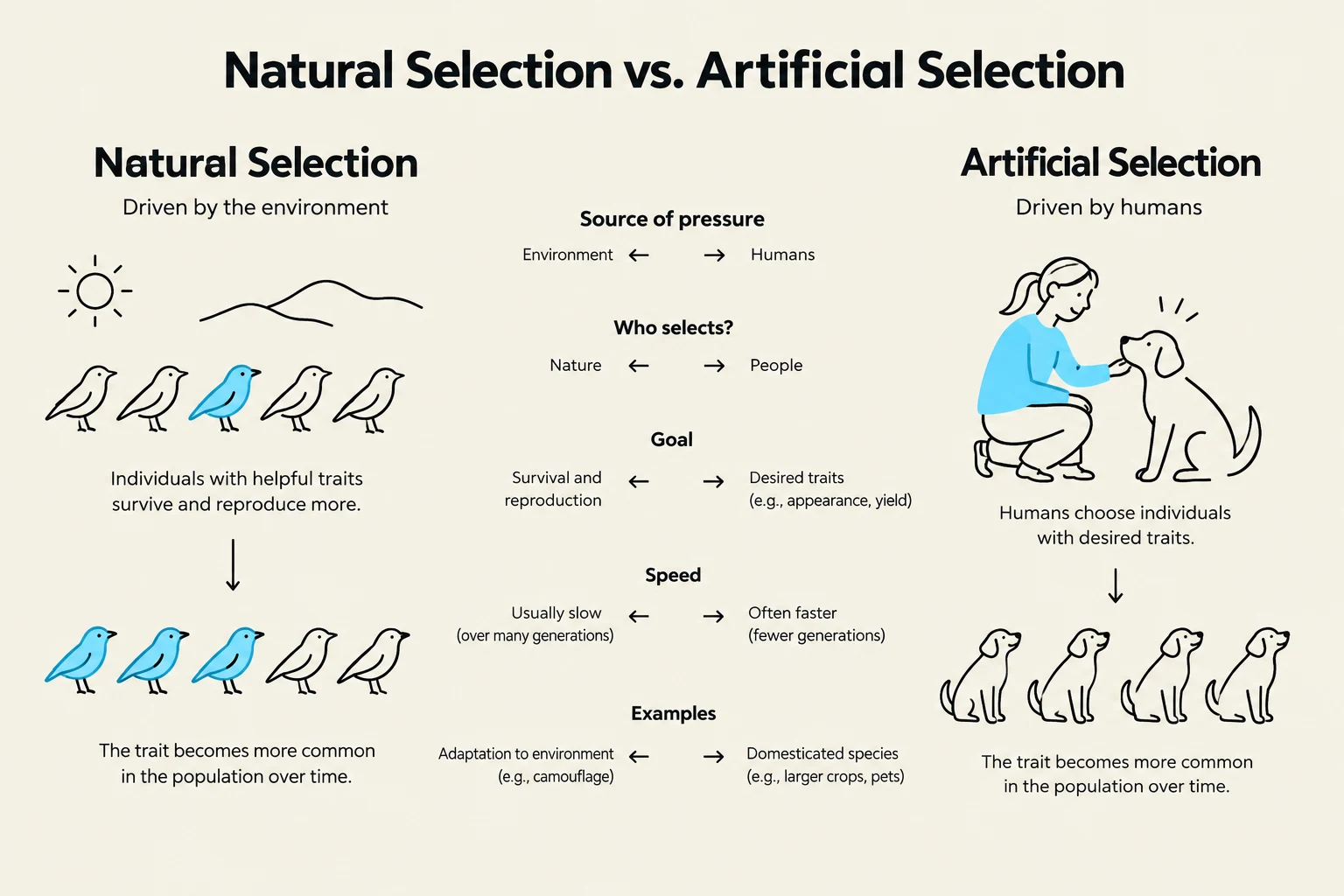
This diagram illustrates the differences between natural selection, driven by the environment, and artificial selection, driven by humans, in terms of their source of pressure, selection process, goals, speed, and examples.
From Natural to Artificial Selection
Humans have harnessed the principles of heredity and variation to perform artificial selection, also known as selective breeding. While natural selection is driven by the environment to ensure survival and reproduction, artificial selection is driven by human preference to produce specific characteristics.
Feature
Natural Selection
Artificial Selection
Who selects?
Environment / Nature
Humans
Goal
Survival and reproduction
Specific traits (e.g., tameness, size)
Example
Camouflage, resistance
Domesticated, tame foxes
For example, in Belyaev's Fox Experiment, humans selected for tameness, resulting in foxes that were domesticated and behaved differently than their wild counterparts.
The Physiological Connection: Homeostasis and Hormones
Adaptation is not just about external traits; it is deeply rooted in an animal's internal physiology. A primary motive for all animals is the maintenance of homeostasis—the attempt to maintain a constant and balanced internal environment (such as temperature, hydration, and energy levels).
When an animal encounters a threat, its physiology shifts into a "fight, flight, or freeze" mode. This is a survival response involving:
Increased heart rate.
Hypervigilance.
The release of adrenal hormones.
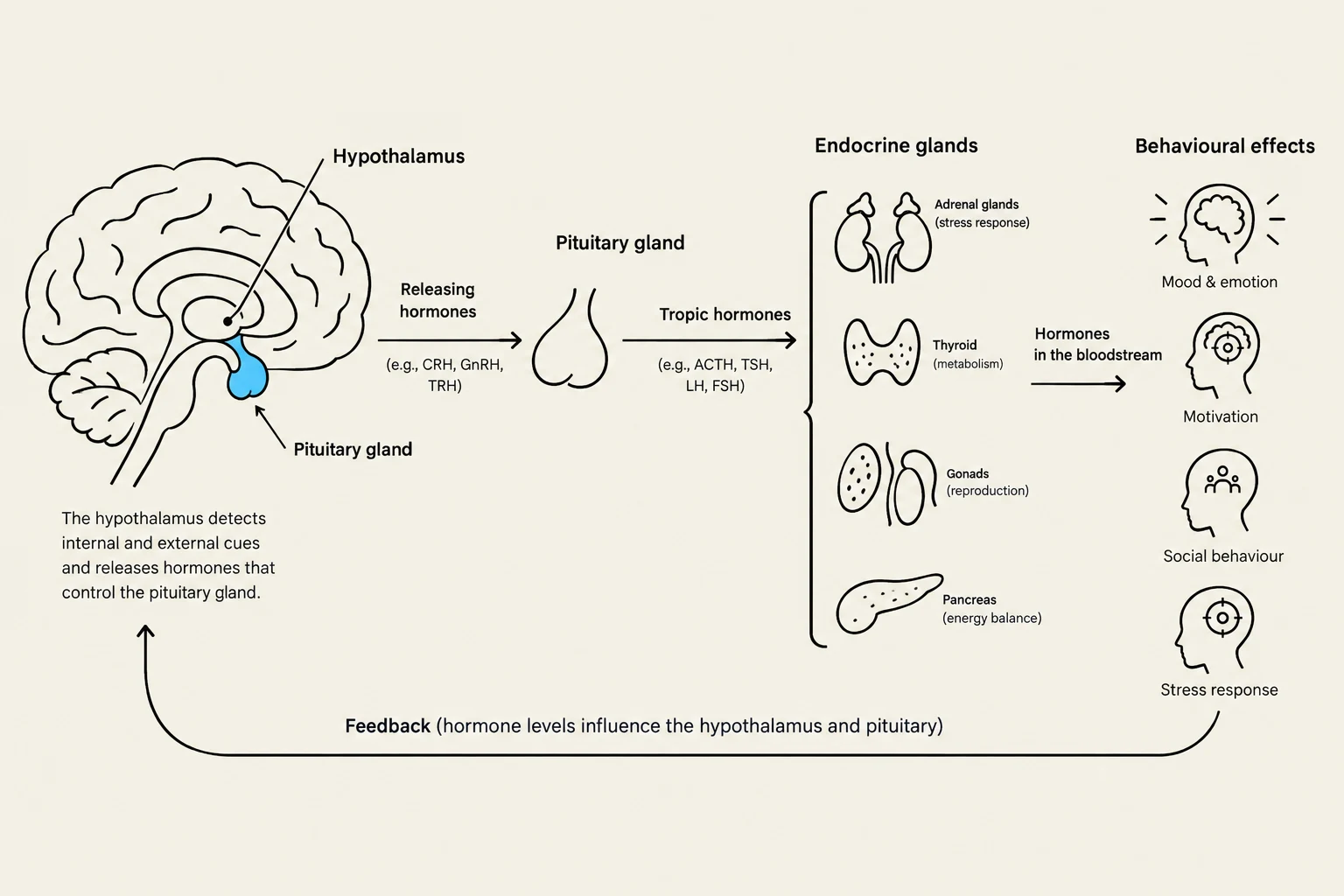
This physiological state is heavily regulated by the endocrine system. Key anatomical components associated with behavior include the hypothalamus, pituitary gland, adrenal gland, and various other glands that produce hormones. Hormones act as chemical messengers that regulate biological processes such as hunger, muscle growth, and stress responses.
This diagram illustrates the endocrine system's regulation of behavior, starting with the hypothalamus and pituitary gland, which control various endocrine glands like the adrenals, thyroid, gonads, and pancreas. Hormones released into the bloodstream influence mood, motivation, social behavior, and stress response.
Understanding these physiological drivers is essential in fields like Applied Animal Behaviour. For instance, if an animal's basic needs (as outlined in Maslow's Hierarchy, such as food, safety, and social belonging) are not met, their ability to engage in normal social behaviors may be compromised by their physiological need to regain homeostasis.
Keep reading for free.
Create an account to finish this reading and make it part of your study routine.