Evolution of Seed Plants and Angiosperm Innovations
Explore the evolutionary journey of seed plants, from their independence from water to the development of pollen, ovules, and seeds. Learn about the key innovations of angiosperms, including flowers, fruits, and double fertilization, and their impact on plant diversity and reproduction.
The evolution of plants is a story of increasing independence from water. While early plants like bryophytes required moist environments for their sperm to swim to an egg, seed plants developed revolutionary strategies to thrive in dry environments. By utilizing specialized structures like pollen and seeds, these plants can reproduce and disperse across vast distances without relying on a film of water for fertilization.
The Evolution of Seed Plants
Seed plants represent a major evolutionary leap characterized by several key advancements: the continued reduction in the size of the gametophyte, the development of heterospory, and the production of pollen, ovules, and seeds.
Heterospory and Reduced Gametophytes
In many primitive plants, a single type of spore produces a gametophyte (homospory). However, seed plants exhibit heterospory, meaning they produce two distinct types of spores: microspores (which develop into male gametophytes) and megaspores (which develop into female gametophytes).
A critical trend in this evolution is the reduction of the gametophyte generation. In seed plants, the gametophytes are tiny and develop from spores that are retained within the parent's sporangia. This allows the sporophyte (the dominant, diploid plant) to provide nutrients and protection to the delicate gametophyte, shielding it from environmental stress.
Pollen and Ovules
To solve the problem of reproduction in dry air, seed plants produce pollen grains. Unlike the sperm of ferns or mosses, pollen grains do not need to swim through water to reach an egg. Instead, the pollen grain acts as the male gametophyte, containing the necessary nuclei to facilitate fertilization.
The female counterpart is the ovule. The ovule is a structure that contains the megasporangium and eventually develops into a seed after fertilization. In gymnosperms, the ovule may also contain an archegonium, but in the more advanced angiosperms, this structure is absent.
Diagram illustrating the male microspore pathway to pollen and the female megaspore pathway to ovule in plants.
Exam Tip: Remember that a seed is NOT a spore. A spore is a single haploid cell (N), whereas a seed is a multicellular, complex structure containing an embryo ($2N$) and a food supply.
Angiosperms: The Flowering Revolution
Angiosperms, or flowering plants, are the most abundant and diverse group of plants on Earth. They have achieved massive success through three primary innovations: flowers, fruits, and double fertilization.
Flower Structure and Pollination
Flowers are specialized structures designed to facilitate the transfer of pollen. Through co-evolution with animals like insects, birds, and mammals, angiosperms use flowers to ensure that pollen is delivered specifically to members of the same species.
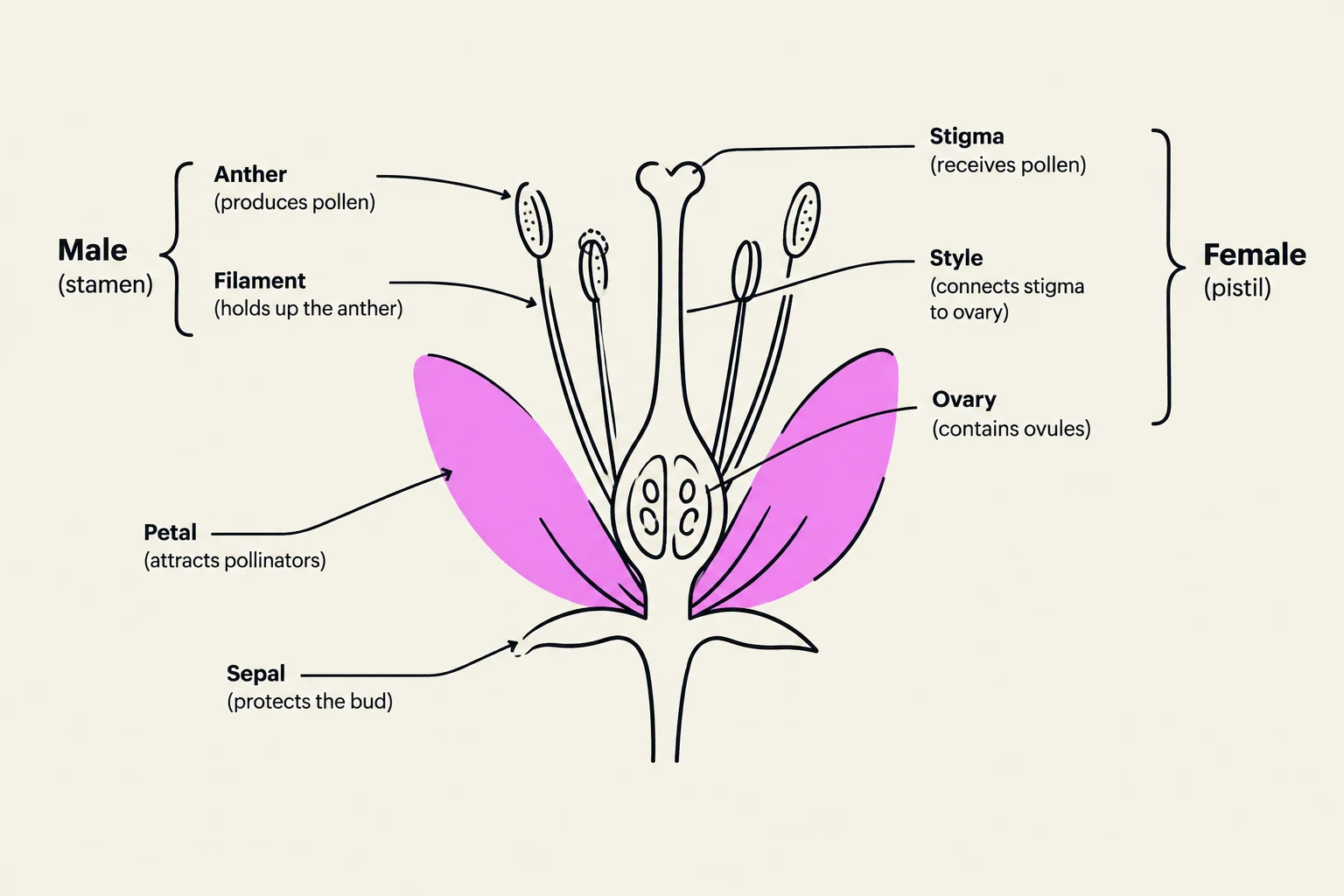
A flower is composed of several distinct parts:
Male Parts (Stamen): Consist of the anther (the structure that produces pollen) and the filament (the stalk that supports the anther).
Female Parts (Carpel/Pistil): Consist of the stigma (a sticky surface to catch pollen), the style (the tube through which the pollen tube grows), and the ovary (the base that holds the ovules).
Supporting Structures:Petals often serve to attract pollinators, while sepals protect the developing flower.
Critical Distinction: Pollination vs. Fertilization
It is easy to confuse these two terms, but they are biologically distinct:
Pollination is the physical transfer of pollen from an anther to a receptive stigma.
Fertilization is the biological union where the sperm and egg cells actually join.
Diagram illustrating the parts of a flower, including the male stamen (anther and filament) and the female pistil (stigma, style, and ovary), along with petals and sepals.
Double Fertilization
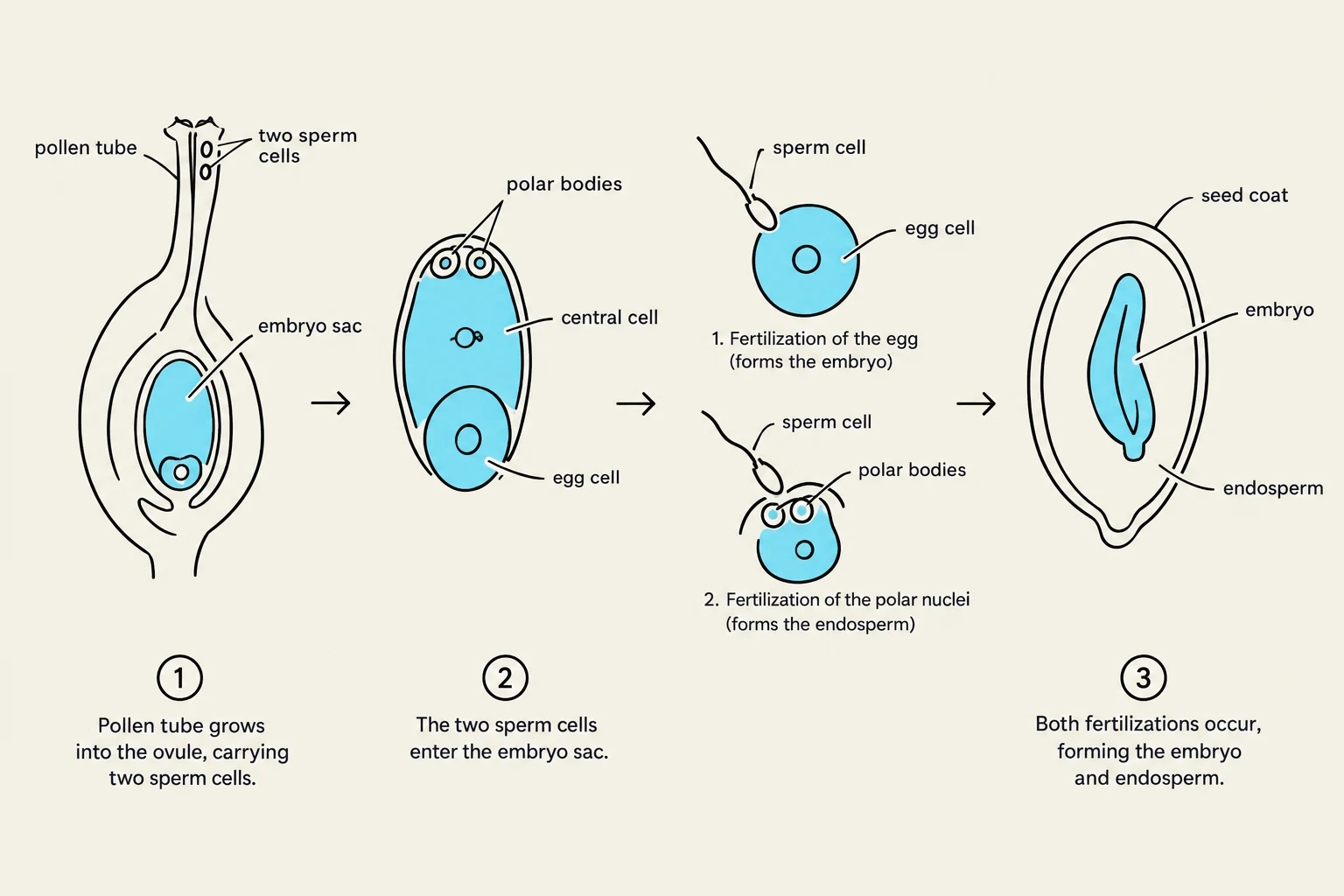
Angiosperms perform a unique process called double fertilization. When a pollen grain lands on the stigma, it grows a pollen tube down through the style to reach the ovule. The pollen grain contains two nuclei that perform two different roles:
The first sperm (N) fuses with the egg (N) to form the zygote ($2N$), which will become the embryo.
The second sperm (N) fuses with two polar bodies (N+N) to create the endosperm ($3N$).
The endosperm is vital because it serves as the nutrient-rich food supply for the developing embryo. In angiosperms, the female gametophyte is specifically called the embryo sac, which typically consists of 7 cells and 8 nuclei.
Fruits and Dispersal
While the ovule becomes the seed, the ovary undergoes a transformation to become the fruit. This is a major advantage for angiosperms, as fruits serve as containers that protect the seeds and facilitate their dispersal.
Fruits increase reproductive success by utilizing various dispersal mechanisms to carry seeds away from the parent plant:
Animal Dispersal: Animals may eat fleshy fruits and deposit seeds elsewhere, or seeds may adhere to animal fur.
Physical Dispersal: Seeds can be moved by wind, water, or even through "explosive" mechanisms.
The color of a fruit often serves as a signal to animals that the fruit is ripe and the seeds are ready for dispersal.
Diagram illustrating the process of double fertilization in flowering plants, showing the pollen tube delivering sperm cells to the ovule, leading to the formation of the embryo and endosperm.
Summary Table: Seed Plant Comparison
Feature
Gymnosperms
Angiosperms
Seed Protection
"Naked" seeds (no ovary)
"Covered" seeds (inside fruit)
Reproductive Structure
Cones
Flowers
Fertilization
Single fertilization
Double fertilization
Food Supply
Female gametophyte tissue
Endosperm ($3N$)
Female Gametophyte
Contains archegonium
Embryo sac (no archegonium)
Keep reading for free.
Create an account to finish this reading and make it part of your study routine.