


In the study of logic, we evaluate arguments based on how well they support their conclusions. A "good" argument is one that provides sufficient reason to accept its conclusion, while a "bad" argument fails to do so. However, not all arguments are judged by the same standards. To evaluate an argument effectively, you must first determine its type: is it intended to provide absolute certainty, or merely probable support?
The Two Forms of Argumentation
Arguments generally fall into two categories: deductive and inductive.
Deductive Arguments
Deductive arguments aim to provide logically conclusive support for their conclusions. They attempt to use rigorous, inescapable logic to prove that if the premises are true, the conclusion must be true. Because of this, deductive arguments are often described as "truth-preserving".
To identify these, look for deduction indicator words such as certainly, definitely, absolutely, conclusively, or phrases like it logically follows that.
Inductive Arguments
Inductive arguments, by contrast, intend to provide probable—but not conclusive—support for their conclusions. Even if all the premises are true, the conclusion is not guaranteed; it is simply likely or plausible.
Look for induction indicator words such as probably, likely, chances are, odds are, or it is plausible that.
Exam Tip: Think of validity like an "on-off" switch (it either works or it doesn't), whereas inductive strength is more like a light dimmer (it can range from very weak to extremely strong).
Evaluating Deductive Arguments: Validity and Soundness
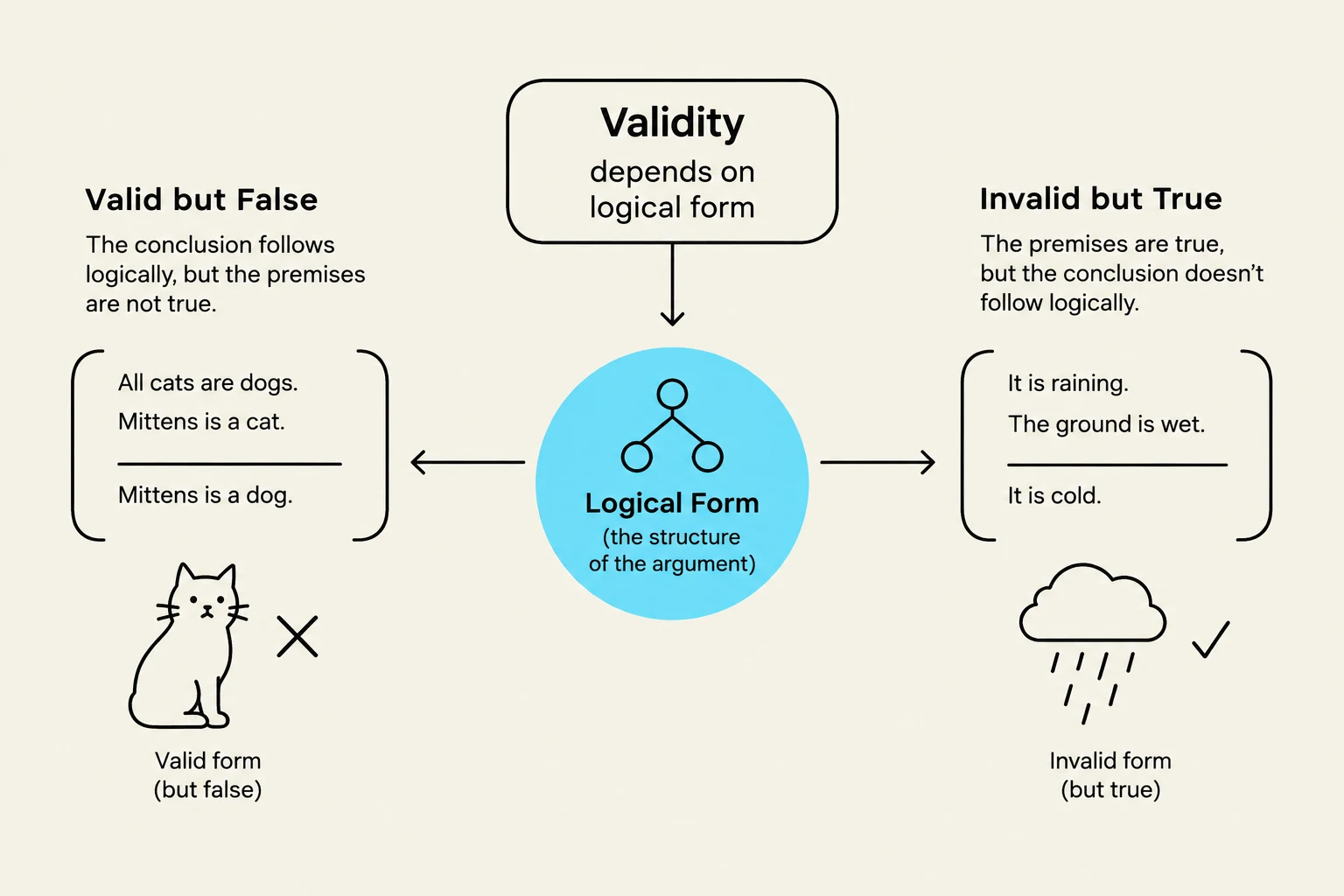
When assessing a deductive argument, you must separate the form (the logical structure) from the content (the actual truth of the statements).
Keep reading for free.
Create an account to finish this reading and make it part of your study routine.
Continue reading freeAlready have an account? Log in
Updated