European Political Evolution: From Feudalism to the Modern State
Examines the historical transition of European political structures from medieval feudalism and the Three Estates to the rise of sovereign nation-states, influenced by the Renaissance, Enlightenment, and revolutions.
The history of Europe is not a linear progression of stability, but rather a turbulent transition from fragmented, localized power structures to the centralized, sovereign nation-states we recognize today. This evolution was driven by a constant tension between traditional hierarchies and revolutionary ideas that sought to redefine the very meaning of authority, citizenship, and the "state".
The Medieval Order: Feudalism and the Three Estates
The Three Estates: A hierarchical pyramid of medieval social structure, illustrating the flow of authority and resources.
In the pre-modern era, Europe was defined by a rigid social hierarchy known as the Three Estates. This structure was designed to maintain order through specialized roles:
The Clergy: Held moral authority and provided the spiritual framework for society.
The Aristocracy: A tiny minority of nobles who held the rights to govern, fight, and protect the monarch.
The Peasantry: Comprising approximately 85% of the population, this class provided the labor that sustained the upper estates.
Within this hierarchy, many commoners were serfs—individuals legally bound to the land in a system of hereditary virtual slavery. However, this order was not static. The Black Death in the 14th century acted as a massive demographic catalyst; by wiping out nearly half of Europe's population, it created a labor shortage that gave surviving peasants unprecedented leverage to demand higher wages, contributing to the gradual decline of serfdom in Western Europe.
As cities grew, a new class emerged: the Burghers. These city residents enjoyed legal freedoms and self-governance through guilds and elected councils, acting as "islands of democracy" that would eventually lay the groundwork for modern constitutional rights.
The Rise of the Sovereign State
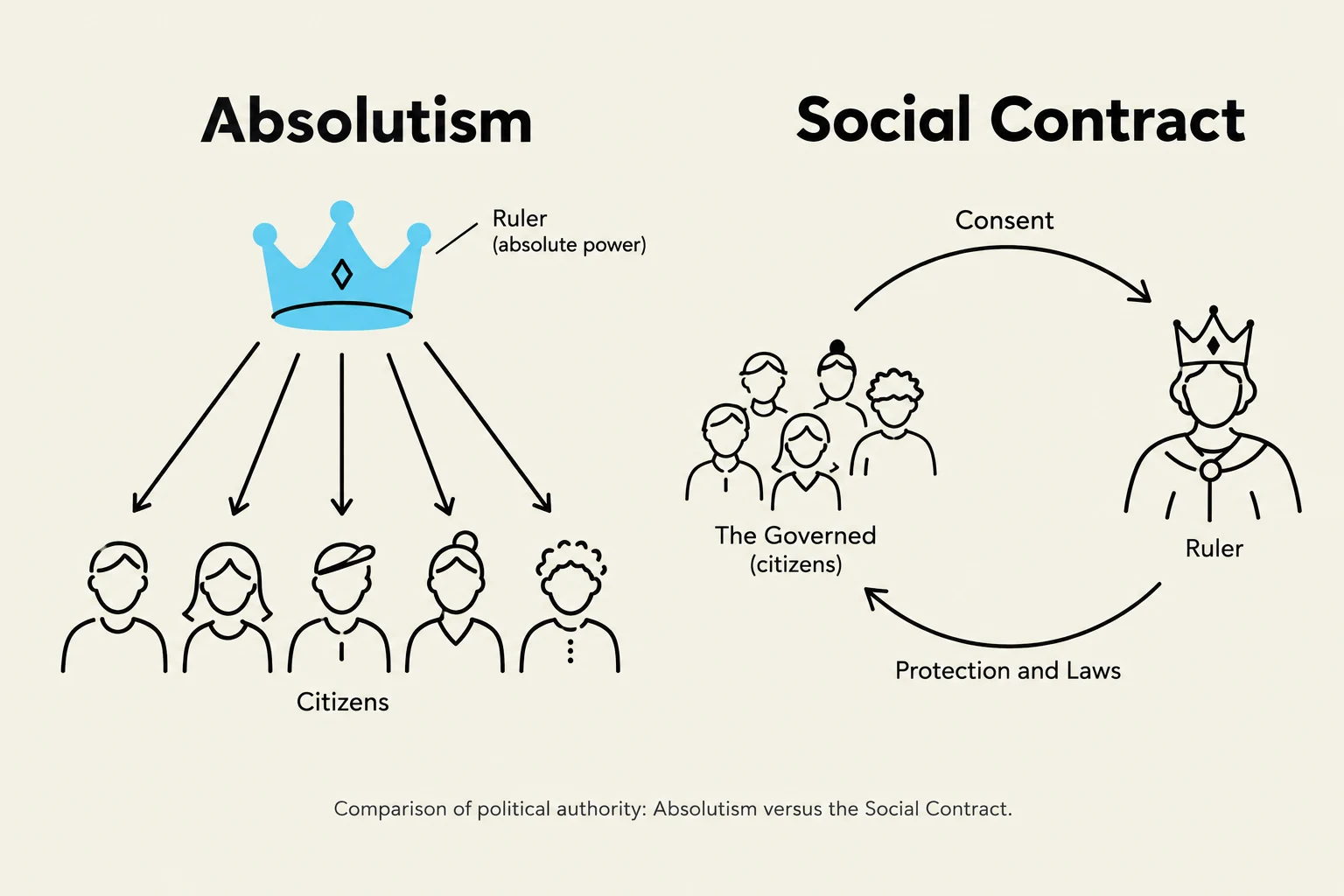
This diagram compares Absolutism, where a ruler holds absolute power over citizens, with the Social Contract theory, where a ruler governs with the consent of the governed in exchange for protection and laws.
The transition from the medieval worldview—where Jerusalem was the perceived center of the world—to the modern era was marked by the Renaissance and the invention of the Printing Press. The press allowed for the rapid spread of Reformation ideas and political propaganda, making it impossible for the Church to maintain its absolute monopoly on knowledge.
The 17th century saw the birth of the modern "state" as a defined territorial entity. This shift was epitomized by Louis XIV of France, who practiced Absolutism. He famously claimed, "L'État, c'est moi" (I am the state), suggesting his physical body embodied the nation. To solidify this, the strategist Vauban helped transform France into a defensible "hexagon" by establishing natural borders and fortified zones.
Exam Tip: Rebellion vs. Revolution
Do not confuse these two terms. A rebellion aims to remove a specific, "bad" ruler (e.g., executing Louis XVI), whereas a revolution seeks to completely transform the underlying political system, shifting the source of authority from "divine right" to "popular sovereignty".
Intellectual Foundations: The Social Contract
As the concept of the state matured, philosophers began debating the "Social Contract"—the theoretical agreement between the rulers and the ruled.
Philosopher
Core Concept
View on Authority
Thomas Hobbes
The Leviathan
Argued for an absolute sovereign to prevent the "chaos" of human nature.
John Locke
Natural Rights
Asserted that legitimacy requires the consent of the governed; if a ruler fails, the people may overthrow them.
Montesquieu
Trias Politica
Advocated for the separation of powers (Legislative, Executive, Judicial) to ensure a Rechtsstaat (law-governed state).
Rousseau
Popular Sovereignty
Promoted the General Will, arguing that sovereignty belongs inherently to the people.
The Revolutionary Era
The late 18th century saw these theories explode into violent reality, most notably during the French Revolution (1789–1799). The revolution moved through three distinct phases:
The Constitutional Phase: The Third Estate sought a constitutional monarchy via the National Assembly.
The Radical Phase (The Terror): Characterized by extreme paranoia, mass executions by guillotine, and the attempt at "radical de-Christianization".
The Consolidation Phase: The rise of Napoleon Bonaparte, who restored stability while spreading revolutionary legal principles across Europe.
A landmark achievement of this era was the Declaration of the Rights of Man and of the Citizen, which fundamentally redefined the individual from a "subject" of a crown to a "citizen" of a state. This spirit of liberation crossed oceans, fueling the Haitian Revolution, which established the world's first Black Republic.
The 20th Century: Totalitarianism and the Cold War
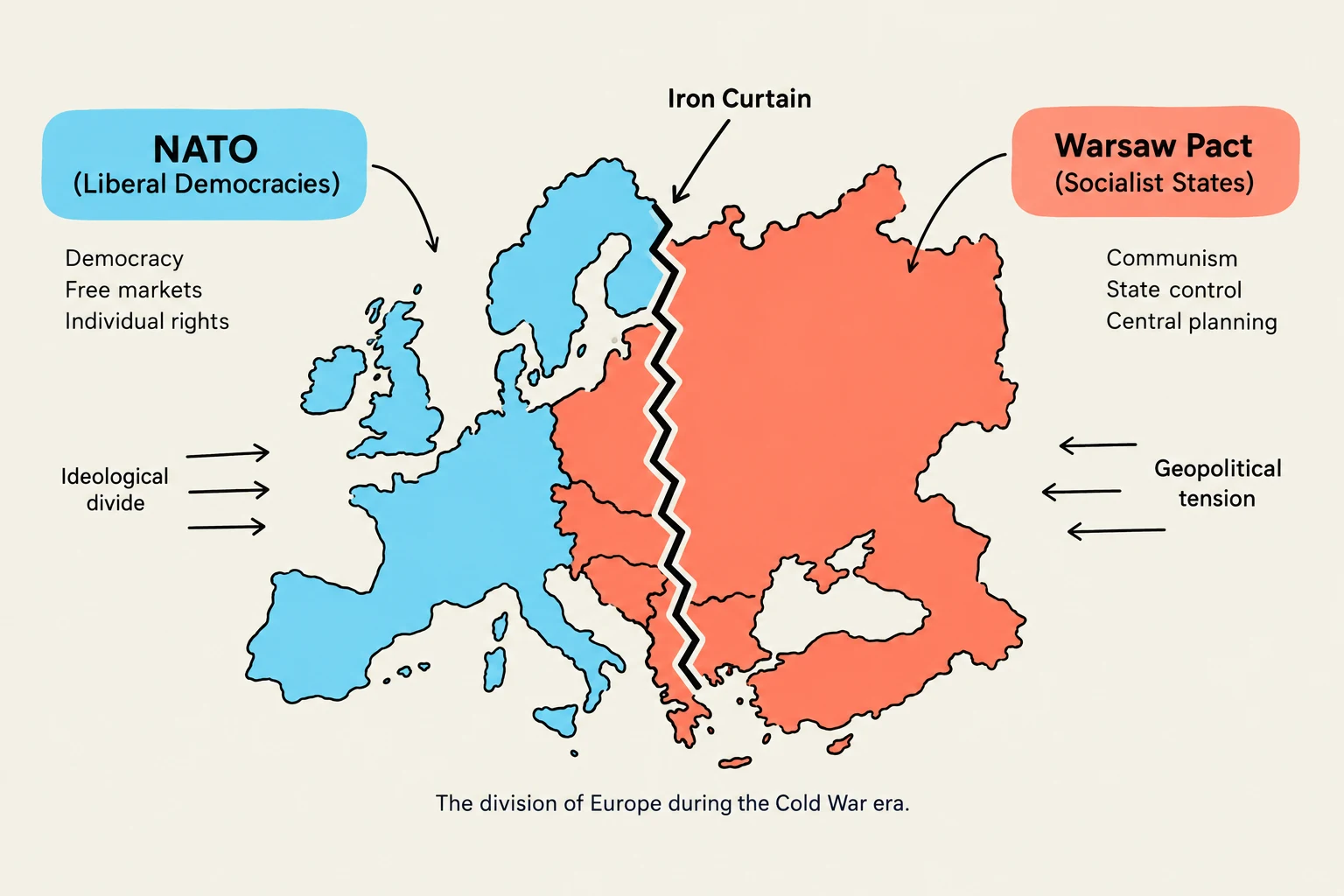
A map illustrating the division of Europe during the Cold War, with NATO (Liberal Democracies) on one side and the Warsaw Pact (Socialist States) on the other, separated by the Iron Curtain and marked by ideological divides and geopolitical tension.
The evolution of the state took a dark turn in the 20th century. The collapse of the great empires (German, Russian, Austro-Hungarian, and Ottoman) following World War I led to a period of intense ideological competition.
The rise of Fascism (pioneered by Mussolini) and Nazism (Hitler) demonstrated how modern states could use total societal mobilization and terror to enforce single-party dictatorships. In the East, Stalinism transformed the Soviet Union into a centralized command economy through forced collectivization and the GULAG system.
Following World War II, Europe was divided by the Cold War between the U.S.-led NATO (liberal democracies) and the Soviet-led Warsaw Pact (socialist states). This division lasted until 1989, when a wave of peaceful revolutions—such as the Solidarity movement in Poland and the fall of the Berlin Wall—eroded communist legitimacy and led to the eventual dissolution of the Soviet Union in 1991.
Through these cycles of collapse and rebirth, European politics moved from the localized, religious, and hierarchical structures of the Middle Ages toward a complex, interconnected system of sovereign states and supranational institutions.
Keep reading for free.
Create an account to finish this reading and make it part of your study routine.