This article explores how the physical arrangement of genes on a chromosome influences inheritance patterns, how recombination is used to map gene locations, and how gene interactions can modify expected phenotypic ratios. It covers allele frequency, meiosis, linked genes vs. independent assortment, recombination frequ
In classical Mendelian genetics, we often assume that genes for different traits are inherited independently. However, because genes are physically located on chromosomes, they do not always follow the rules of independent assortment. This article explores how the physical arrangement of genes on a chromosome influences inheritance patterns, how we can use recombination to map their locations, and how gene interactions can modify expected phenotypic ratios.
Population Genetics: Allele Frequency and Variation
Before diving into the mechanics of linkage, it is essential to understand how we describe alleles within a population.
Allele frequency is defined as the percentage of the total number of gene copies for a specific allele in a given population. In many biological contexts, the most common allele is the "wild-type" (+) allele, while rarer versions are considered mutant alleles.
Geneticists categorize genes based on their level of variation:
Monomorphic genes: Genes that possess only one common wild-type allele within a population.
Polymorphic genes: Genes that possess more than one common allele. The high-frequency alleles found in polymorphic genes are known as common variants.
The Cellular Basis: Meiosis and Crossing Over
The physical movement of genes during inheritance is driven by meiosis. Specifically, the process of crossing over occurs during Prophase I of Meiosis I. This process allows homologous chromosomes to exchange genetic material, creating new combinations of alleles.
Prophase I is divided into several distinct stages:
Lepotene: Chromosomes begin to condense.
Zygotene: Homologous chromosomes pair up to form a bivalent or tetrad (consisting of four chromatids).
Pachytene: The chromosomes become shorter and thicker.
Diplotene: The centromeres begin to move.
Diakinesis: The nuclear membrane breaks down and the spindle forms.
Diagram illustrating the stages of meiosis I: Leptotene, Zygotene, Pachytene, Diplotene, and Diakinesis, showing chromosome pairing, synaptonemal complex formation, crossing over, and chiasmata.
Linked Genes vs. Independent Assortment
Mendel’s Principle of Segregation states that each diploid organism possesses two alleles at a locus that separate during meiosis, with one allele passing into each gamete. When genes are on different chromosomes, they follow the Principle of Independent Assortment, meaning the inheritance of one trait does not affect the inheritance of another.
However, linked genes are located close together on the same chromosome and belong to the same linkage group. Because they are physically tethered, they tend to be inherited together, violating the rule of independent assortment.
Recombination and Progeny Types
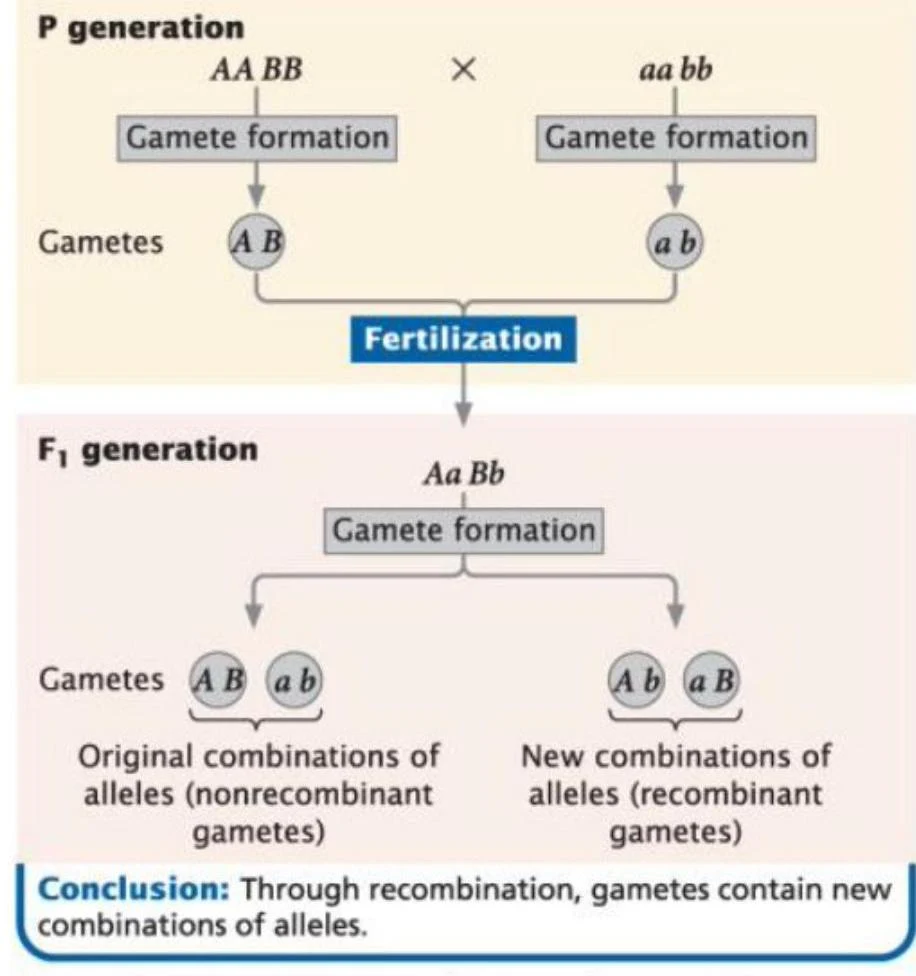
While linked genes tend to stay together, crossing over can occasionally cause them to switch to the other homologous chromosome, a process known as genetic recombination. This results in two types of offspring:
Nonrecombinant progeny: Offspring that possess the same combination of traits as the parents (also called parental progeny).
Recombinant progeny: Offspring that possess new combinations of traits not seen in the parents.
This diagram illustrates Mendelian genetics, showing the process of gamete formation and fertilization across two generations (P and F1) to demonstrate the concept of allele recombination.
Allelic Configurations: Coupling and Repulsion
When analyzing linked genes, the specific arrangement of alleles on the homologous chromosomes is critical.
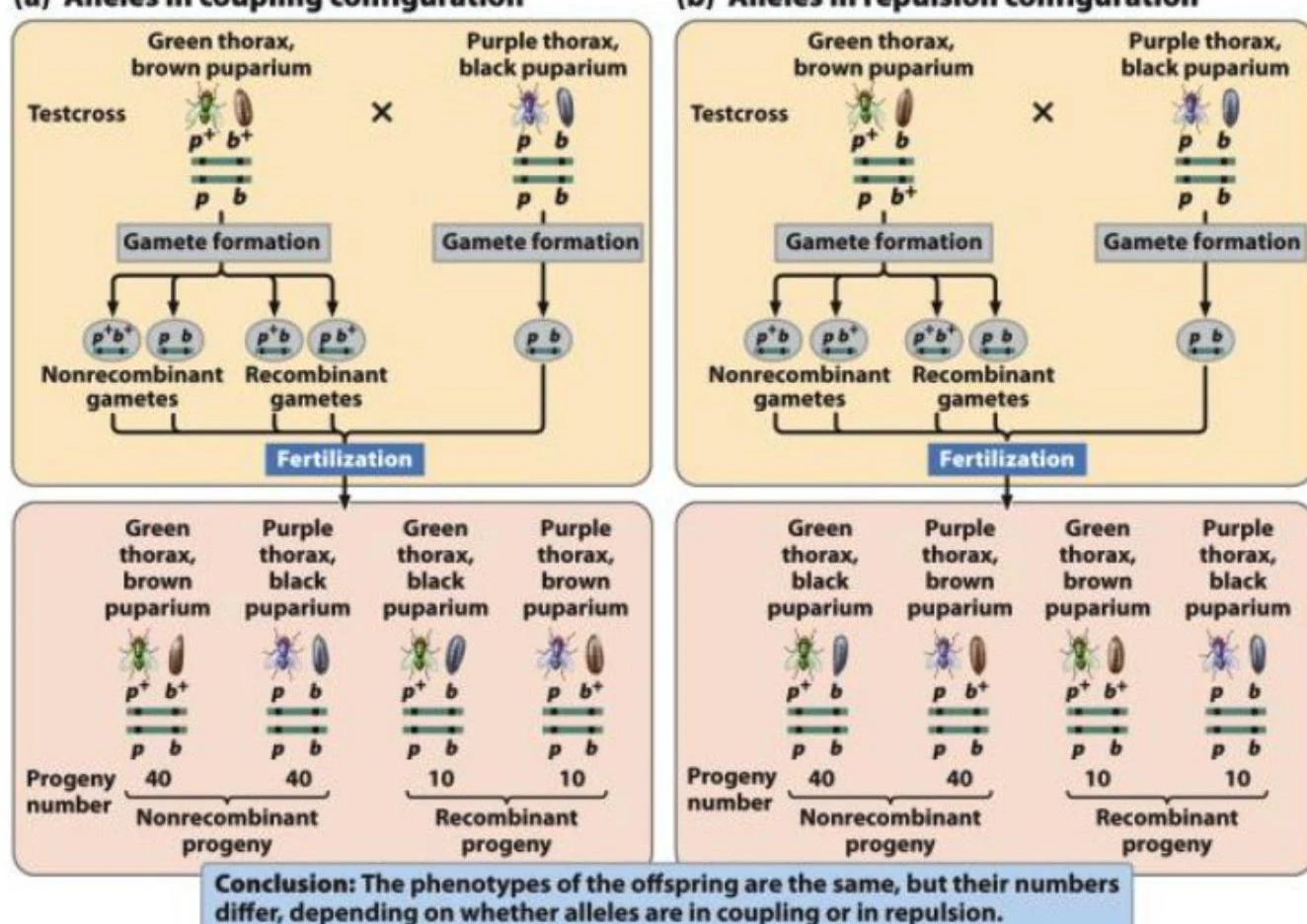
Coupling (Cis) configuration: The wild-type alleles are on one chromosome, and the mutant alleles are on the other ($AB / ab$).
Repulsion (Trans) configuration: Each chromosome carries one wild-type and one mutant allele ($Ab / aB$).
This diagram illustrates genetic linkage and recombination in fruit flies, showing how the arrangement of alleles (in coupling or repulsion) affects the proportions of offspring phenotypes in a testcross.
Calculating Recombination Frequency
We can use the frequency of recombinant offspring to estimate the physical distance between genes on a chromosome. The recombination frequency is calculated using the following formula:
recombination frequency=total number of progenynumber of recombinant progeny×100%
Worked Example:
In a testcross of tomato plants, a researcher observes 123 total progeny. Of these, 55 are one parental type, 53 are the other parental type, 8 are recombinant type A, and 7 are recombinant type B.
Testing for Linkage: The Chi-Square Test of Independence
To determine if the deviation from a 9:3:3:1 ratio (expected in independent assortment) is due to linkage or mere chance, scientists use the Chi-square (χ2) Test of Independence. Unlike a goodness-of-fit test, this method uses a contingency table to test whether the segregation of alleles at one locus is independent of the segregation at another.
The formula for χ2 is:
χ2=∑expected(observed−expected)2
If the calculated χ2 value is higher than the critical value for a given degree of freedom (calculated as df=(rows−1)×(cols−1)), we reject the hypothesis of independent assortment, concluding that the genes are linked.
Modified Dihybrid Ratios: Gene Interactions
Sometimes, a dihybrid cross (AaBb×AaBb) does not result in the standard 9:3:3:1 ratio because the genes interact with one another, a phenomenon known as epistasis.
Ratio
Genotype Pattern
Type of Interaction
9:3:3:1
$A_B_ : A_bb : aaB_ : aabb$
None (Independent Assortment)
9:3:4
$A_B_ : A_bb : aa__$
Recessive epistasis
12:3:1
$A__ : aaB_ : aabb$
Dominant epistasis
9:7
$A_B_ : aa__$
Duplicate recessive epistasis
9:6:1
$A_B_ : A_bb/aaB_ : aabb$
Duplicate interaction
15:1
$A__ : aabb$
Duplicate dominant epistasis
Exam Tip: If you see a ratio like 9:7, look for "duplicate recessive epistasis," where having even one homozygous recessive pair at either locus results in the same phenotype.
Keep reading for free.
Create an account to finish this reading and make it part of your study routine.