This content explains the structure and function of eukaryotic cells, differentiating them from prokaryotic cells and detailing key organelles like the nucleus, mitochondria, and chloroplasts. It also covers plant cell specializations such as the cell wall and plasmodesmata, and briefly compares them to animal cells.
When studying biology, one of the first major distinctions to make is between prokaryotic and eukaryotic organisms. While prokaryotes (such as bacteria and cyanobacteria) are simpler, single-celled organisms lacking a membrane-bound nucleus, eukaryotic cells represent a much higher level of structural complexity. These cells are characterized by the presence of specialized, membrane-bound organelles that allow different chemical processes to occur simultaneously in isolated compartments.
In a eukaryotic cell, all the material and organelles contained within the plasma membrane are collectively referred to as the protoplast. This protoplast houses the machinery necessary for life, from energy production to genetic storage.
The Control Center: The Nucleus
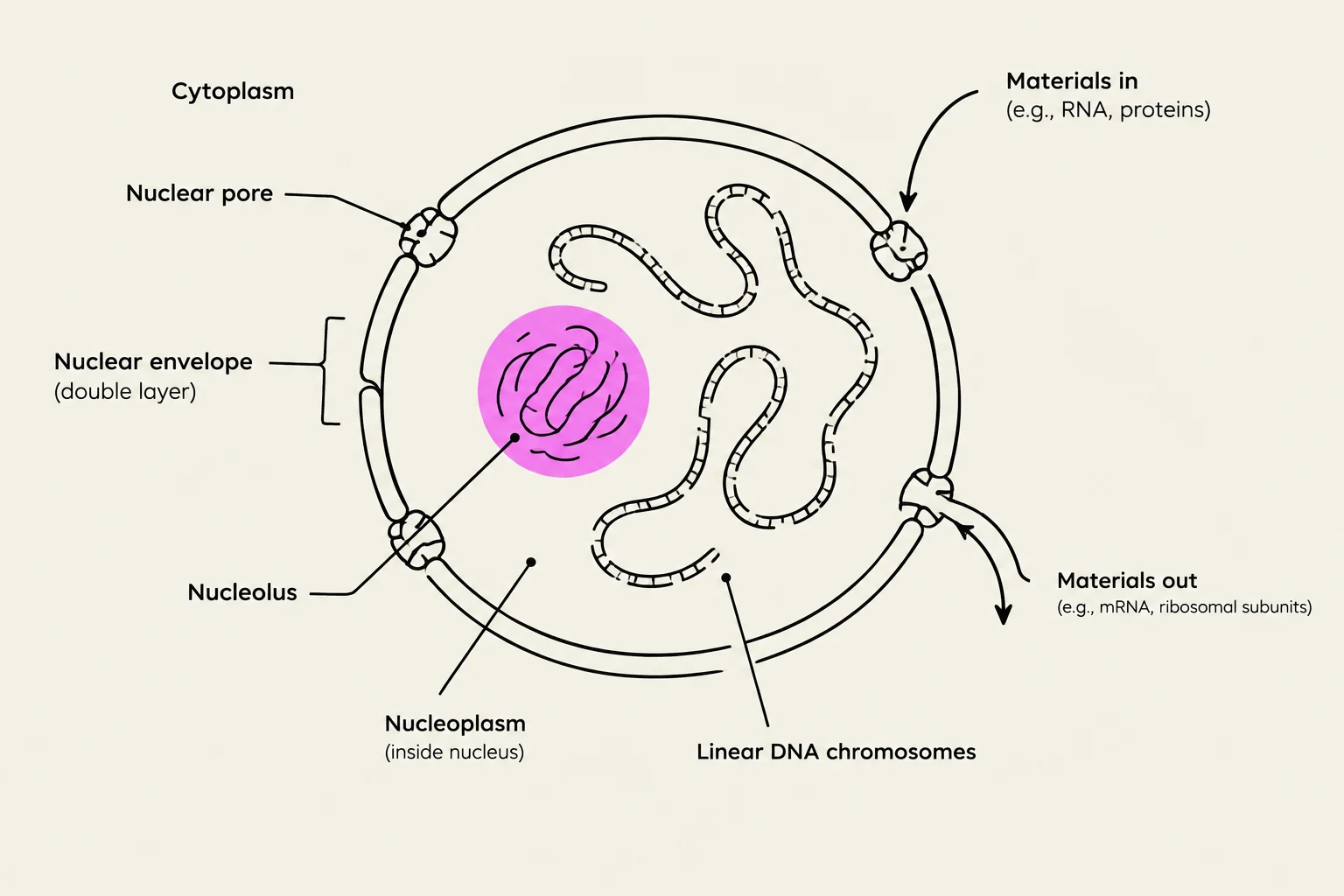
Diagram of a cell nucleus showing its components like the nuclear envelope, nuclear pores, nucleolus, nucleoplasm, and linear DNA chromosomes, along with the transport of materials in and out.
The most prominent organelle in a eukaryotic cell is the nucleus, which acts as the cell's control center. It is responsible for directing metabolism and managing the cell's activities by housing the genetic material.
Unlike the circular DNA found in prokaryotes, the DNA in eukaryotic cells is organized into linear chromosomes. To protect this precious genetic information, the nucleus is enclosed by a double membrane known as the nuclear envelope. This envelope is not a solid barrier; it is perforated by nuclear pores that extend through both membrane layers, allowing for the controlled transport of materials in and out of the nucleus. Within the fluid-filled interior of the nucleus, one may also observe a dense spot known as the nucleolus.
Energy Production and Storage
Comparison of mitochondrial cristae and chloroplast thylakoid stacks.
Eukaryotic cells rely on specific organelles to convert nutrients into usable energy and to store food for later use.
Mitochondria: The Powerhouse
Mitochondria are the primary sites of aerobic respiration. These organelles are surrounded by two membranes. A key structural feature is the inner membrane, which folds inward to form structures called cristae. These folds increase the surface area available to house respiratory enzymes and other large respiratory molecules essential for energy production. Interestingly, mitochondria are semi-autonomous, meaning they contain their own DNA.
Plastids: Food Production and Storage
Plastids are a group of organelles used for the production and storage of food, specifically sugars and starch.
Chloroplasts: Found in plant cells, these are green, elliptical organelles where photosynthesis occurs. The inner membrane of a chloroplast is fused to form stacks of closed vesicles called thylakoids. These thylakoids are typically organized into columns known as grana. Like mitochondria, chloroplasts are double-membraned and contain their own DNA.
Amyloplasts: These are specialized plastids used specifically for the storage of starch. When viewed under a microscope and stained with iodine, amyloplasts will stain darkly, making them easy to identify.
Exam Tip: If you are asked to identify an organelle in a plant cell slide, look for the large central vacuole or the green chloroplasts. If the organelle contains DNA and is involved in energy, it is likely either a mitochondrion or a chloroplast.
Plant Cell Specializations
While animal cells and plant cells share many eukaryotic features, plant cells possess unique structures that provide support and facilitate communication between cells.
The Cell Wall and Plasmodesmata
Plant cells are encased in a rigid cell wall made primarily of cellulose, a complex carbohydrate composed of glucose molecules attached end-to-end. The cell wall structure includes an outer primary cell wall (deposited during growth) and a middle lamella, which is the substance that holds the walls of two adjacent cells together.
Because the cell wall is a rigid barrier, plants have evolved plasmodesmata—small channels that penetrate the cell walls to connect the cytoplasm of neighboring cells. These channels act as "living bridges," allowing for direct transport and communication between cells.
The Central Vacuole
In mature plant cells, a large vacuole often dominates the internal space, sometimes occupying approximately 90% of the total cell volume. This organelle is bounded by a vacuolar membrane and serves several critical functions, including the storage of water, ions, enzymes, organic and inorganic molecules, and waste products. Because of its size, the vacuole often pushes other organelles, such as chloroplasts, against the margins of the cell.
Comparative Anatomy: Animal Cells
To understand eukaryotic complexity, it is helpful to look at human tissues. For example, the trachea is lined with a specialized tissue known as ciliated pseudostratified columnar epithelium. Within this tissue, you can observe individual columnar epithelial cells. Unlike plant cells, these animal cells lack a cell wall and chloroplasts, focusing instead on specialized functions like secretion or movement via cilia.
Feature
Prokaryotic Cell
Eukaryotic Cell
Nucleus
Absent (Nucleoid region)
Present (Membrane-bound)
DNA Structure
Circular
Linear
Organelles
No membrane-bound organelles
Many membrane-bound organelles
Examples
Bacteria, Cyanobacteria
Plants, Animals, Fungi, Protists
Keep reading for free.
Create an account to finish this reading and make it part of your study routine.