Ethics and Cultural Competence in Social Work Research
This article explores the ethical protection of human subjects and the application of cultural competence in social work research, covering principles like respect for persons, beneficence, justice, informed consent, privacy, confidentiality, and the role of IRBs.
In the field of social work, research is not merely a pursuit of data; it is a professional endeavor that carries significant moral weight. Because social workers often engage with individuals in sensitive or precarious life situations, the methods used to gather information must be governed by strict ethical standards. This article explores the dual pillars of responsible research: the ethical protection of human subjects and the application of cultural competence to ensure research is both accurate and respectful.
Ethics in the Use of Human Subjects
Research involving human subjects is defined by the interaction with living persons, such as conducting surveys about specific variables or collecting identifiable private information. It is important to note that if data are collected in a way that is entirely non-identifiable (meaning no names or identifying markers are attached), the study may not qualify as human research.
To navigate these complexities, social workers rely on a professional Code of Ethics. This code serves as a fundamental guide, ensuring that research participants are protected from any harm that might arise from the research experience. Beyond preventing harm, the code emphasizes honesty—researchers must avoid being deceitful with clients or participants and must ensure the accurate reporting of all findings to avoid conflicts of interest.
Exam Tip: When evaluating a research scenario, always check if the researcher is adhering to the Code of Ethics by looking for honesty in reporting and the protection of participants from harm.
The Three Pillars of Ethical Protection
To operationalize the Code of Ethics, social workers implement three major ethical principles designed to safeguard participants:
Respect for Persons: This principle centers on autonomy and self-determination. It recognizes that individuals have the right to make their own decisions about whether to participate in a study.
Beneficence: This requires researchers to maximize potential benefits while minimizing any possible harm.
Justice: This principle ensures that the burdens and benefits of research are distributed fairly. Researchers must design studies so they do not unfairly target specific groups for risky procedures.
The three pillars of ethical research are Respect for Persons, Beneficence, and Justice, which together contribute to ethical and trustworthy research.
Informed Consent, Privacy, and Confidentiality
A practical application of "Respect for Persons" is the process of informed consent. For consent to be valid, participants must:
Give explicit consent.
Be clearly informed of all potential risks.
Be given the opportunity to refuse participation.
Retain the right to withdraw from the study at any time.
Closely linked to consent are the concepts of privacy and confidentiality. Privacy refers to an individual's ability to control access to information about themselves, distinguishing between their public and private behaviors. While privacy is about the person, confidentiality is about how the researcher handles the data. One of the greatest challenges for a researcher is assuring confidentiality while obtaining necessary information.
Managing Risks and Benefits
Every research project involves a calculation of risks and benefits. Risks in social work research often manifest as threats to a participant's privacy or potential psychological/social harm. When risks are present, the researcher must justify them by demonstrating that the potential benefits outweigh the risks, or by seeking alternative, less risky procedures.
Protecting Vulnerable Populations
One of the most critical challenges in social work research is the protection of vulnerable populations. These include groups such as children, prisoners, minorities, and cognitively impaired individuals.
Vulnerable populations are at higher risk because they may feel they cannot deny participation due to their circumstances (e.g., their residence in a prison or their dependence on a service provider). Therefore, a fundamental ethical rule is that research on these populations should only be conducted if it directly benefits that specific population.
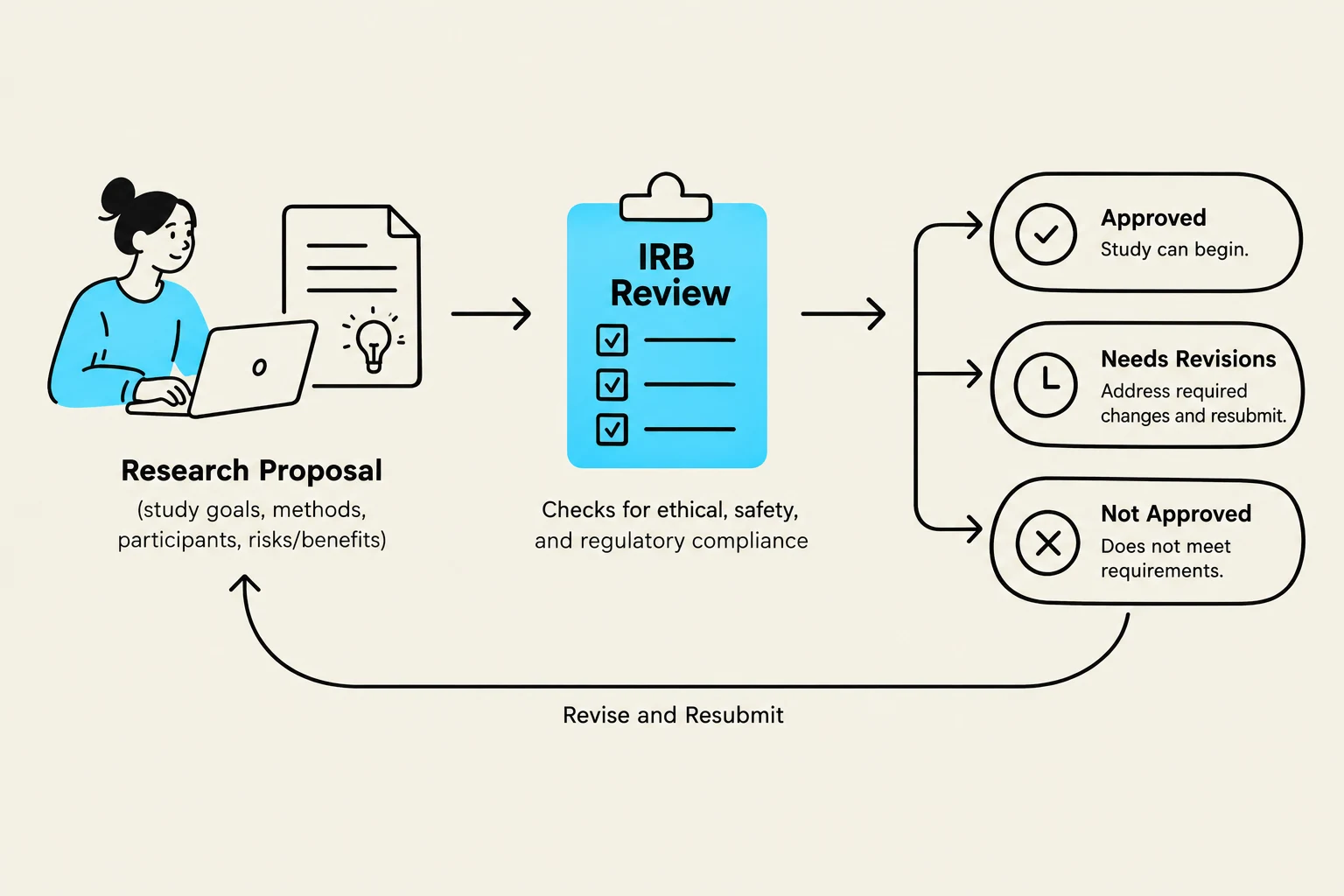
This flowchart illustrates the process of Institutional Review Board (IRB) review for research proposals, outlining the steps from submission to approval, revision, or rejection.
The Role of the Institutional Review Board (IRB)
To prevent the historical violations of human rights that have occurred in past research, Institutional Review Boards (IRBs) were established. The IRB reviews research proposals to ensure ethical standards are met, particularly for research intended for public release. Researchers are advised that collecting data anonymously is often the best way to navigate the IRB process and protect participants.
Cultural Competence in Research
Ethical research is not just about following rules; it is about understanding the people being studied. Cultural competence is the ability to conduct research in a way that is sensitive to the diverse backgrounds of participants.
The National Association of Social Workers (NASW) identifies 10 standards related to cultural competence, including self-awareness, cross-cultural knowledge, and language/communication skills.
Cultural Competence Across Research Types
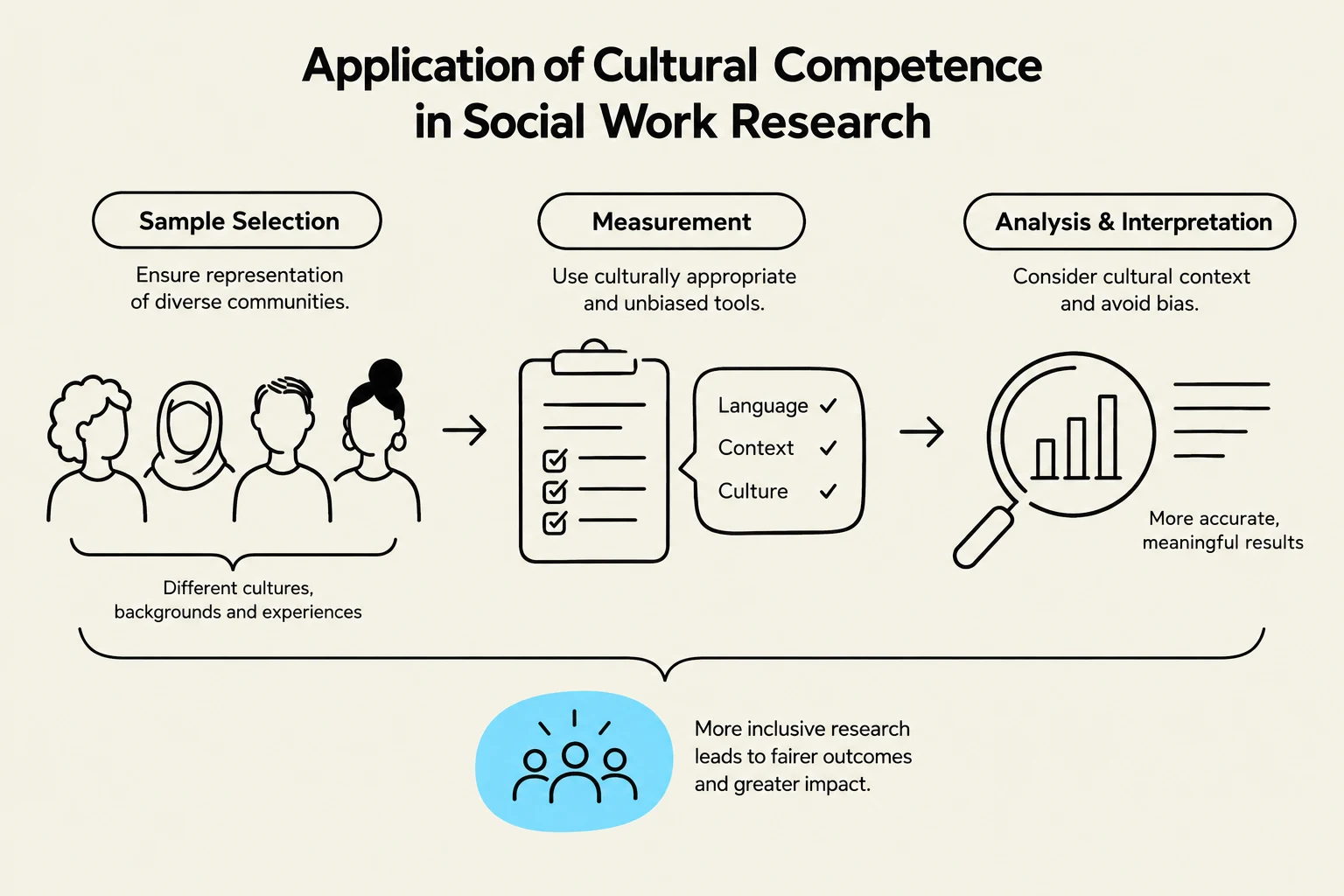
Cultural competence must be integrated into every stage of the research process:
Exploratory Studies: Culture should always be treated as a central theme due to its influence on human behavior.
Descriptive Studies: Researchers must create measurement tools that are sensitive to cultural differences to ensure an accurate portrayal of the group.
Explanatory Studies: Researchers must be careful when investigating causation (e.g., asking if a specific culture "causes" a certain economic outcome).
Evaluative Studies: When examining the success of a program, researchers must be sensitive to how cultural influences affect client behavior.
This diagram illustrates the application of cultural competence in social work research, covering sample selection, measurement, and analysis & interpretation, emphasizing the importance of diverse representation and culturally appropriate methods for more accurate and meaningful results.
Rethinking Culture
It is vital for researchers to move away from seeing culture as a "fixed" characteristic. Contemporary anthropology suggests that culture is an ongoing, changing process of sharing and using knowledge. Therefore, a culturally competent researcher does not treat a culture as a static checkbox, but as a dynamic and evolving reality.
Summary Checklist for Researchers:
Have I obtained informed consent and respected autonomy?
Have I minimized risks and maximized benefits?
Is my sample representative of diverse cultures?
Are my measurement tools culturally sensitive?
Have I submitted my plan to the IRB?
Keep reading for free.
Create an account to finish this reading and make it part of your study routine.