This content explores the fundamental aspects of decision making in management, covering individual and group decision-making processes, cognitive biases, and data-driven approaches. It explains concepts like optimizing, satisficing, bounded rationality, heuristics, and various biases such as anchoring and confirmation
Decision making is a fundamental aspect of management, influencing everything from daily operations to long-term strategic direction. For managers, the ability to navigate uncertainty and make effective choices is a core competency. However, the process is rarely straightforward. It is often complicated by mental shortcuts, emotional influences, and environmental constraints. By understanding the mechanics of how decisions are made—and the barriers that prevent them from being optimal—leaders can implement more structured, data-driven approaches to improve organizational outcomes.
Individual Decision Making: Logic vs. Reality
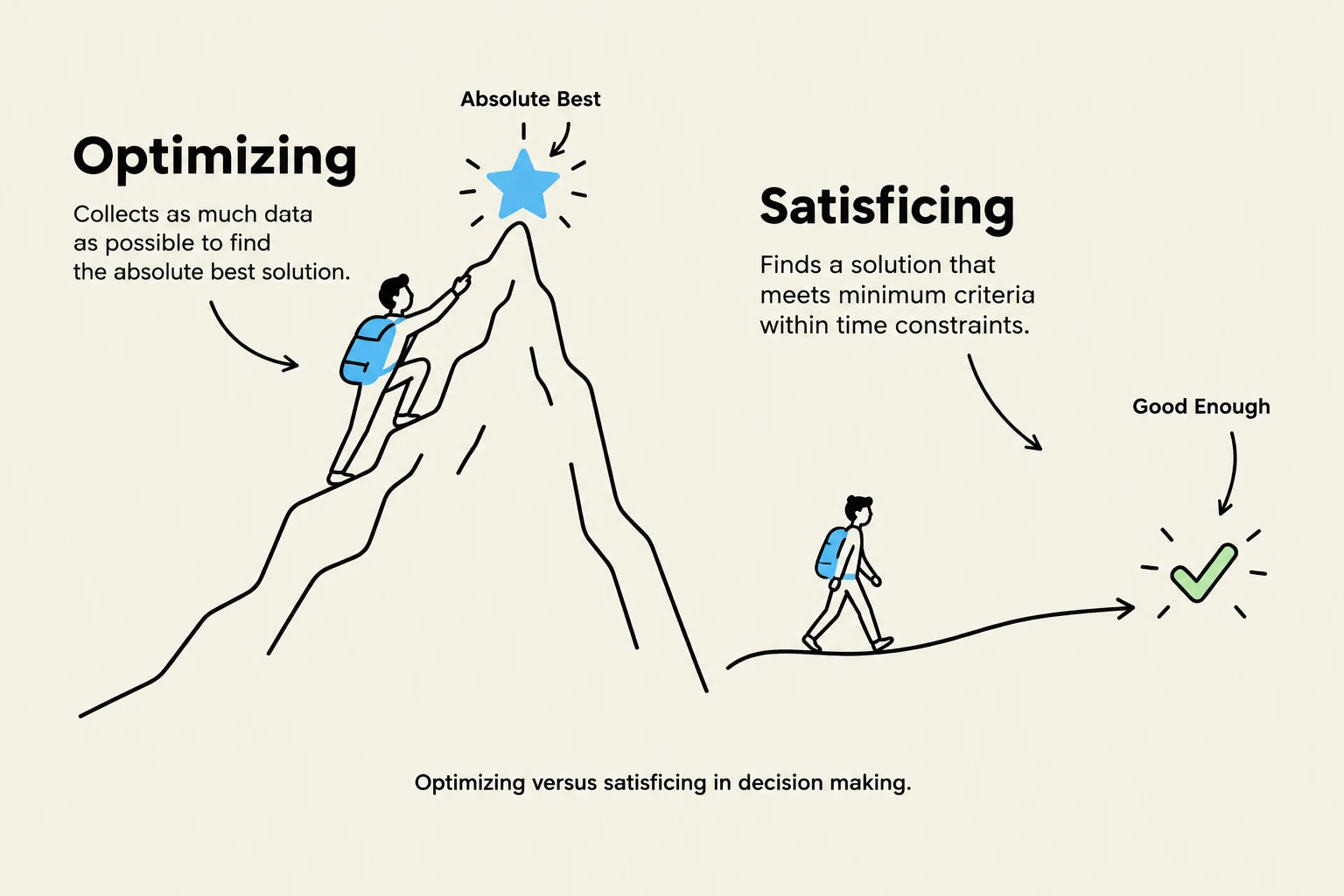
This illustration contrasts optimizing, which involves gathering extensive data to find the absolute best solution, with satisficing, which focuses on finding a solution that meets minimum criteria within given constraints.
When an individual makes a decision, they often navigate between two primary objectives: optimizing and satisficing.
Optimizing involves gathering as much data as possible to strive for the absolute best or most efficient solution.
Satisficing (a blend of "satisfy" and "suffice") occurs when a person settles for a solution that is "good enough" given the available information and time constraints.
In a perfect world, managers would follow a rational decision-making process. This is a highly structured, systematic approach that involves:
Identifying the problem.
Establishing and weighing criteria.
Generating and evaluating alternatives.
Selecting the best option.
However, the reality of the workplace often involves bounded rationality. This concept recognizes that human decision-makers are limited by their cognitive capacity, the time available, and the information at hand. Because we cannot process every possible variable, we often rely on heuristics—mental shortcuts or "rules of thumb" that simplify complex decisions by focusing on key information while bypassing unnecessary details.
Study Tip: Think of the difference between a "Rational Mind" and an "Intuitive Mind." The rational mind is a deliberate, analytical mode of thinking that requires conscious effort, whereas the intuitive mind is a fast, automatic mode that synthesizes information based on past experiences and instincts.
Cognitive Biases: The Hidden Barriers
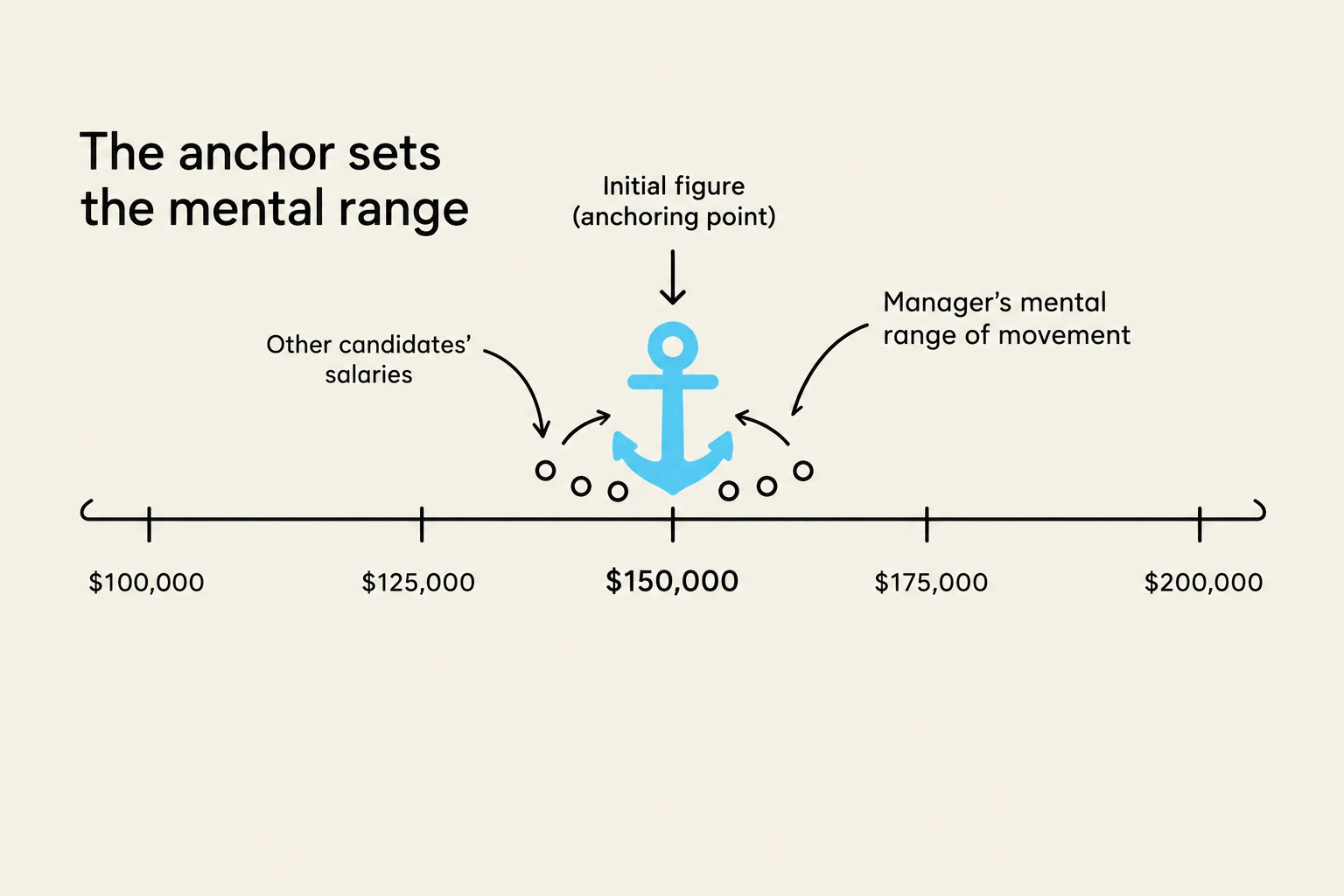
A diagram illustrating the anchoring effect in salary negotiations, where an initial figure (anchoring point) influences the perceived range of acceptable salaries for other candidates and the manager's flexibility.
Even when we attempt to be rational, our brains are prone to cognitive biases—tendencies to think in certain ways that lead to incorrect judgments or decisions. These biases can cause us to overlook vital data or stick to familiar patterns even when they are no longer effective.
Several specific biases frequently impact management decisions:
Anchoring Bias: This occurs when we fixate on the first piece of information we receive and fail to adjust our thinking even when new, more relevant data arrives.
Confirmation Bias: The tendency to seek out information that supports our existing beliefs while simultaneously ignoring or devaluing information that contradicts them.
Decision Fatigue: Making numerous choices can lead to mental exhaustion, which often results in hasty decisions, poor judgment, or even total decision avoidance.
Worked Example: The Salary Negotiation
Imagine a manager is hiring a new executive. The first candidate mentioned a salary expectation of $150,000. Even if subsequent candidates are significantly more qualified and would be happy with $130,000, the manager might find themselves "anchored" to that $150,000 figure, using it as the primary benchmark for all other negotiations.
Data-Driven and Evidence-Based Approaches
To combat biases and the limitations of intuition, modern managers increasingly rely on structured, objective methods.
Data Analytics and Decision Making
There is a distinction between how we use data to guide our choices:
Evidence-Based Decision Making (EBDM): This approach utilizes proven data from past experiences to inform current choices.
Data-Driven Decision Making (DDDM): This relies more heavily on quantitative metrics and analytics to guide decisions, particularly in environments rich with data.
These approaches are supported by data analytics, which involves collecting and analyzing large datasets to uncover patterns. Managers typically use two types of analytics:
Descriptive Analytics: Focused on understanding the past by identifying trends and relationships in historical data.
Predictive Analytics: An advanced form of analysis that uses historical patterns to forecast future trends and provide projections.
Visualizing Complexity: Decision Trees
When faced with multiple decision points and uncertain outcomes, managers can use decision trees. A decision tree is a visual tool that maps out alternatives and possible outcomes, often incorporating the likelihood of those outcomes. Within these trees, a decision node represents a specific point where different pathways or choices are presented.
Group Decision Making: Dynamics and Conflict
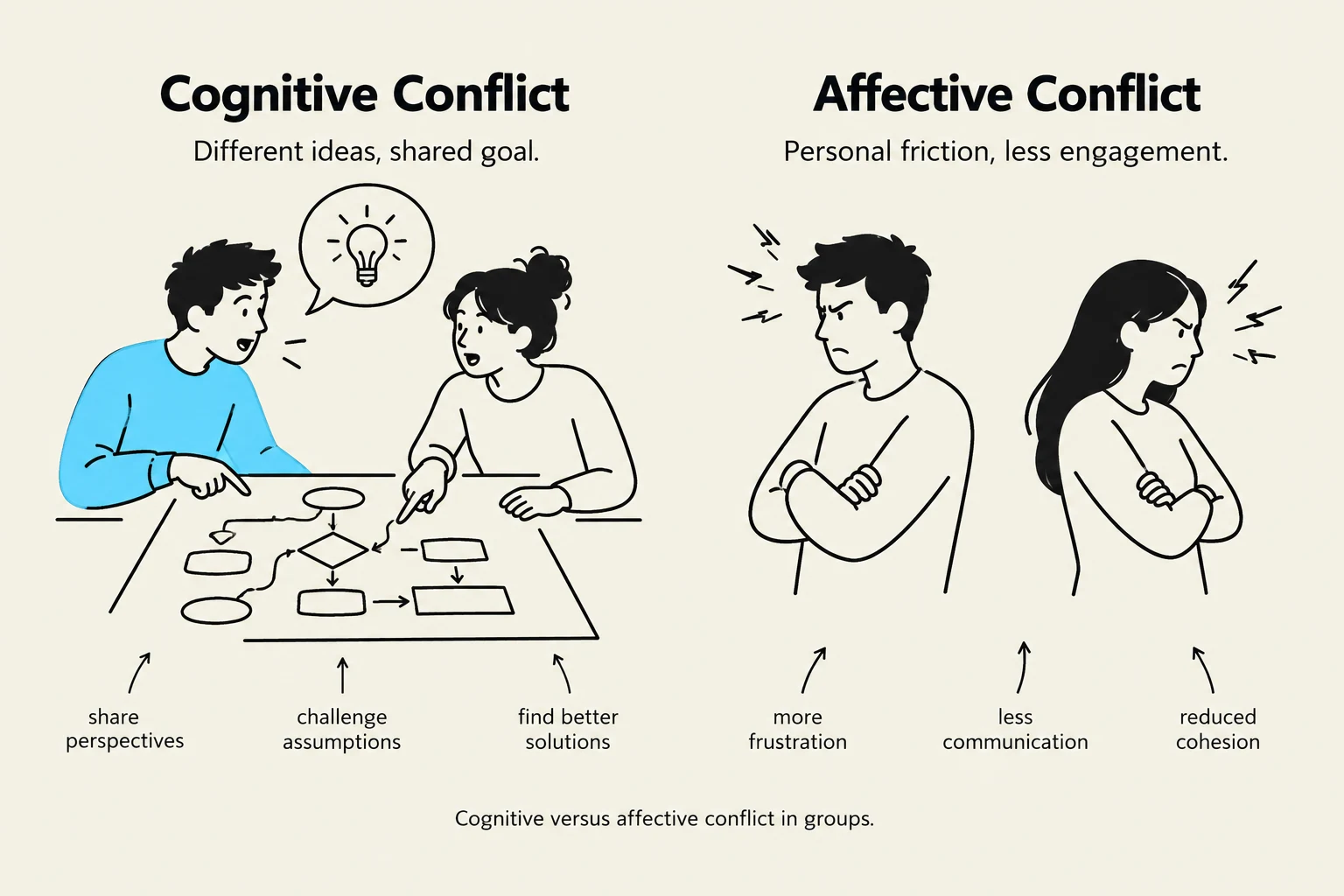
This illustration contrasts cognitive conflict, characterized by differing ideas towards a shared goal, with affective conflict, marked by personal friction and reduced engagement.
Decisions are not always made in isolation. Group decision making offers the advantage of diverse knowledge, improved idea evaluation, and increased "buy-in" from team members. However, groups also face unique risks, such as "groupthink" or the diffusion of responsibility.
A critical part of managing a group is navigating the type of conflict that arises during debates. Managers must distinguish between two types of conflict:
Conflict Type
Focus
Outcome
Cognitive Conflict
Task-focused debate and alternative perspectives.
Collaborative problem-solving and better solutions.
Affective Conflict
Personal disagreements and aggression.
Disengagement and a focus on "winning" rather than solving.
Management Goal: To optimize group outcomes, strive to encourage cognitive conflict (healthy debate over the task) while actively minimizing affective conflict (personal friction).
Keep reading for free.
Create an account to finish this reading and make it part of your study routine.