Ergonomics and Musculoskeletal Issues in Sonography
This article explores the principles of ergonomics, the nature of work-related injuries (WRMSDs), and strategies to mitigate risks in the sonography profession, focusing on the relationship between clinician work and body response for a healthy career.
In the field of medical imaging, the physical demands placed on a sonographer are significant. While the technology has advanced rapidly, the human body remains subject to the same physical laws of strain and fatigue. Understanding the relationship between how a clinician works and how their body responds is essential for a long and healthy career. This article explores the principles of ergonomics, the nature of work-related injuries, and the strategies used to mitigate risks in the sonography profession.
Understanding Ergonomics
Broadly defined, ergonomics is the study of the human body at work. The primary objective is to increase productivity while simultaneously decreasing worker injury. This is achieved not by changing the worker, but by modifying products, tasks, and the work environment to better fit the human form.
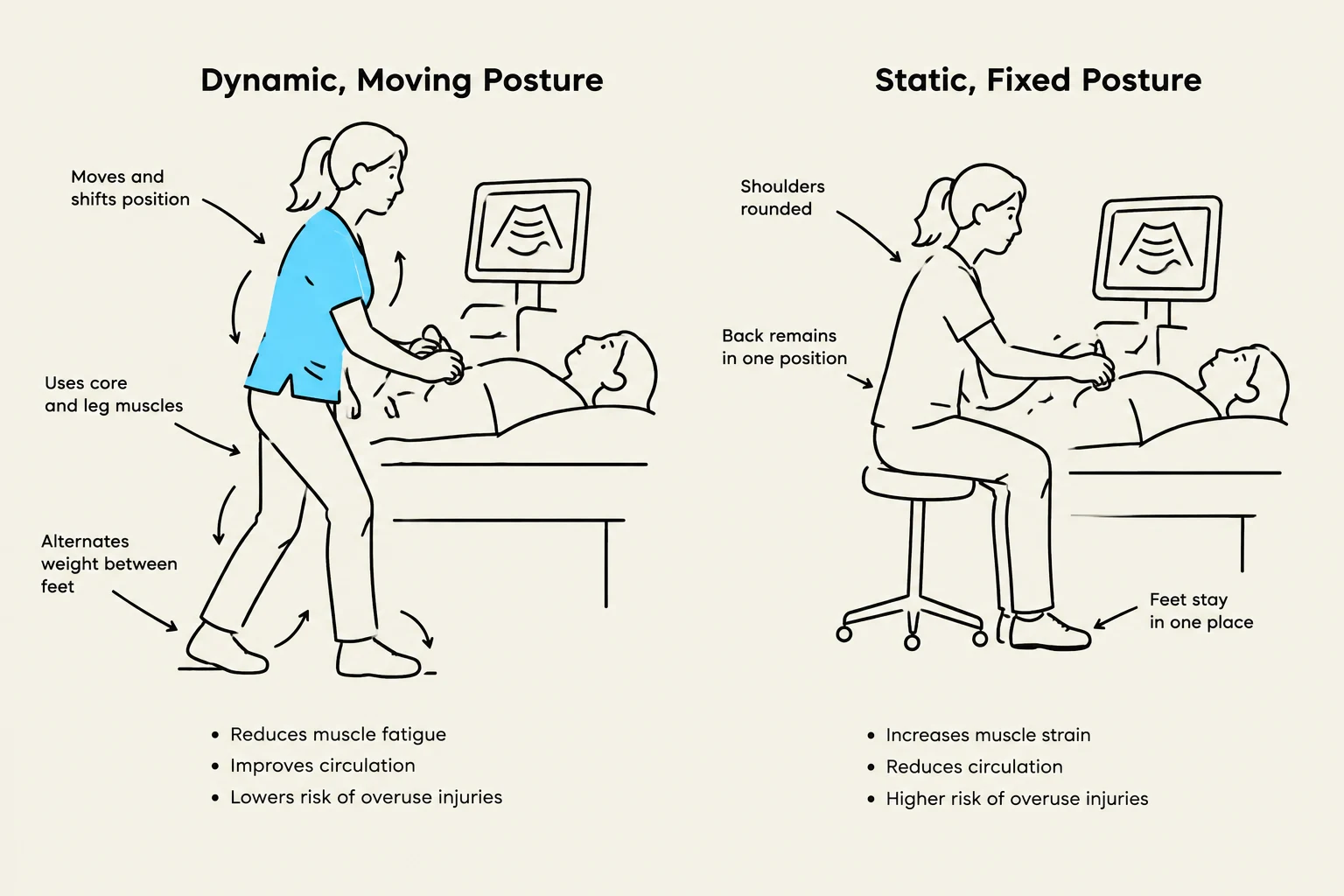
Historically, ergonomic concepts gained popularity during the Industrial Revolution as production moved toward assembly lines. While this improved efficiency, it introduced the problem of "static work postures," where workers remained in fixed positions for long periods. In modern sonography, we see a similar challenge: the relationship between the user and the workstation equipment often becomes "frozen," forcing the sonographer into prolonged static postures that can lead to injury.
Comparison of dynamic, moving posture versus static, fixed posture, illustrating their effects on muscle fatigue, circulation, and risk of overuse injuries.
Work-Related Musculoskeletal Disorders (WRMSD)
The most critical term for a sonographer to understand is Work-Related Musculoskeletal Disorder (WRMSD). This is the current umbrella term used to describe injuries to muscles, tendons, and joints that are caused or aggravated by workplace activities.
In the past, various terms were used interchangeably to describe these issues, including:
Cumulative trauma disorder (CTD)
Repetitive motion injury (RMI)
Repetitive strain injury (RSI)
Musculoskeletal strain injury (MSI)
The incidence of WRMSDs in sonography is alarmingly high. Research indicates that more than 80% of sonographers experience some form of musculoskeletal disorder (MSD) that can be attributed to their work activities. In North America, the combined average incidence of WRMSDs is approximately 84%.
Exam Tip: If a question asks for the current standard term for occupational injuries in sonography, the answer is "Work-Related Musculoskeletal Disorder (WRMSD)".
Mechanisms of Injury and Risk Factors
Injuries in sonography are rarely the result of a single event; rather, they stem from a combination of risk factors that stress the body over time.
Primary Risk Factors
Forceful Exertions: Using excessive grip strength or pushing heavy equipment.
Awkward Postures: Bending, twisting, or reaching in ways that deviate from a neutral spine.
Repetitive Motions: Performing the same movement (like scanning) repeatedly without adequate rest.
Pinch Grip: Using a tight, narrow grip on the transducer.
Environmental Factors: Extreme heat, cold, humidity, or vibrations.
How the Body Breaks Down
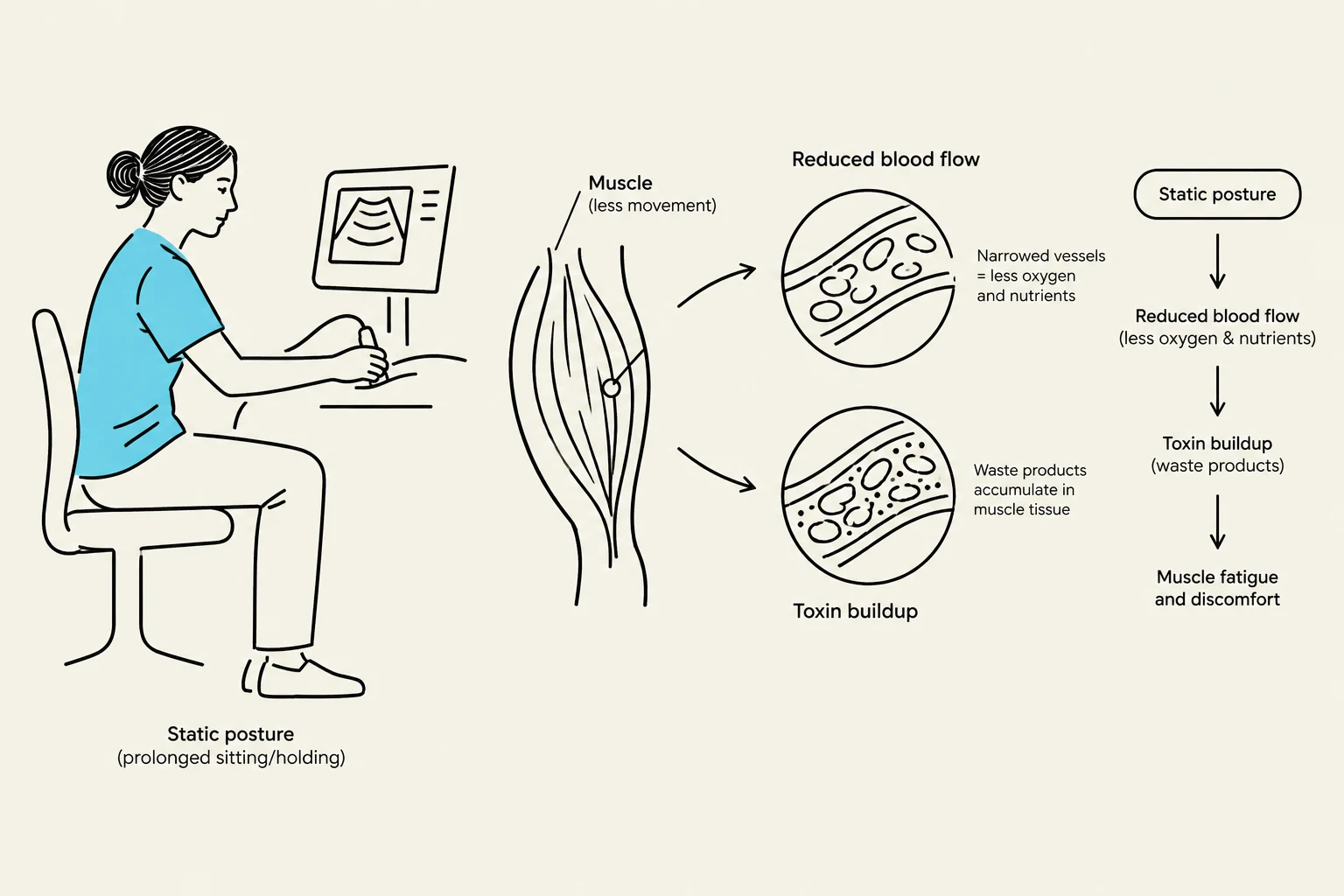
When a sonographer maintains a static posture, the body must contract more than 50% of its muscles just to stay in place. This continuous contraction prevents the normal cycle of muscle contraction and relaxation, which is necessary to circulate blood, deliver oxygen, and remove toxins from the tissue.
Furthermore, sustained awkward postures can create imbalances. For example, repeatedly rotating the head or neck can cause one set of muscles to become shorter and stronger, while the opposing muscles become weaker and elongated. This can lead to asymmetric forces on the spine, causing misalignment and nerve entrapment.
This diagram illustrates how static posture, such as prolonged sitting or holding a position, can lead to reduced blood flow in muscles. This reduced flow results in less oxygen and nutrients reaching the muscle tissue, and a buildup of waste products. Consequently, this can cause muscle fatigue and discomfort.
Common Clinical Presentations
Sonographers are particularly susceptible to several specific conditions:
Tendonitis and Tenosynovitis: Inflammation of the tendon and its protective sheath.
de Quervain disease: A specific thumb tendonitis often caused by gripping the transducer.
Carpal Tunnel Syndrome: Entrapment of the median nerve in the wrist.
Cubital Tunnel Syndrome: Entrapment of the ulnar nerve at the elbow.
Rotator Cuff Injury: Fraying of the shoulder tendons, often exacerbated by arm abduction (lifting the arm away from the body).
Regulatory Standards and Industry Consensus
To address these widespread health issues, various regulatory and professional bodies have stepped in. In the United States, the Occupational Safety and Health Act was passed in 1970 to ensure safe and healthful working conditions. This act is administered by the Occupational Safety and Health Administration (OSHA).
In cases where specific industry guidelines for sonography do not exist, OSHA utilizes the General Duty Clause. This clause requires employers to provide a workplace free from recognized hazards that cause serious physical harm, provided that a feasible way to correct the hazard exists.
Because sonography has unique needs, the International Ultrasound Industry Consensus Conference was organized in 2003 by the Society for Diagnostic Medical Sonography (SDMS). The goal of this conference was to develop injury risk-reducing standards. These standards involve all stakeholders, including employers, equipment manufacturers, and educators, to ensure that ergonomics is integrated into the entire lifecycle of the profession.
Strategies for Injury Prevention
Preventing WRMSDs requires a multi-tiered approach involving engineering, administration, and personal practice.
1. Engineering Solutions (The Preferred Method)
Engineering solutions involve changing the physical features of the workplace. While they are often the most expensive initially, they are the most effective because they eliminate the hazard at the source.
Ultrasound Systems: Should have height-adjustable, swiveling control panels and monitors.
Transducers: Should be designed to avoid a "pinch grip" and have flexible, lightweight cables.
Furniture: Use electronically height-adjustable examination tables and ergonomic chairs.
2. Administrative Solutions
These involve changes to workplace policies and scheduling.
Scheduling: Avoid scheduling the same type of examination back-to-back to allow for muscle recovery.
Rotation: Encourage sonographers to perform a variety of examinations to use different muscle groups.
Breaks: Implement "mini" breaks during procedures to relax the neck and shoulders.
3. Personal Protective Equipment (PPE) and Professional Controls
This is the least effective method because the worker is still exposed to the risk, but it can help reduce the impact.
Body Mechanics: Maintain a neutral spine, avoid forward/backward reaching, and alternate between sitting and standing.
The 20-20-20 Rule: To prevent eye strain, every 20 minutes, look at an object 20 feet away for 20 seconds.
Patient Positioning: Instruct patients to move closer to the sonographer to reduce the need for reaching.
Comparison of bad and good ergonomic postures for a seated individual, highlighting key differences in neck, arm, back, and hip positioning.
The Economics of Ergonomics
The cost of ignoring ergonomics is staggering for both the individual and the institution. For employers, costs include medical expenses, worker's compensation, and the high price of replacing skilled staff. For the worker, the cost can include chronic pain and the potential loss of their profession.
Interestingly, the cost of preventing an injury is often much lower than the cost of treating one. For example:
An ergonomic stool costs approximately $750, which can be reimbursed by the savings from just two or three avoided injury cases.
An ergonomic examination table costs roughly $$7,400$, but this is recovered after only two days of work if it prevents a single major injury.
Ultimately, a healthy sonographer is a productive sonographer. By implementing ergonomic standards, the industry can protect its most valuable asset: its people.
Keep reading for free.
Create an account to finish this reading and make it part of your study routine.