Explores the role of enzymes as biological catalysts in metabolic pathways, detailing factors influencing reaction rates such as concentration, temperature, and pH, and introduces cofactors, coenzymes, and energy capture mechanisms.
Metabolism represents the sum total of all chemical reactions occurring within an organism. These reactions are not random; they are highly organized pathways that allow cells to build structures, break down nutrients, and capture energy to perform work. To manage these complex processes, biological systems rely on specialized proteins known as enzymes to ensure that reactions occur at speeds compatible with life.
The Role of Enzymes as Biological Catalysts
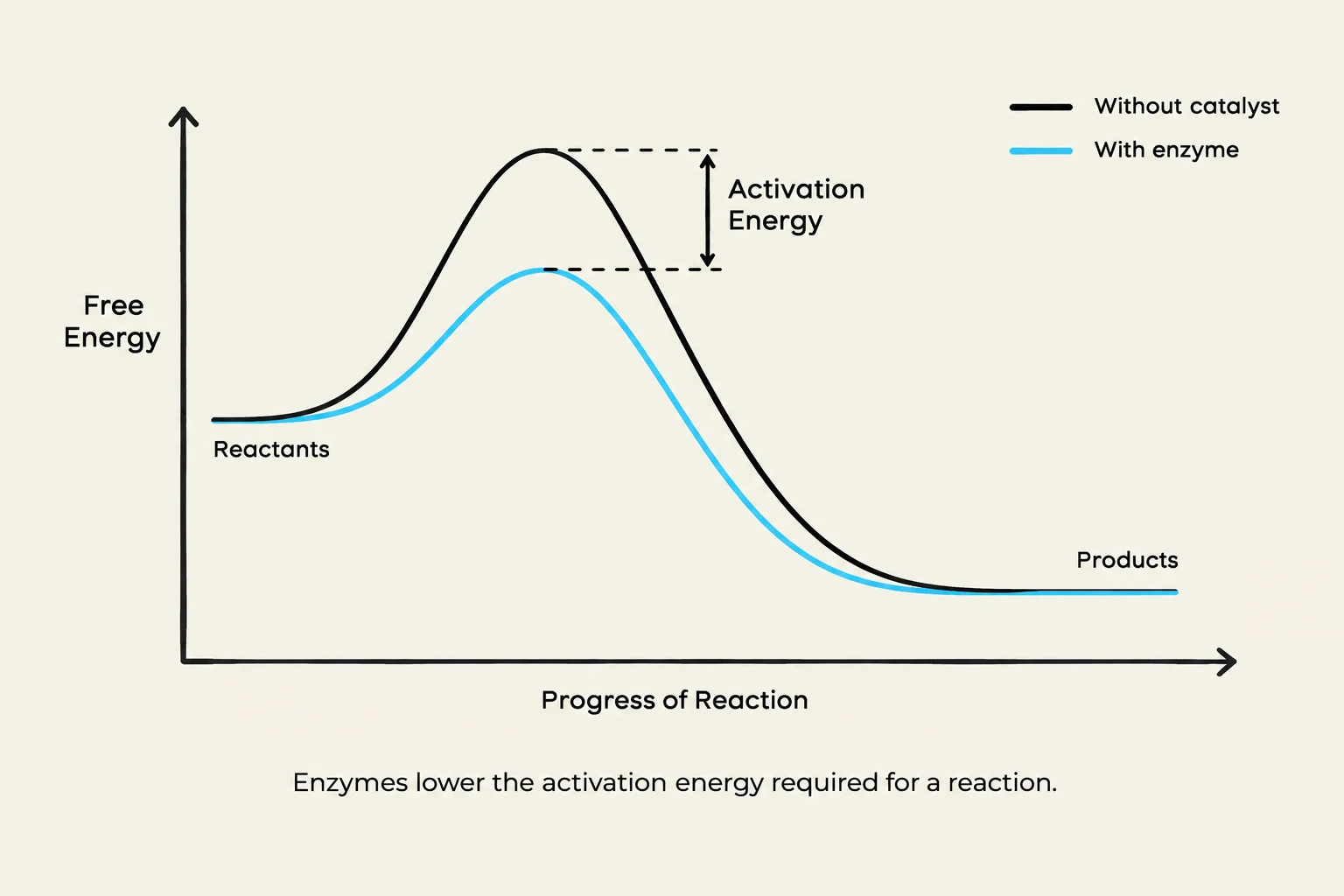
This graph illustrates how enzymes lower the activation energy required for a chemical reaction, depicted by the difference in peak energy between the catalyzed and uncatalyzed pathways.
In any chemical reaction, molecules must overcome an energy barrier to transform from reactants into products. This barrier is known as the activation energy—the initial input of energy required to allow molecules to get close enough to cause bond rearrangement and start a reaction.
Without assistance, many biological reactions would occur too slowly to sustain life. This is where catalysts come in. A catalyst is a substance that speeds up the rate of a chemical reaction without being consumed by the process. In biological systems, these organic catalysts are called enzymes.
Specificity and the Active Site
Enzymes are characterized by their extreme specificity; an enzyme typically catalyzes only one particular reaction or a specific group of related reactions. This specificity is dictated by the physical compatibility between the enzyme's structure and its target molecule.
Substrate: The specific reactant molecules that an enzyme acts upon.
Active Site: A specific location on the enzyme where the reaction takes place.
Enzyme-Substrate Complex: The temporary structure formed when the substrate binds to the active site.
For a reaction to proceed, the shape of the substrate must match the shape of the active site. Many enzymes are named according to their function by adding the suffix "-ase" to the substrate name. For example, dehydrogenases are enzymes specifically responsible for removing hydrogen from a substrate.
Exam Tip: Remember that enzymes do not change the overall free energy (ΔG) of a reaction; they only lower the activation energy required to get the reaction started.
Factors Influencing Reaction Rate
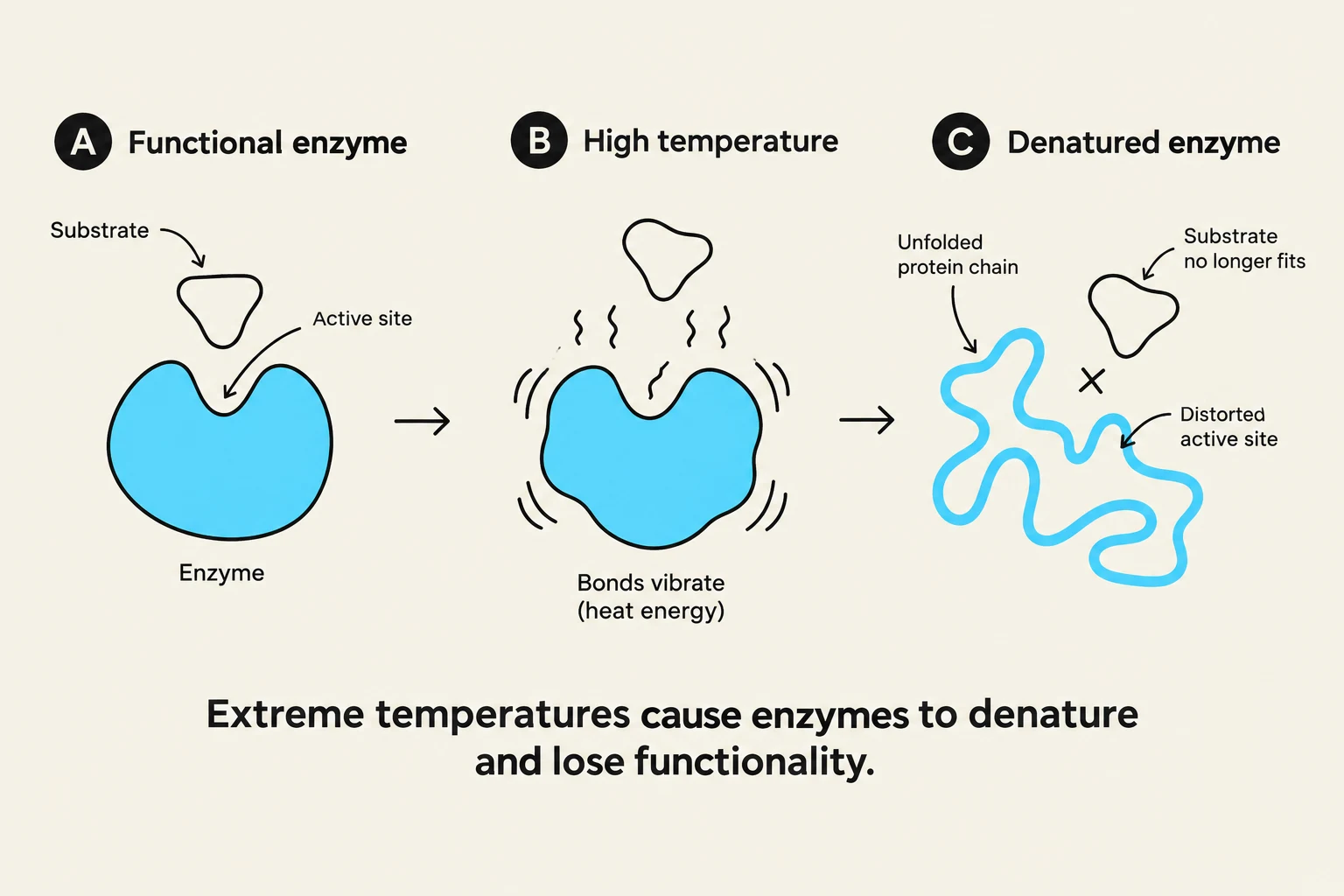
This diagram illustrates how extreme temperatures can denature enzymes, causing them to lose their functional shape and ability to bind with substrates.
The efficiency of an enzyme is highly sensitive to its environment. Several factors can dictate how quickly a reaction proceeds.
Concentration
The relationship between concentration and the reaction rate depends on the availability of substrates and enzymes:
High Substrate Concentration: If there is an abundance of substrate, increasing the enzyme concentration will cause the reaction rate to increase linearly.
Low Substrate Concentration: If substrate is limited, the reaction rate increases as more enzyme is added, but it eventually levels off once all available active sites are occupied.
Excess Enzyme: If there are more enzyme molecules than there are substrate molecules to bind with, adding additional enzyme will not increase the reaction rate.
Temperature
Temperature affects the kinetic energy of molecules. Increasing the temperature generally increases the reaction rate because it increases the frequency of molecular collisions. However, enzymes are proteins with delicate shapes. If the temperature exceeds an optimal threshold, the thermal energy becomes high enough to break the bonds holding the enzyme together, causing the enzyme to denature. Once denatured, the enzyme loses its shape and can no longer function, causing the reaction rate to drop sharply.
pH Levels
Enzymes function maximally within a very narrow pH range. A deviation from this optimal pH can alter the ionization of the amino acid R-groups (side chains) within the enzyme. When the electrical charges on these amino acids change, the hydrogen bonding that maintains the protein's structure is disrupted. This causes the enzyme to change shape, rendering the active site ineffective for the substrate.
Cofactors and Coenzymes
Many enzymatic processes are not "stand-alone" and require additional non-protein components to function, particularly those involved in carrying electrons during redox reactions. These helper molecules include:
Cofactors: General terms for non-protein chemical compounds that assist enzymes.
Coenzymes: Specific organic cofactors that often act as electron carriers.
Key coenzymes used in cellular metabolism include:
Metabolism involves both catabolic pathways (breaking down molecules to release energy) and anabolic pathways (using energy to build molecules). To make these processes work, cells use specific mechanisms to capture and transfer energy.
Substrate-Level Phosphorylation
In this mechanism, an enzyme directly transfers a phosphate group from a high-energy donor molecule to an acceptor molecule (such as converting ADP to ATP).
Chemiosmosis
This is a more complex method of energy transduction. Energy is stored in an electrochemical gradient (often a concentration gradient of protons across a membrane). This stored potential energy is then utilized by specialized enzymes to synthesize ATP from ADP and inorganic phosphate (Pi).
Summary Table: Enzyme Sensitivity
Factor
Effect of Increase
Risk of Excess
Substrate
Increases rate (until saturation)
N/A
Enzyme
Increases rate (until saturation)
No further increase if substrate is limiting
Temperature
Increases collision frequency
Denaturation (loss of shape)
pH
Optimal at specific range
Altered ionization and shape change
Keep reading for free.
Create an account to finish this reading and make it part of your study routine.