Explores the role of enzymes as biological catalysts in speeding up chemical reactions by lowering activation energy. Discusses enzyme specificity, active sites, cofactors, coenzymes, and regulatory mechanisms like feedback inhibition and environmental factors affecting enzyme activity.
Life is a continuous series of chemical transformations. From the moment a cell is formed until its eventual death, it must constantly perform work: moving molecules, growing, pumping ions, and synthesizing new materials. These transformations are collectively known as metabolism. To manage the vast array of reactions required for survival, biological systems rely on a sophisticated toolkit of energy management and molecular machinery.
The Energetics of Metabolism
Metabolism is the sum of all chemical reactions within an organism. These reactions are not all the same; they are categorized based on how they handle energy, specifically Gibbs free energy (G), which measures the amount of usable energy available in molecules.
Exergonic and Endergonic Reactions
Chemical reactions can be broadly divided into two types:
Exergonic reactions (from "ex-" meaning exit): These reactions release free energy that can perform work. They are often "downhill" or spontaneous processes, such as the catabolic pathways that break down complex molecules into simpler ones (e.g., cellular respiration).
Endergonic reactions (from "en-" meaning enter): These reactions require an input of energy to proceed. They are "uphill" or nonspontaneous processes, such as anabolic pathways that use energy to build complex molecules (e.g., photosynthesis).
The net change in free energy is denoted as ΔG. For an exergonic reaction, ΔG<0, while for an endergonic reaction, ΔG>0.
Exam Tip: Remember that catabolism (breaking down) is generally exergonic, while anabolism (building up) is generally endergonic. Cells often use "energy coupling"—using the energy released from an exergonic reaction (like ATP hydrolysis) to drive an endergonic one.
Enzymes: The Biological Catalysts
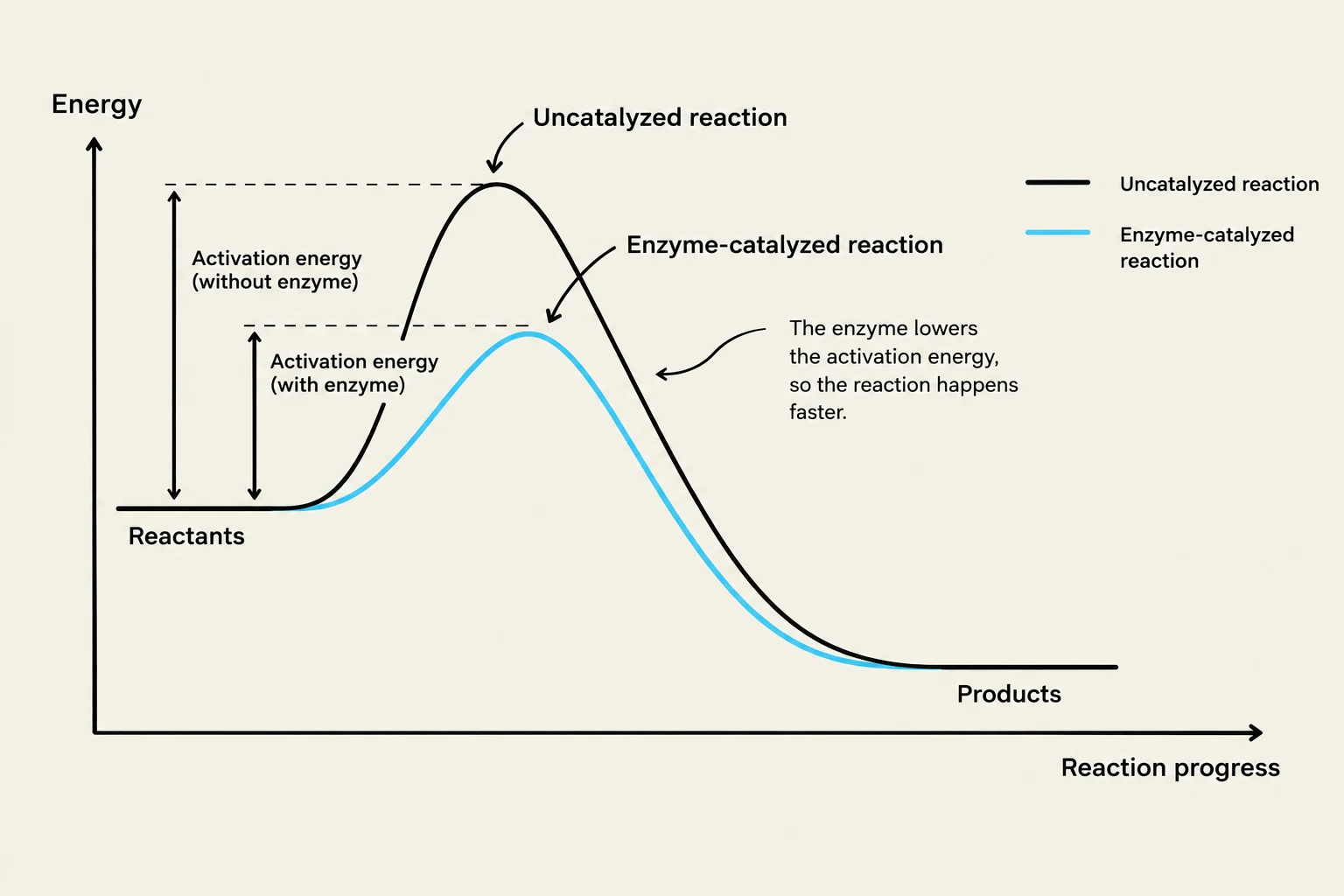
Even if a reaction is energetically favorable (exergonic), it might happen too slowly to sustain life. This is because every chemical reaction faces an energy barrier known as activation energy (EA). EA is the initial input of energy required to reach a "transition state" where old bonds break and new ones can form.
Enzymes are biological catalysts—specialized proteins that speed up chemical reactions by lowering the activation energy requirement. Crucially, enzymes are not consumed in the reaction; they emerge unchanged and ready to catalyze the next substrate molecule.
This graph illustrates the effect of an enzyme on the activation energy of a reaction. The black line represents an uncatalyzed reaction, while the blue line shows an enzyme-catalyzed reaction. Enzymes lower the activation energy, thus speeding up the reaction.
Specificity and the Active Site
Enzymes are highly specific, meaning a single enzyme typically catalyzes only one specific reaction. This specificity is determined by the enzyme's unique 3D shape. The reactant that the enzyme acts upon is called the substrate.
The substrate binds to a specific pocket on the enzyme known as the active site. Rather than being a rigid "lock and key," many enzymes undergo an induced fit, where the active site slightly changes its shape upon contact with the substrate to create a more precise and effective fit.
Helpers: Cofactors and Coenzymes
Not all enzymes can function alone. Many require non-protein "helpers" to assist in catalysis:
Cofactors: These are typically inorganic substances, such as metal ions like zinc, iron, or copper.
Coenzymes: These are organic molecules, most of which are derived from vitamins.
Regulation of Enzyme Activity
If every enzyme in a cell worked at maximum speed all the time, the cell would quickly exhaust its resources and lose its internal balance (homeostasis). Therefore, metabolic pathways must be regulated.
Feedback Inhibition
One of the most efficient ways to regulate a pathway is feedback inhibition. In this mechanism, the final product of a metabolic pathway acts as an inhibitor for an enzyme that functions early in that same pathway. When the end product accumulates to a high concentration, it shuts down its own production, preventing the waste of chemical resources.
Enzyme Inhibitors
Cells and external molecules can also alter enzyme activity through inhibition:
Competitive Inhibitors: These molecules resemble the substrate and bind directly to the active site. By occupying the site, they physically prevent the substrate from binding, thereby reducing the reaction rate.
Non-competitive Inhibitors: These molecules bind to an alternate site on the enzyme (often called an allosteric site) rather than the active site. This binding causes the enzyme's 3D shape to change, which in turn alters the active site and makes it less effective at catalyzing the reaction.
Diagrams illustrating competitive and non-competitive enzyme inhibition.
Real-World Connection: Many pharmaceutical drugs are designed to be enzyme inhibitors. By targeting specific enzymes in a pathogen or a diseased cell, scientists can "turn off" harmful biological processes.
Environmental Factors
Because an enzyme's function is entirely dependent on its precise 3D shape, it is highly sensitive to its environment.
Temperature: Reaction rates typically increase with temperature until an "optimal" point is reached. Beyond this point, the heat can break the bonds holding the enzyme together, causing it to denature (lose its shape).
pH: Each enzyme has an optimal pH level. For example, enzymes in the human stomach require a highly acidic environment, while those in the small intestine require a more neutral or slightly basic environment.
Concentration: The rate of reaction is also influenced by the concentration of both the enzyme and the substrate.
This graph illustrates the relationship between enzyme activity and temperature. Enzyme activity increases with rising temperature up to an optimal point, after which it rapidly declines as the enzyme denatures.
Keep reading for free.
Create an account to finish this reading and make it part of your study routine.