Enzyme Cofactors: Essential Helpers in Biological Catalysis
Explore the crucial role of cofactors, including inorganic ions and organic coenzymes, in enabling enzyme function. Learn about apoenzymes, holoenzymes, and prosthetic groups, and understand how these components are vital for biochemical reactions and clinical diagnostics.
Enzymes are the biological catalysts of life, essential for speeding up biochemical reactions that would otherwise occur too slowly to sustain living organisms. While most enzymes are composed entirely of protein, many require additional non-protein components to function effectively. These essential helpers are known as cofactors. Understanding the relationship between the protein portion of an enzyme and its required cofactors is fundamental to biochemistry and clinical diagnostics.
The Architecture of Catalysis: Active Sites and Substrates
The primary function of an enzyme is to facilitate the conversion of substrates into products. This process occurs within a specific three-dimensional pocket or cleft known as the active site. The active site is formed by the complex folding of the protein chain, positioning specific amino acid side chains in a way that allows them to participate in substrate binding and chemical catalysis.
Substrates bind to the active site through various weak, noncovalent interactions, such as hydrogen bonds, hydrophobic interactions, and ionic bonds. There are two primary models describing this interaction:
Lock-and-Key Model: The active site is a rigid, perfect complement to the substrate's shape.
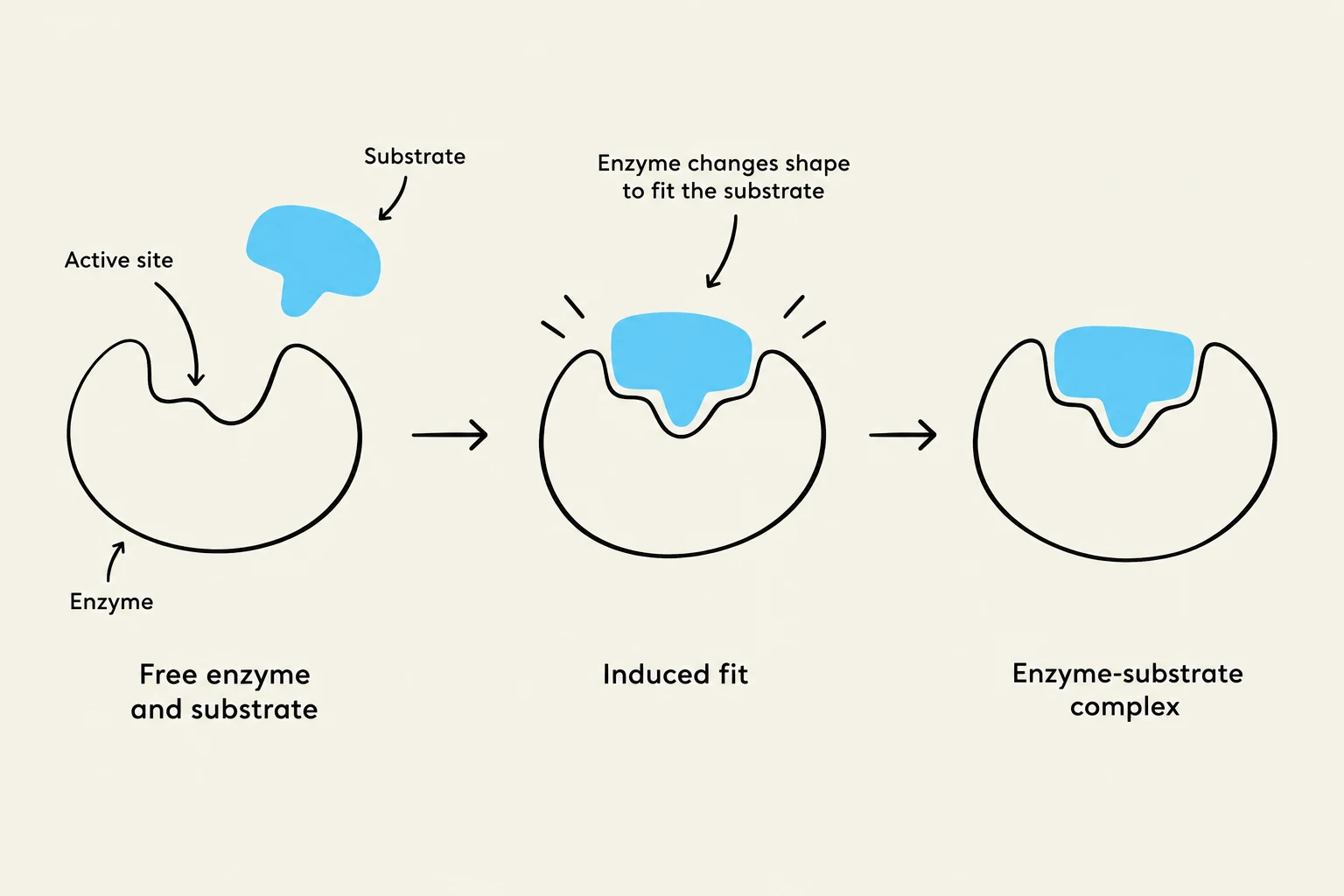
Induced-Fit Model: The enzyme is flexible and undergoes a conformational change upon binding to "embrace" the substrate more tightly, much like a hand entering a glove.
Diagram illustrating the induced fit model of enzyme-substrate interaction, showing how an enzyme's active site changes shape to bind with a substrate, forming an enzyme-substrate complex.
The efficiency of this process is measured by catalytic efficiency. Enzymes increase reaction rates by lowering the activation energy (Ea) required to reach the transition state. A key metric here is the turnover rate (kcat), which represents the number of substrate molecules one enzyme molecule can convert to product per unit of time. For example, Carbonic anhydrase is considered a "perfect enzyme" because it can process nearly 600,000 substrates per second.
Understanding Cofactors: The Essential Helpers
Not all enzymes are "complete" upon synthesis. Many require cofactors—organic or inorganic molecules—to achieve catalytic activity. To understand the terminology used in biochemistry, we must distinguish between the different components of an enzyme complex:
Apoenzyme: The protein portion of the enzyme, which is inactive on its own.
Cofactor: The non-protein component (can be an inorganic ion or an organic molecule).
Holoenzyme: The complete, catalytically active enzyme consisting of the apoenzyme plus its required cofactor.
Prosthetic Group: A cofactor that is very tightly or even covalently bound to the enzyme, making it a permanent part of the structure (e.g., FAD or heme).
Exam Tip: Remember the mathematical relationship:
Apoenzyme (inactive)+Cofactor=Holoenzyme (active)
Inorganic Cofactors: Metal Ions
Inorganic cofactors are typically metal ions such as Mg2+, Fe2+, Zn2+, or Cu2+. These ions can participate in temporary bonding between the active site and the substrate or help change the conformation of the active site to facilitate catalysis.
The importance of these ions is highlighted by heavy metal toxicity. Certain toxic metals, such as Cadmium (Cd2+) and Mercury (Hg2+), can replace essential metal ions like Zinc (Zn2+) in the active sites of enzymes. Because these heavy metals do not possess the same catalytic properties, they render the enzymes inactive.
Organic Cofactors: Coenzymes and Vitamins
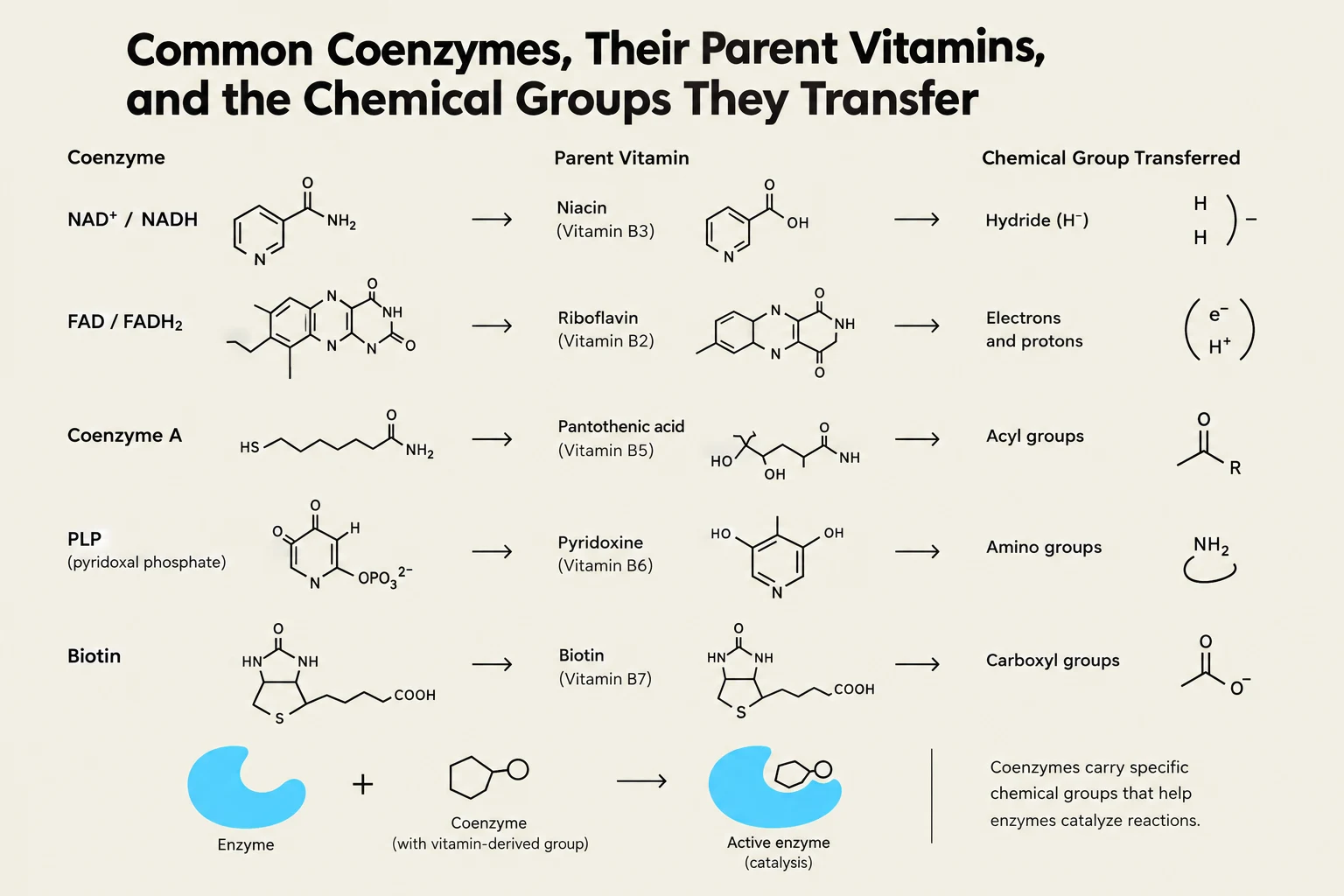
Organic cofactors are called coenzymes. Many coenzymes are transiently associated with the enzyme (acting as "cosubstrates") and are often derived from Vitamin B derivatives.
Common examples include:
NAD+ / NADP+: Derived from Niacin (Vitamin B3).
FAD / FMN: Derived from Riboflavin (Vitamin B2).
TPP (Thiamine Pyrophosphate): Derived from Thiamine (Vitamin B1).
Coenzyme A (CoA): Derived from Pantothenic acid (Vitamin B5).
This diagram illustrates common coenzymes, their corresponding parent vitamins, and the chemical groups they transfer. It also shows a general representation of how enzymes and coenzymes interact to catalyze reactions.
Clinical Significance and Enzyme Specificity
Enzymes exhibit high specificity, meaning they interact with only a few specific substrates or catalyze only specific types of reactions. This specificity is vital in medicine. Because enzymes are often localized within specific organs, their presence in the blood can serve as a diagnostic marker for tissue damage.
For instance, non-plasma-specific enzymes (intracellular enzymes) are normally found in the blood at very low levels. If a patient has a myocardial infarction (heart attack) or hepatitis (liver inflammation), these enzymes leak from the damaged cells into the circulation, causing their levels to rise significantly.
Condition
Diagnostic Enzyme(s)
Tissue Involved
Heart Attack (MI)
Troponin I/T, CK-MB, LDH
Heart/Myocardium
Hepatitis
ALT, AST
Liver
Pancreatic Disease
Amylase, Lipase
Pancreas
Bone/Liver Disease
Alkaline Phosphatase (ALP)
Bone/Liver
Isoenzymes: The Fine Detail of Diagnosis
Sometimes, a single reaction is catalyzed by multiple forms of an enzyme called isoenzymes (or isozymes). Isoenzymes catalyze the same reaction but differ in their amino acid sequence, physical properties, and tissue distribution.
A classic clinical example is Lactate Dehydrogenase (LDH). LDH has five isoenzymes. In a healthy individual, the ratio of LDH levels follows a specific pattern, but in the event of a myocardial infarction, the pattern "flips" (LDH1 > LDH2), providing a specific clue to the physician regarding the location of the tissue damage.
Summary of Enzyme Characteristics
To master this topic, keep these core characteristics in mind:
Active Site: The specific 3D pocket where catalysis occurs.