Environmental Impacts of Agricultural and Land-Use Practices
Examines the environmental consequences of modern agricultural techniques such as monocropping and tilling, alongside land-use practices like slash-and-burn farming, mining, and urbanization. It also discusses water management issues in agriculture and explores sustainable alternatives.
Modern agriculture is a marvel of efficiency, designed to feed a growing global population through mechanization and intensive resource management. However, the methods used to achieve high yields often come at a significant cost to ecosystem health, soil stability, and air and water quality. Understanding the trade-offs between industrial efficiency and environmental sustainability is crucial for managing our planet's finite resources.
Industrial Farming: Monocropping and Tilling
Two of the most common practices in industrial agriculture are monocropping and tilling. While these methods streamline the harvest and facilitate the application of fertilizers and pesticides, they disrupt natural ecological cycles.
Monocropping
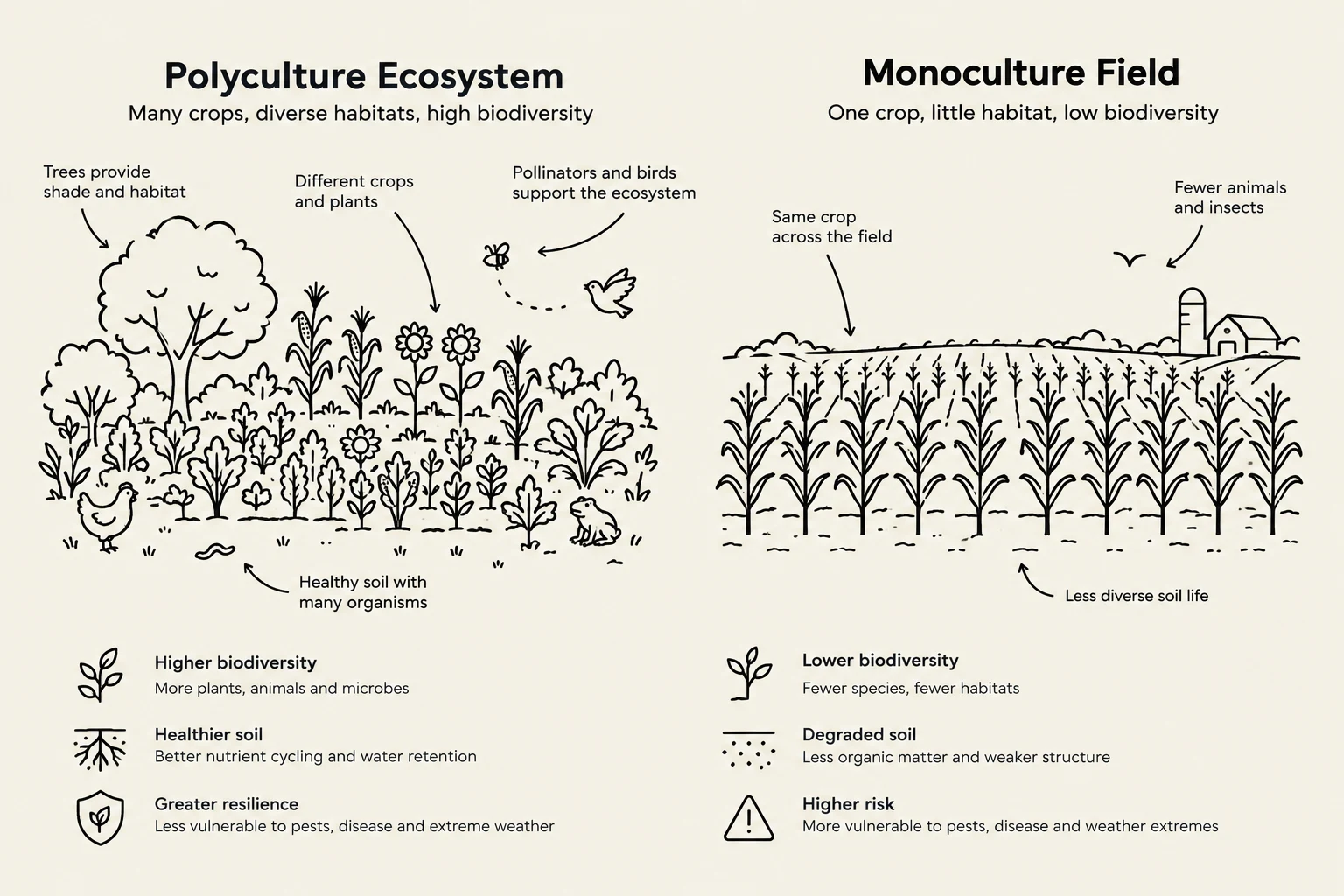
Monocropping involves growing a single species (such as corn, wheat, or soy) over a vast area. This practice is highly efficient for mechanical harvesting and the uniform application of chemicals. However, it leads to several environmental drawbacks:
Decreased Biodiversity: Because only one species is present, the ecosystem becomes more prone to pests and lacks the natural predators that would exist in a diverse environment.
Soil Erosion: Since crops are often harvested all at once, large areas of soil are left bare and unprotected.
Habitat Loss: The lack of plant variety reduces the habitat diversity available for local wildlife.
This illustration compares a polyculture ecosystem with high biodiversity, diverse habitats, and healthier soil to a monoculture field with low biodiversity, limited habitat, and degraded soil, highlighting the benefits of polyculture for resilience and soil health.
Tilling
Tilling is the mechanical process of mixing and breaking up the soil to make planting easier and to loosen the earth for root growth. While beneficial for seed placement, it causes significant degradation:
Loss of Organic Matter: Constant tilling breaks down the soil structure and leads to the loss of topsoil nutrients and organic matter over time.
Air and Water Pollution: Tilling increases particulate matter (PM) in the air, which can act as a respiratory irritant. Furthermore, it increases turbidity in nearby water bodies by allowing loose sediments to wash into the water.
Exam Tip: If asked to differentiate between leaching and percolation, remember that percolation is the physical movement of water through the soil, whereas leaching is the actual loss of dissolved nutrients or chemicals as that water moves through.
Land Clearing and Resource Extraction
Beyond the farm field, other methods of land use significantly alter the landscape and contribute to global environmental changes.
Slash-and-Burn and Clearcutting
Slash-and-burn farming involves cutting down vegetation and burning it to clear land for agriculture and return nutrients to the soil. While it may provide a short-term nutrient boost, it is ineffective in the long run due to rapid loss of soil fertility. It also contributes to deforestation, releases greenhouse gases (such as CO2, CO, and N2O), and lowers the area's albedo, making it warmer.
Similarly, clearcutting—the removal of all trees in a specific area—reduces the environment's ability to perform CO2 sequestration and disrupts local ecosystems.
Mining and Urbanization
Human impact extends to resource extraction and city building. Surface mining is more common than the more expensive subsurface mining, but both produce waste products known as slag and tailings.
In urban areas, the creation of impervious surfaces (like concrete and asphalt) prevents water from soaking into the ground, a process known as infiltration. This leads to increased urban runoff, which can carry pollutants into local waterways.
This diagram illustrates how impervious surfaces like roads and buildings prevent rainwater infiltration, leading to increased surface runoff that carries pollutants into local waterways.
Water Management and Irrigation
Agriculture is one of the largest consumers of water globally. The method of irrigation used determines both the efficiency of water use and the potential for soil damage.
Irrigation Efficiency
Irrigation methods can be ranked from most efficient to least efficient:
Drip Irrigation (Most efficient)
Spray Irrigation
Furrow Irrigation
Flood Irrigation (Least efficient)
Irrigation-Related Issues
Improper or excessive irrigation can lead to several detrimental effects:
Waterlogging: The excessive saturation of soil with water.
Salinization: The buildup of salts in the soil, a common problem in arid regions where irrigation water evaporates and leaves minerals behind.
Aquifer Depletion: The over-extraction of groundwater at a rate faster than it can naturally recharge.
Sustainable Alternatives and the Human Footprint
To mitigate these impacts, scientists and farmers are looking toward more sustainable models.
Integrated Pest Management (IPM)
Instead of relying solely on synthetic pesticides—which can lead to leaching of nitrates and phosphates into groundwater and cause eutrophication in surface waters—farmers can use Integrated Pest Management (IPM). IPM uses a combination of biological and mechanical controls to manage pests with fewer chemical inputs.
Meat Production and Aquaculture
Meat production, particularly through Concentrated Animal Feeding Operations (CAFOs), offers high efficiency but requires massive amounts of water and contributes significantly to CO2 emissions. Aquaculture (fish farming) provides an alternative food source but faces its own set of sustainability challenges.
The Tragedy of the Commons and the Ecological Footprint
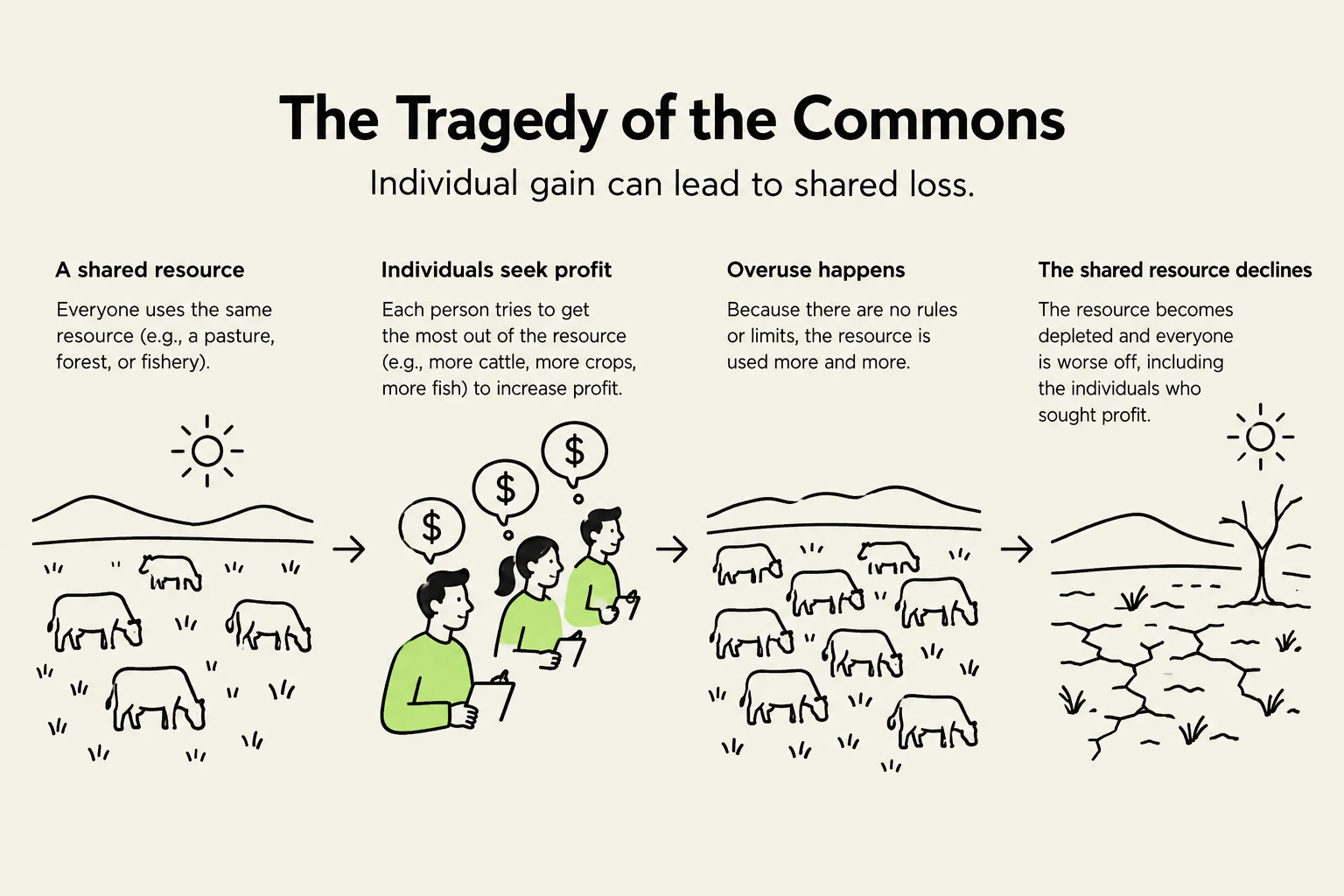
Many of these environmental issues are driven by the Tragedy of the Commons, a concept where individuals acting in their own self-interest deplete shared resources, such as through overfishing.
To measure the cumulative impact of these human activities, scientists use the ecological footprint, which calculates the total amount of resources required to support a specific population's lifestyle.
The Tragedy of the Commons illustrates how individual pursuit of gain can lead to shared loss, depicting the depletion of a shared resource due to overuse.
Keep reading for free.
Create an account to finish this reading and make it part of your study routine.