This content explores the spectrum of AI innovation, including Generative AI and Agentic AI, and their impact on entrepreneurial growth strategies such as Product-Led Growth (PLG), Sales-Led Growth (SLG), and operational efficiency. It also covers developing AI capabilities, managing risks, and practical applications i
In the modern business landscape, Artificial Intelligence (AI) is no longer just a tool for automation; it is a fundamental shift in how value is created and captured. For entrepreneurs, AI represents a spectrum of innovation that ranges from incremental improvements to radical shifts in business models. As a "general purpose technology," AI has the potential to impact almost every sector of the economy, driving both disruptive innovation and significant gains in productivity.
Understanding the AI Innovation Spectrum
To leverage AI effectively, entrepreneurs must distinguish between the different types of intelligence currently reshaping the market.
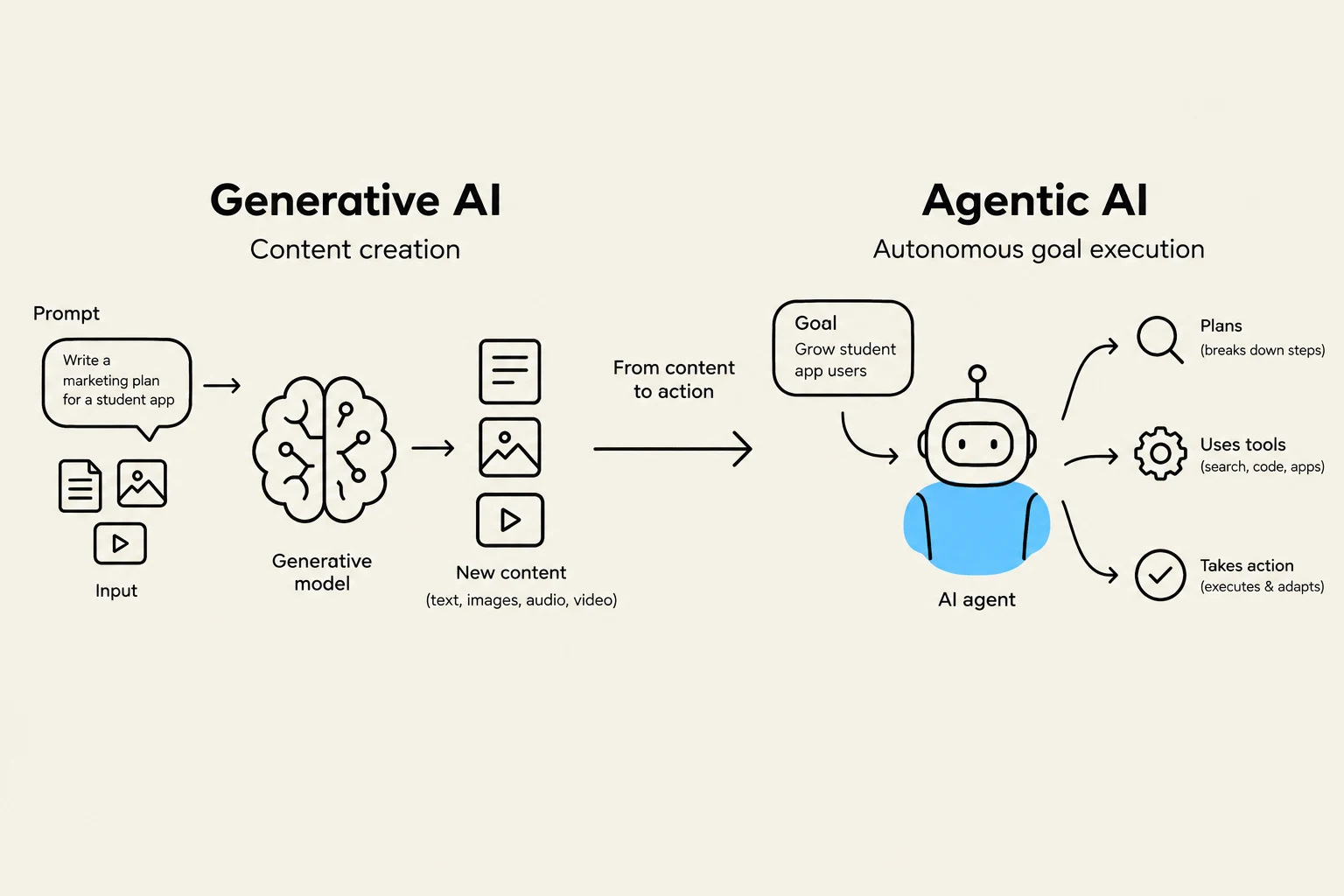
Generative AI refers to systems capable of creating entirely new content—such as text, images, or code—by learning complex patterns from existing datasets. This is the technology behind many of the "growth hacking" tools used today.
Agentic AI represents the next frontier. These are advanced systems designed to act autonomously. Unlike standard chatbots, agentic systems can make decisions, utilize external tools, and execute multi-step workflows to achieve a specific goal without constant human intervention.
This diagram illustrates the difference between Generative AI, which creates content from input, and Agentic AI, which executes autonomous goals by using tools and taking action.
The impact of these technologies can be categorized by their level of disruption:
Radical Innovation: Creating entirely new markets or value networks.
Disruptive Innovation: Transforming existing markets by offering simpler, more accessible, or cheaper alternatives.
AI-Driven Growth Strategies
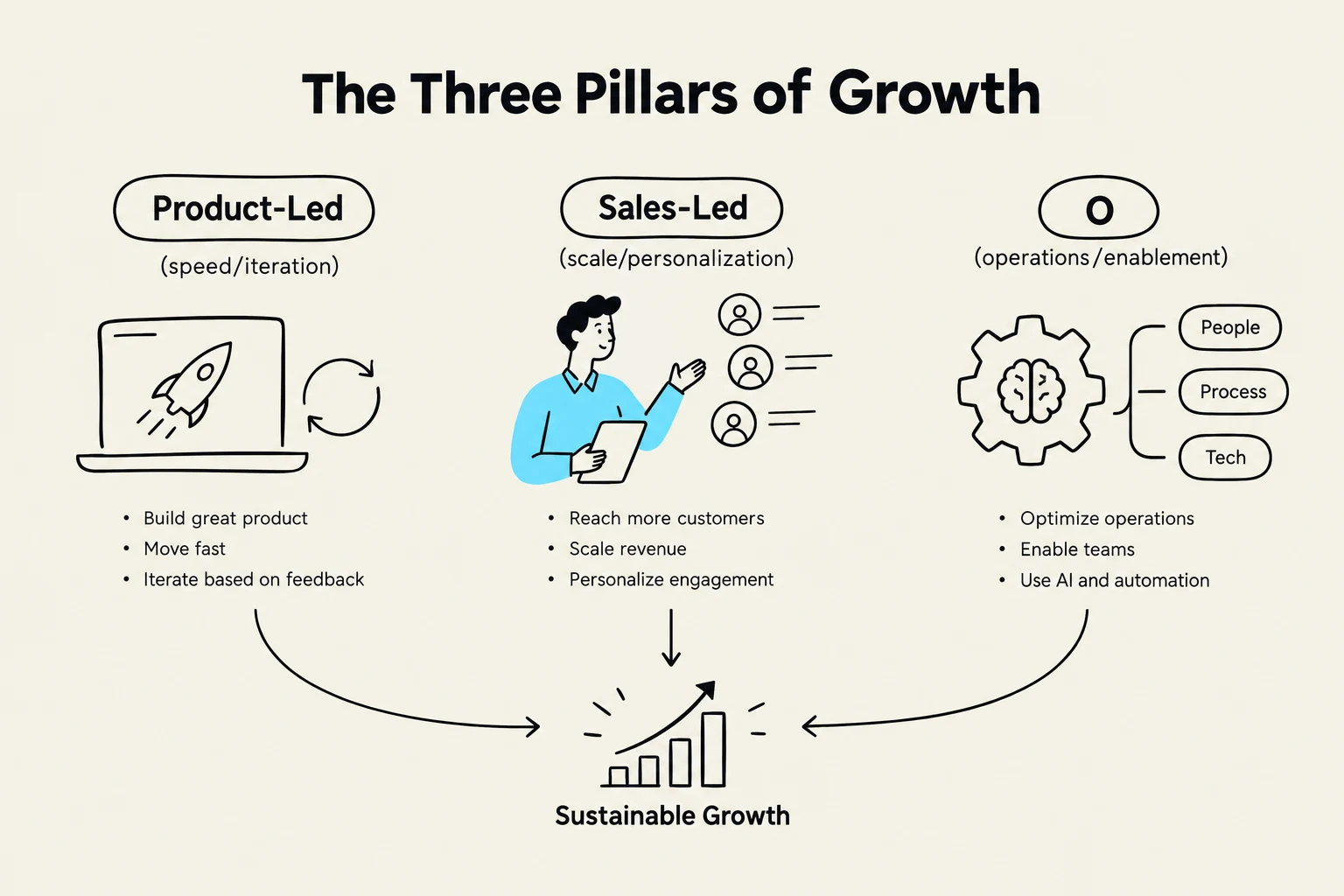
Start-ups often face severe resource constraints. They require creative, cost-effective ways to scale without massive capital injections. AI supports this through three primary growth levers: Product-Led, Sales-Led, and Operational Efficiency.
1. Product-Led Growth (PLG)
In a product-led model, the product itself is the primary driver of customer acquisition and expansion. AI accelerates this by enabling faster development cycles through coding assistance, code verification, and the automated generation of user stories and documentation.
The PLG Tension: While AI allows a team to build 10× faster, it also increases the risk of building the wrong product 10× faster. Speed does not guarantee value; the team must still ensure they are solving a real customer need.
2. Sales-Led Growth (SLG)
Sales-led growth relies on marketing, sales teams, and direct customer relationships to drive revenue. AI empowers this by scaling communication and hyper-personalization.
Growth Challenge
LLM Use Case Solution
Over-reliance on paid marketing
SEO & Social-Media content production
Identifying Ideal Customer Profile (ICP)
Idea generation for market-entry and pain points
Customer Churn
Hyper-personalized outreach and "Chatbots 2.0"
Fundraising
Investor research assistants and outreach drafting
The SLG Tension: There is a fine line between genuine personalization and "targeted persuasion." Entrepreneurs must consider the ethics of using AI to decide exactly which message will trigger a purchase.
3. Operational Efficiency
This strategy focuses on making internal processes more resource-saving. AI can brainstorm ideas, analyze market sizes, and process massive volumes of text for internal knowledge management.
The diagram illustrates the three pillars of growth: Product-Led (speed/iteration), Sales-Led (scale/personalization), and Operations/Enablement (operations/enablement), all contributing to Sustainable Growth.
Developing AI Capabilities and Managing Risk
Simply adopting technology is not enough; entrepreneurs must develop specific "AI Knowledge" sets to remain competitive:
AI Feature Knowledge: Understanding what GenAI can actually do.
AI Refining Knowledge: Mastering prompts and iterative improvement.
AI Combinatory Knowledge: Connecting AI with other existing workflows.
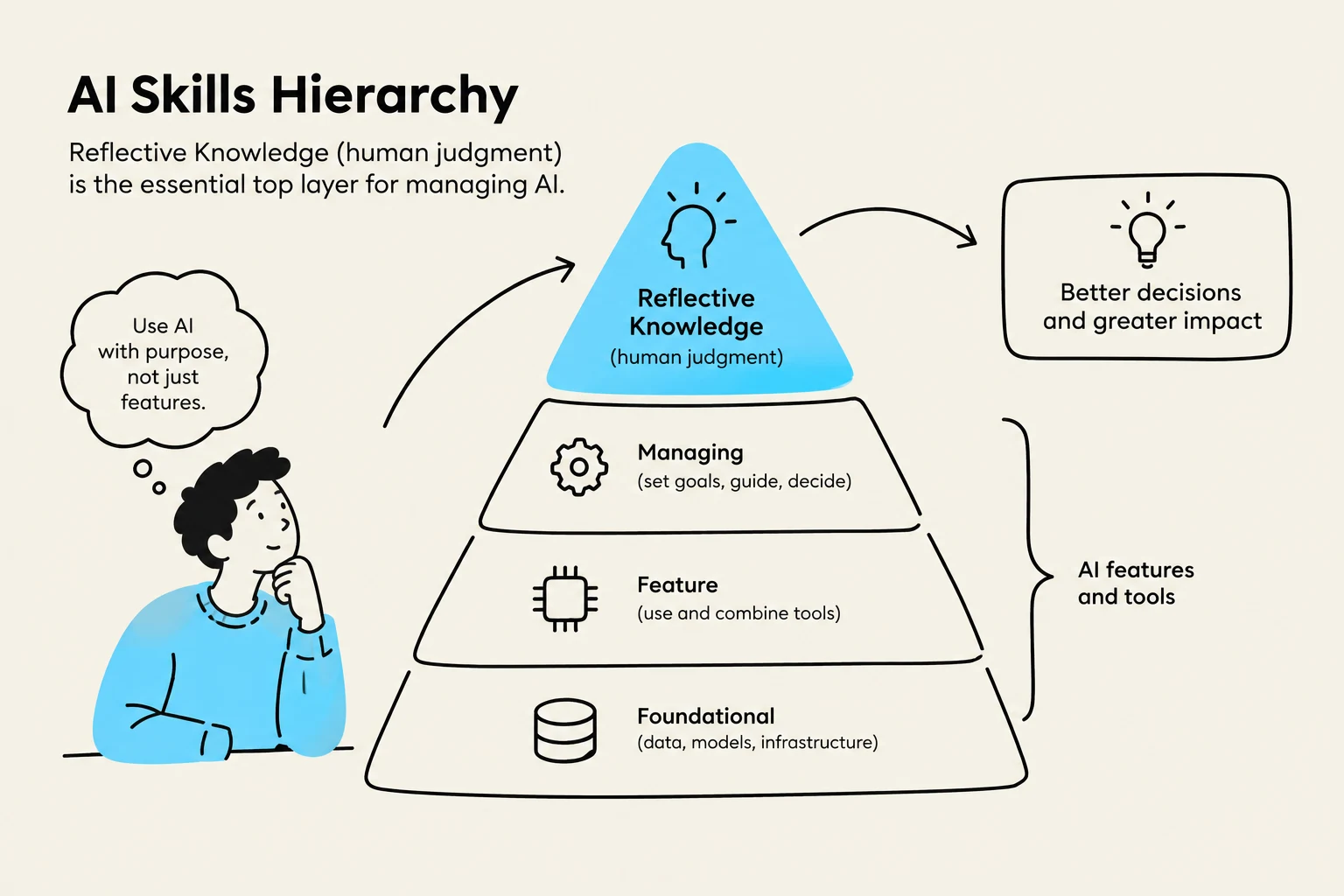
Reflective Knowledge: Using human judgment to detect bias, hallucinations, and copyright issues.
The AI Skills Hierarchy illustrates the essential layers for managing Artificial Intelligence, emphasizing Reflective Knowledge (human judgment) as the top tier, followed by Managing, Feature utilization, and Foundational elements like data and infrastructure. The diagram also highlights the outcome of better decisions and greater impact when AI is used with purpose.
Implementation and Risks
Successful implementation requires more than just software. It requires Leadership (C-level buy-in), Bottom-up ideas (employee-driven innovation), and a culture where AI is seen as an accelerator rather than a replacement for human jobs.
Entrepreneurs must also navigate three tiers of risk:
Organizational: Privacy, security, bias, and intellectual property.
Competitive: Pressure to adopt quickly and dependence on AI providers.
Societal: Environmental costs and unintended social consequences.
Exam Tip: The "Human" Element. When discussing AI implementation, always emphasize that technology alone is not a strategy. Successful adoption depends on people, leadership, and the ability to decide which tasks should remain human-centric.
Practical Application: Ideation and Validation
To move from theory to practice, use these structured approaches for initial research phases:
For Ideation:
Ask an LLM to act as a TRIZ expert (a systematic problem-solving methodology).
Set strict constraints: "Every idea must be genuinely distinct with no more than 10% overlap with existing solutions".
Validate: Ask the AI to validate its own output for logical coherence and cross-check it with other software.
For Validation:
Use the LLM as a "sparring partner" to simulate The Mom Test (a method for conducting customer interviews without bias).
Provide the AI with your constraints (budget, time, skillset) and ask it to act as a market expert to generate Ideal Customer Profiles (ICPs) and pain points.
Keep reading for free.
Create an account to finish this reading and make it part of your study routine.