Enthalpy and Energy: From Biological Metabolism to Global Consumption
Explore the fundamental concept of enthalpy in thermodynamics, its application in quantifying energy within biological nutrients like glucose and fats, and its role in industrial energy sources such as gasoline and hydrogen. This article also touches upon global energy consumption metrics.
Energy is a fundamental concept that governs everything from the microscopic chemical reactions in our cells to the massive industrial processes that power our cities. Whether it is the kinetic energy of a moving object, the potential energy stored in chemical bonds, or the thermal energy felt as heat, understanding how energy is transferred and transformed is essential to the study of chemistry. This article explores the concept of enthalpy and how it allows us to quantify the energy contained within biological nutrients and industrial fuels.
Understanding Enthalpy
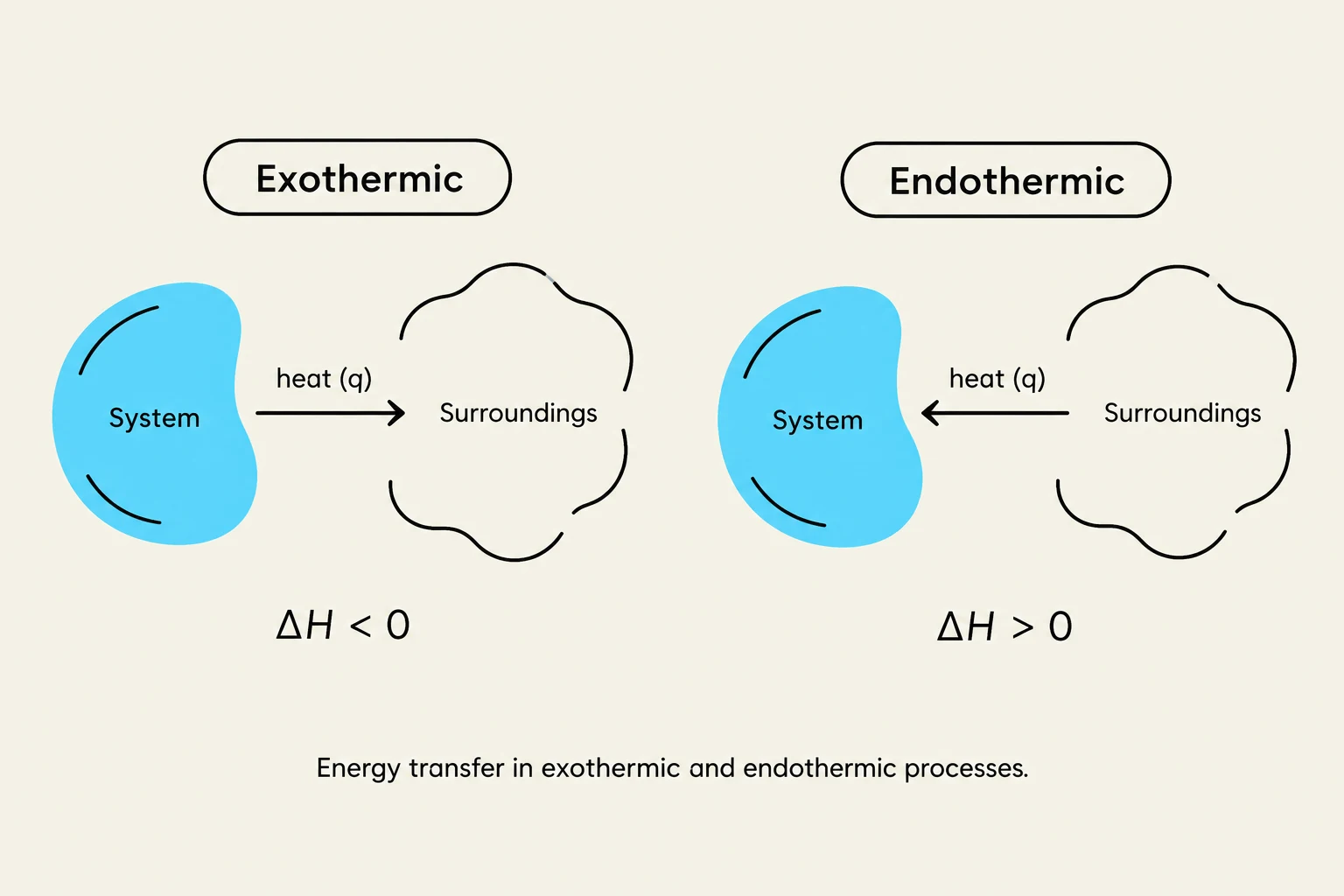
Energy transfer in exothermic and endothermic processes.
In thermodynamics, we distinguish between a "system" (the specific part of the universe we are studying, such as a chemical reaction) and the "surroundings" (everything else). When energy is transferred into or out of a system, it can take the form of work (w) or heat (q).
One of the most important quantities in chemistry is enthalpy (H). For processes occurring in an open system at constant pressure, the change in enthalpy (ΔH) is equal to the heat transferred. We define the change as:
ΔH=Hfinal−Hinitial
Based on the sign of ΔH, we can classify reactions into two types:
Exothermic reactions (ΔH<0): Heat is released from the system to the surroundings (e.g., burning fuel).
Endothermic reactions (ΔH>0): Heat is absorbed by the system from the surroundings (e.g., melting ice).
Enthalpy is a state function, meaning the total change in enthalpy depends only on the initial and final states of the system, not on the specific path taken to get there.
Biological Energy: Glucose vs. Fats
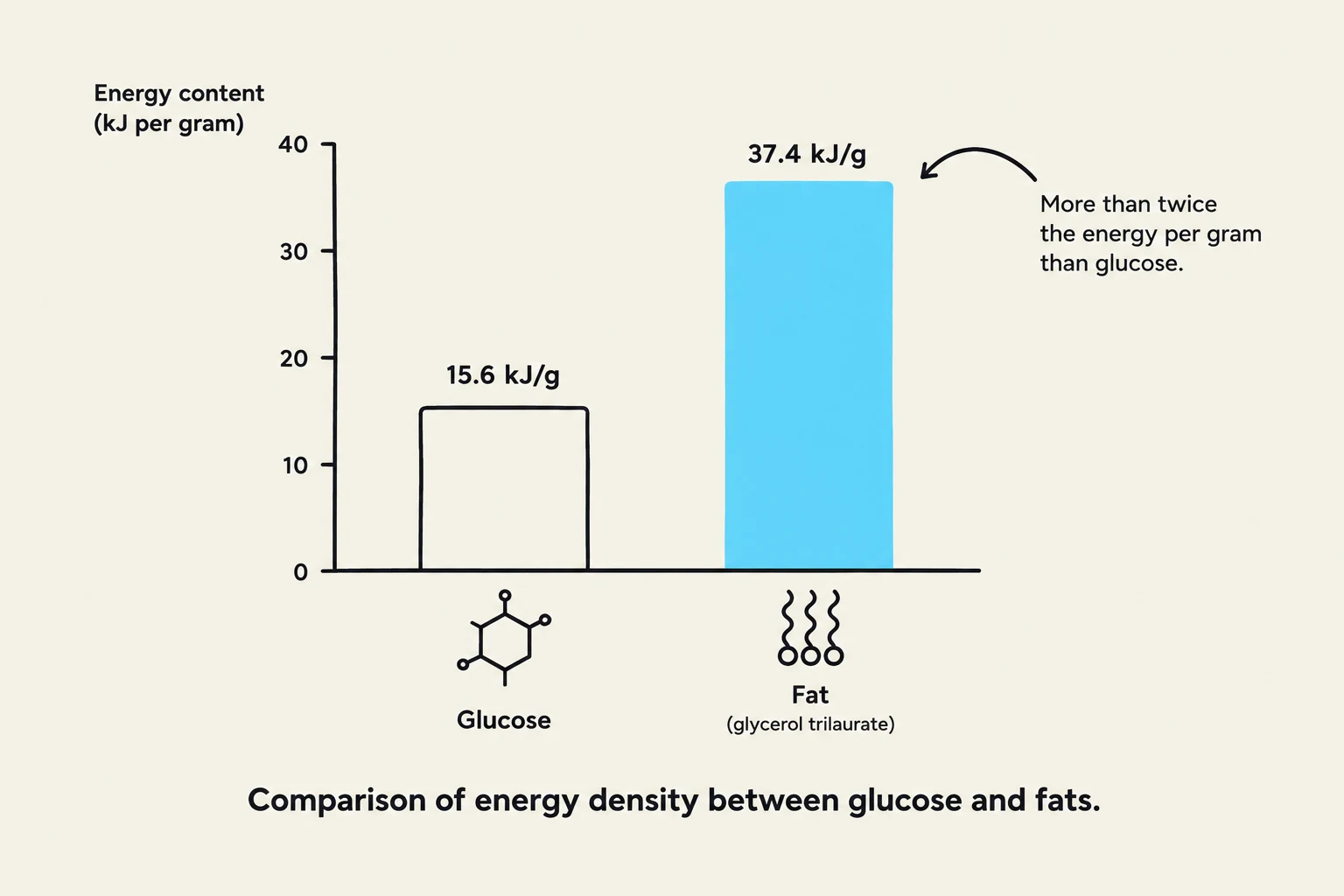
This bar chart compares the energy content per gram of glucose and fat. Fat has an energy density of 37.4 kJ/g, while glucose has an energy density of 15.6 kJ/g, indicating that fats provide more than twice the energy per gram compared to glucose.
Living organisms obtain energy through the metabolic oxidation of nutrients. By applying the principles of combustion enthalpy, we can compare the energy density of different food groups.
Glucose Metabolism
Glucose (C6H12O6) is a primary carbohydrate used by the body. The overall metabolic reaction for glucose is:
C6H12O6(s)+6O2(g)→6CO2(g)+6H2O(l)
The standard enthalpy change for this reaction is ΔH=−2803 kJ/mol, which translates to approximately −15.6 kJ/g.
Fat Energy Content
In contrast, dietary fats are much more energy-dense. Consider glycerol trilaurate (C39H74O6), a typical fat molecule. Its combustion yields:
ΔH=−23900 kJ/mol
This equates to roughly −37.4 kJ/g. Because fats provide more than double the energy per gram compared to carbohydrates, the human body uses fat as a highly efficient long-term storage mechanism, whereas carbohydrate storage capacity is quite limited.
Exam Tip: When calculating energy from mass, always check if the enthalpy is provided in kJ/mol or kJ/g. If it is in kJ/mol, you must use the molar mass to convert to grams.
Quantifying Intake: The Food Calorie
In nutrition, we use the Food Calorie (capitalized Cal) to measure energy intake. Note the distinction between the small calorie (cal) and the large Calorie (kcal):
1 Cal=1 kcal=1000 cal
1 Cal=4180 J
A typical daily diet for an adult is approximately 3000 Cal/day, which totals 12.5 MJ of energy.
Industrial Energy: Gasoline and Hydrogen
The same thermodynamic principles used to study food apply to chemical fuels like octane (C8H18), the primary component of gasoline.
Worked Example: Fuel Requirements
Suppose we want to determine how much gasoline (assumed to be octane) is required to meet a daily requirement of 3000 Cal.
1. Identify the combustion reaction and enthalpy:C8H18(l)+12.5O2(g)→8CO2(g)+9H2O(g)ΔHcombustion=−5506.2 kJ/mol
2. Given constants:
Molar mass (M) = 114.2 g/mol
Density (ρ) = 0.70 g/mL
3. Calculation:
First, convert the daily energy requirement to Joules:
3000 Cal×1000Calcal×4.18calJ=12,540,000 J=12.54×10⁶ J
Next, find the moles of octane needed:
5506.2×103 J/mol12.54×106 J≈2.277 mol
Convert moles to grams:
2.277 mol×114.2 g/mol≈260 g
Convert grams to volume using density:
Volume=0.70 g/mL260 g≈372 mL
Thus, you would need approximately 372 mL of gasoline to meet that energy demand.
Hydrogen as a Future Fuel
Hydrogen (H2) is an interesting energy source because its combustion produces only water:
H2(g)+21O2(g)→H2O(g)ΔH=−242 kJ/mol
While hydrogen has a high energy content per unit of mass, it is difficult to store. It must be compressed in heavy steel tanks, cooled to a liquid state (−253∘C), or stored in solid compounds like metal hydrides.
Global Energy Consumption
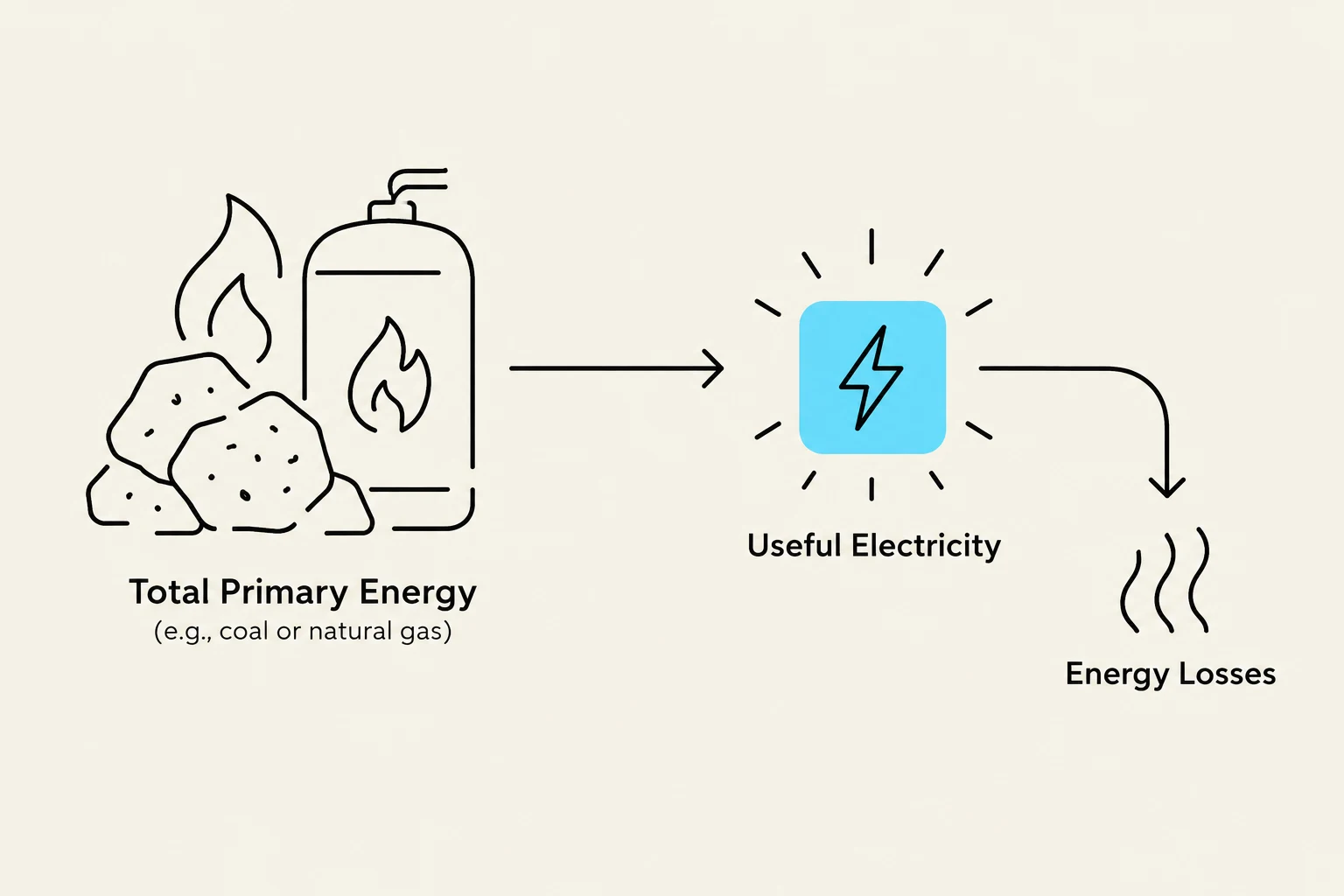
This diagram illustrates the conversion of total primary energy, such as coal or natural gas, into useful electricity, with a portion lost as energy losses.
On a macro scale, scientists measure global energy consumption in terawatt-hours (TWh) of direct primary energy. This metric is crucial because it accounts for the total energy contained within fossil fuels, including the energy lost due to inefficiencies during the production and conversion processes (such as the conversion of coal to electricity).
As shown in historical data, the global energy mix has transitioned from traditional biomass and coal toward a more diverse range of sources, including natural gas, nuclear, and increasingly, renewables like wind and solar.
Keep reading for free.
Create an account to finish this reading and make it part of your study routine.