Explains the fundamental concepts of metabolism, energy transformation, and the laws of thermodynamics. Details the four main stages of aerobic cellular respiration: glycolysis, pyruvate oxidation, the Krebs cycle, and oxidative phosphorylation, including ATP production.
All living organisms require energy to survive, grow, reproduce, and maintain complex biological functions. Whether it is a hummingbird maintaining a heart rate of 1000 beats per minute or a human walking across a room, the ability to transform energy is fundamental to life. This transformation occurs through metabolism, the sum of all chemical reactions within a cell. These reactions are organized into metabolic pathways, where the product of one reaction becomes the substrate for the next, each step catalyzed by a specific enzyme.
The Fundamentals of Metabolism and Energy
Metabolism is divided into two opposing but complementary processes: catabolism and anabolism. Catabolic pathways break down complex, energy-rich molecules (like glucose) into smaller ones to release energy. Conversely, anabolic pathways use that released energy to build complex molecules, such as proteins or fats.
Energy itself is the capacity to do work. It is generally classified as kinetic energy (the energy of motion) or potential energy (stored energy). In biological systems, we are most interested in chemical energy, a form of potential energy stored within the arrangement of molecular bonds.
The movement and transformation of energy are governed by the laws of thermodynamics:
First Law (Law of Conservation of Energy): Energy cannot be created or destroyed, only transformed from one type to another.
Second Law: Every energy transfer increases the entropy, or disorder, of the universe.
To determine if a reaction can proceed, scientists look at free energy (G), which is the energy available to do work. The change in free energy (ΔG) is calculated as:
ΔG=ΔH−TΔS
Where ΔH is enthalpy (bond energy), T is temperature, and ΔS is entropy.
Exam Tip: If ΔG is negative, the reaction is exergonic (spontaneous, releasing energy). If ΔG is positive, the reaction is endergonic (non-spontaneous, requiring energy input).
Cells drive endergonic reactions by using coupled reactions. They take the energy released from an exergonic reaction and use it to power an endergonic one. The primary "energy currency" used for this coupling is ATP (adenosine triphosphate).
Aerobic Cellular Respiration: An Overview
Aerobic respiration is the catabolic process of oxidizing glucose to produce ATP in the presence of oxygen. While the overall process can be summarized as the conversion of glucose and oxygen into carbon dioxide, water, and energy, it actually involves dozens of individual steps.
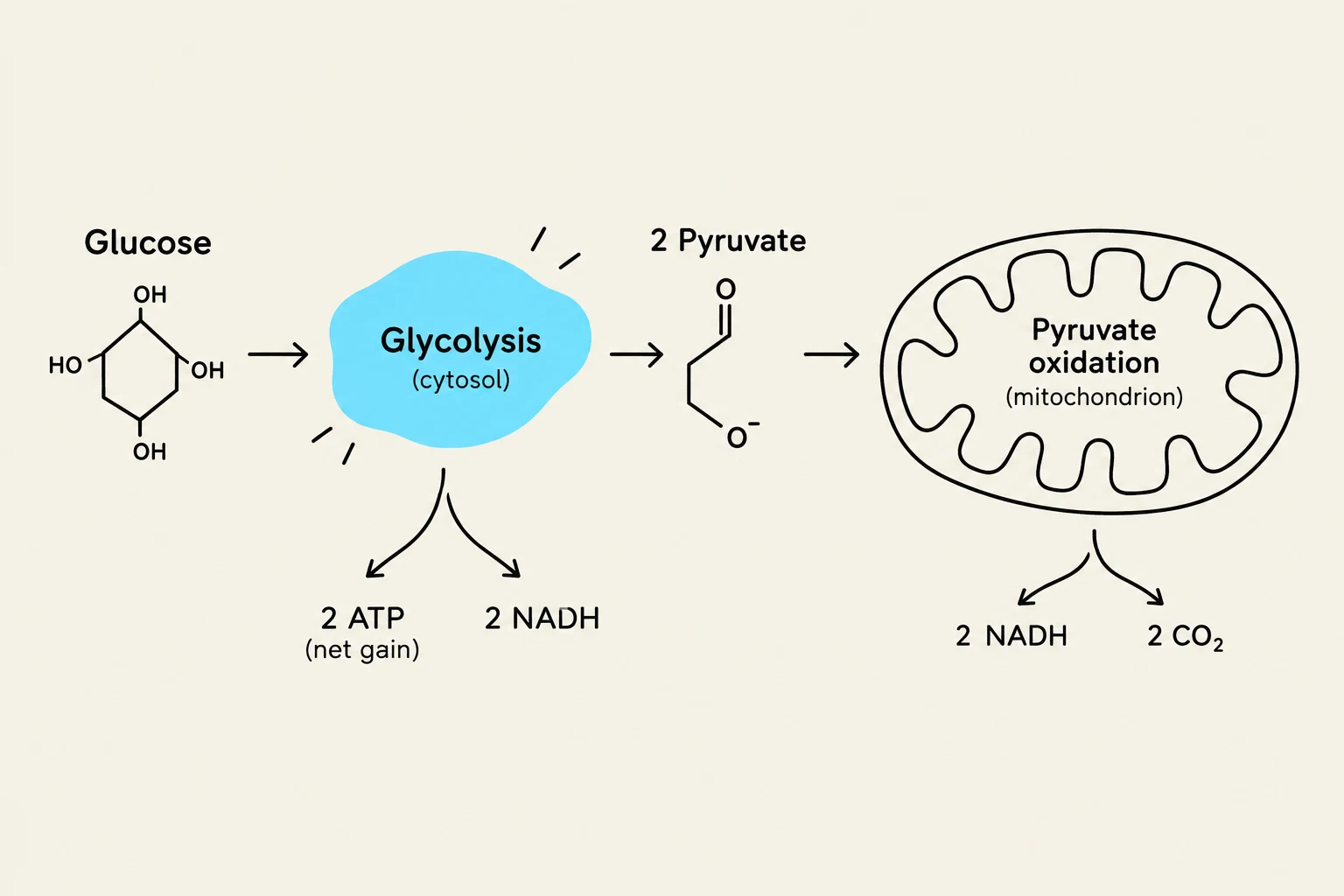
This diagram illustrates the process of cellular respiration, starting with glucose undergoing glycolysis in the cytosol to produce pyruvate, ATP, and NADH. Pyruvate then enters the mitochondrion for oxidation, yielding more NADH and carbon dioxide.
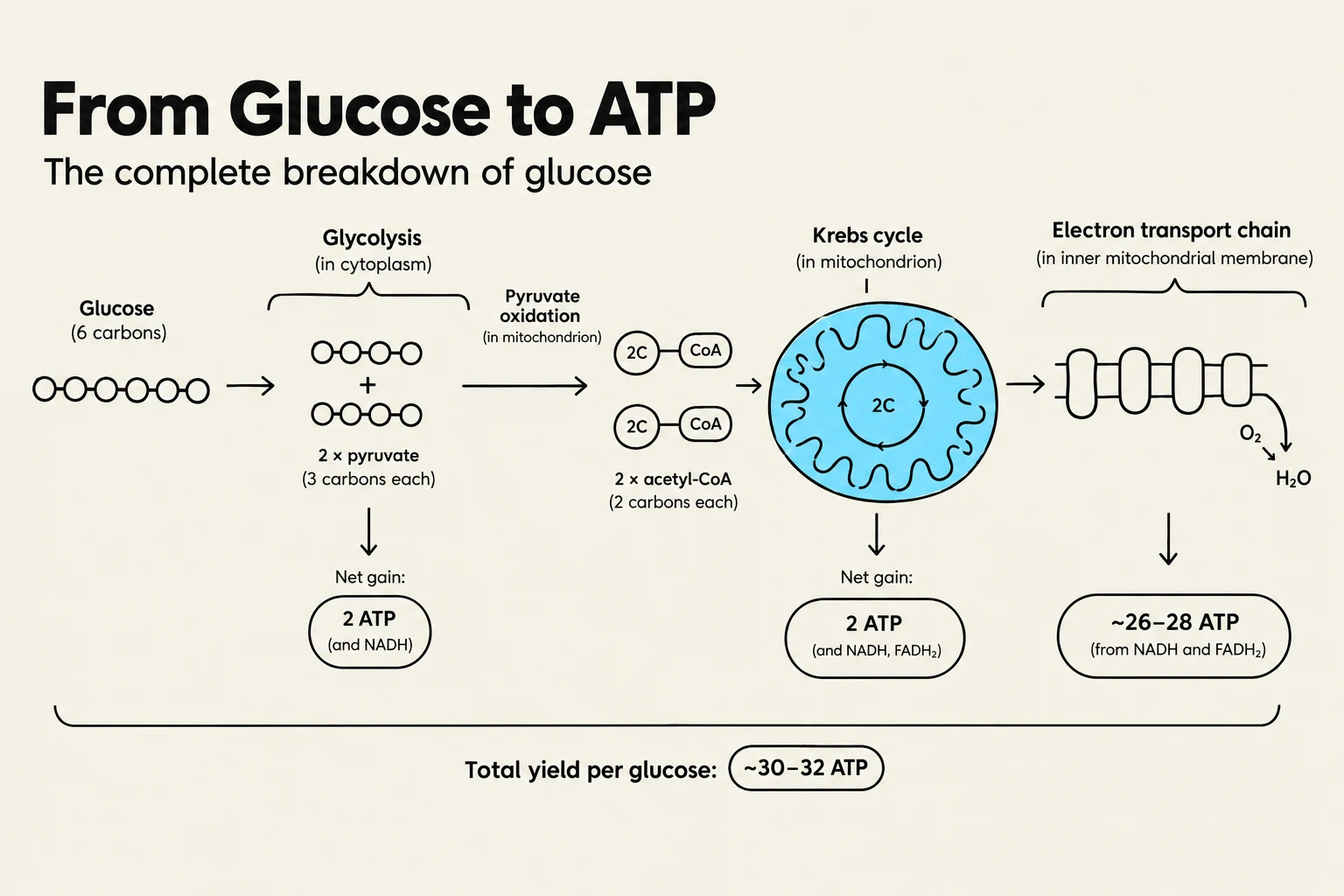
The process is divided into four main stages: glycolysis, pyruvate oxidation, the Krebs cycle, and oxidative phosphorylation.
1. Glycolysis
Glycolysis occurs in the cytosol of the cell and is the only stage that does not require oxygen. During this process, a single six-carbon glucose molecule is "split" into two three-carbon molecules called pyruvate.
While glycolysis requires an initial investment of 2 ATP, it produces 4 ATP through substrate-level phosphorylation (the direct transfer of a phosphate group to ADP). This results in a net gain of 2 ATP and the reduction of two NAD+ molecules into NADH, which act as high-energy electron carriers.
2. Pyruvate Oxidation
When oxygen is present, the pyruvate molecules move from the cytosol into the mitochondrial matrix. Here, each pyruvate is oxidized to form a two-carbon molecule called acetyl-CoA. This step releases one molecule of CO2 per pyruvate and produces one NADH per pyruvate.
3. The Krebs Cycle (Citric Acid Cycle)
The acetyl-CoA then enters the Krebs cycle (also known as the citric acid cycle) within the mitochondrial matrix. In this cyclical pathway, the acetyl group is completely oxidized.
For every turn of the cycle, the cell produces:
1 ATP (via substrate-level phosphorylation)
3 NADH
1 FADH2 (another important electron carrier)
CO2 as a byproduct
Because one glucose molecule produces two acetyl-CoA molecules, the cycle turns twice per glucose, doubling these yields.
4. Oxidative Phosphorylation
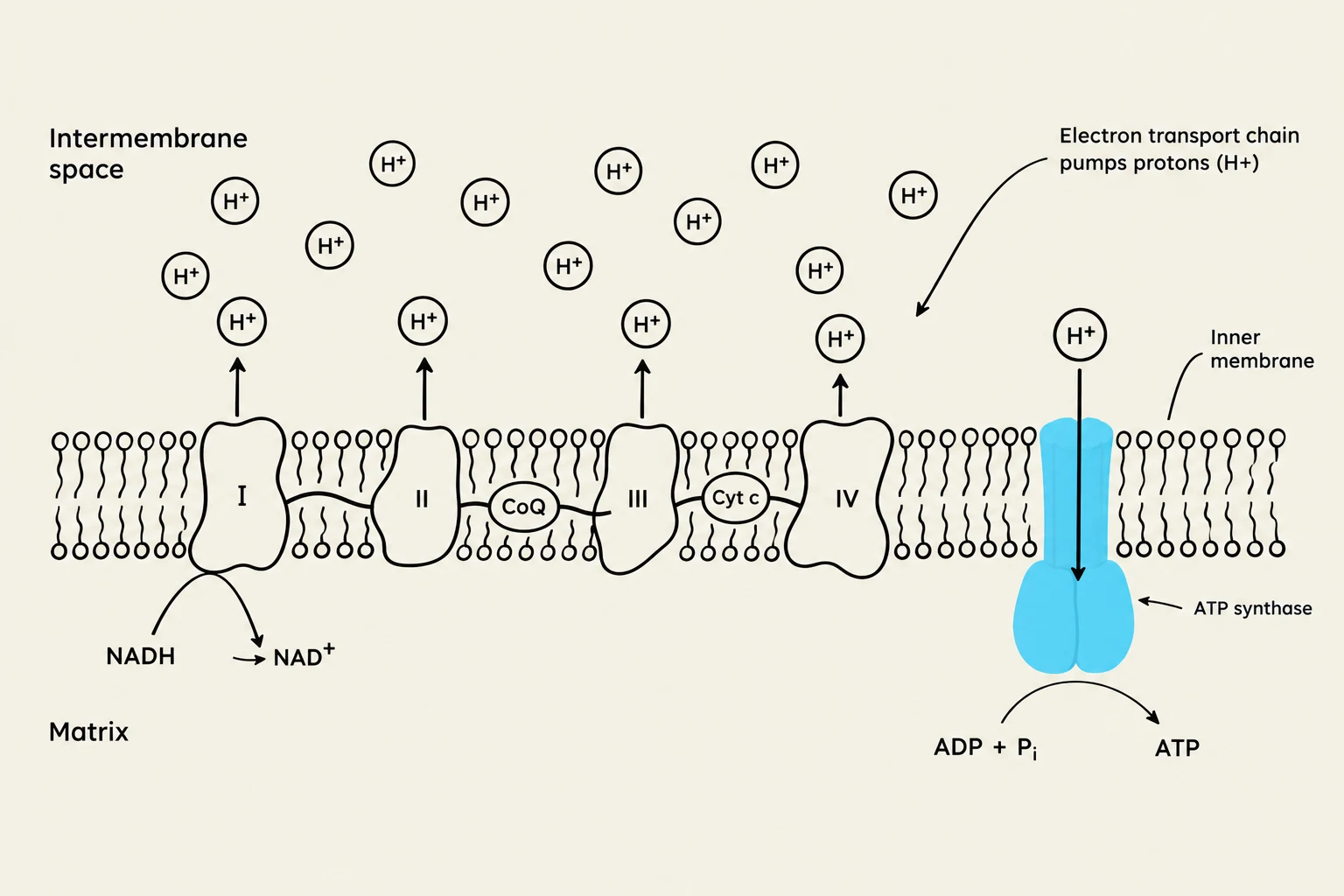
The final and most productive stage is oxidative phosphorylation, which takes place on the inner mitochondrial membrane. This stage consists of two tightly linked processes: the electron transport chain (ETC) and chemiosmosis.
First, the electron carriers NADH and FADH2 donate their high-energy electrons to the electron transport chain. As these electrons move through a series of proteins in the membrane, they release energy used to pump protons ($H^+$) from the matrix into the intermembrane space. This creates a significant hydrogen ion gradient (an electrochemical gradient).
Diagram illustrating the process of oxidative phosphorylation in cellular respiration, showing the electron transport chain and ATP synthase embedded in the inner mitochondrial membrane.
Finally, through chemiosmosis, these protons flow back down their concentration gradient into the matrix through a specialized enzyme called ATP synthase. The movement of protons acts like water flowing through a dam, providing the mechanical energy necessary for ATP synthase to phosphorylate ADP into ATP.
Summary Table: ATP Yield per Glucose
Stage
Method of ATP Production
Net ATP Yield
Glycolysis
Substrate-level phosphorylation
2 ATP
Krebs Cycle
Substrate-level phosphorylation
2 ATP
Oxidative Phosphorylation
Chemiosmosis (via ETC)
~26–34 ATP
Total
~30–38 ATP
Note: Actual yields vary between eukaryotes and prokaryotes.
Summary of Energy Flow
In the absence of oxygen, cells cannot perform oxidative phosphorylation and must rely on fermentation to regenerate NAD+ so that glycolysis can continue. However, aerobic respiration remains the most efficient way to extract energy from organic molecules, utilizing the full potential of the electron transport chain to maximize ATP production.
This diagram illustrates the process of cellular respiration, showing the breakdown of glucose into ATP through glycolysis, pyruvate oxidation, the Krebs cycle, and the electron transport chain.
Keep reading for free.
Create an account to finish this reading and make it part of your study routine.