In the era of rapid digital communication, the line between casual social interaction and formal legal commitment is becoming increasingly blurred. While we often use emojis to convey tone or emotion in text messages, a critical legal question has emerged: Can a single digital icon, such as a "thumbs-up" emoji, constitute a legally binding acceptance of a contract? As businesses move away from traditional paper-based signatures toward instant messaging and email, courts are being forced to decide whether a small yellow icon carries the same weight as a handwritten signature or a formal "I accept" statement.
The Evolution of Contractual Communication
Traditionally, contract formation requires an offer, an acceptance, and consideration. Acceptance is typically expressed through clear, unambiguous language. However, the advent of mobile messaging has introduced a new shorthand for communication. In many professional contexts, a "thumbs-up" is used to acknowledge receipt of information or to signal agreement with a proposal.
The legal challenge lies in the ambiguity of intent. Does a 👍 mean "I have read this," "I agree to these terms," or simply "I acknowledge your message"? Because emojis are inherently subjective and context-dependent, they do not always provide the "meeting of the minds" required for a valid contract.
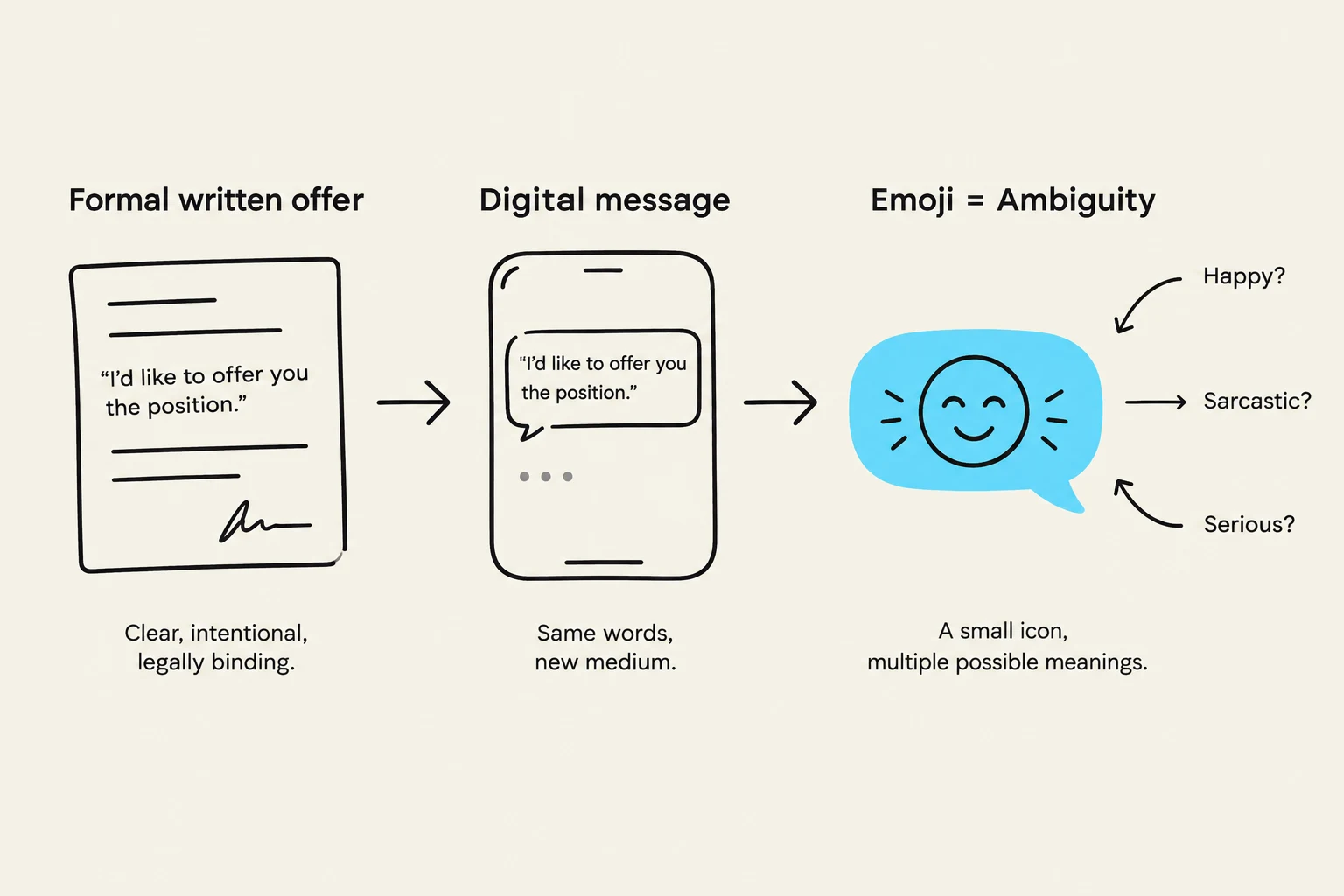
This illustration demonstrates how the same phrase, "I'd like to offer you the position," can be interpreted differently depending on the medium. A formal written offer is clear and legally binding, while a digital message with the same words can be ambiguous, especially when accompanied by an emoji that can have multiple meanings, such as happy, sarcastic, or serious.
Exam Tip: When analyzing whether an emoji constitutes assent, always look for the "objective test." Courts generally do not care what a party subjectively thought; they care how a reasonable person in the position of the other party would interpret the icon based on the surrounding context.
Case Study: South West Terminal Ltd. v. Achter Land
The most significant precedent regarding this issue comes from the Canadian case South West Terminal Ltd. v. Achter Land. In this matter, a grain buyer sent a contract via text message to a farmer. The farmer responded to the contract with a "thumbs-up" emoji.
The dispute arose when the buyer attempted to back out of the deal, arguing that the emoji was merely an acknowledgment and not a formal signature or acceptance. However, the court ruled that the thumbs-up emoji did, in fact, constitute a valid acceptance of the contract.
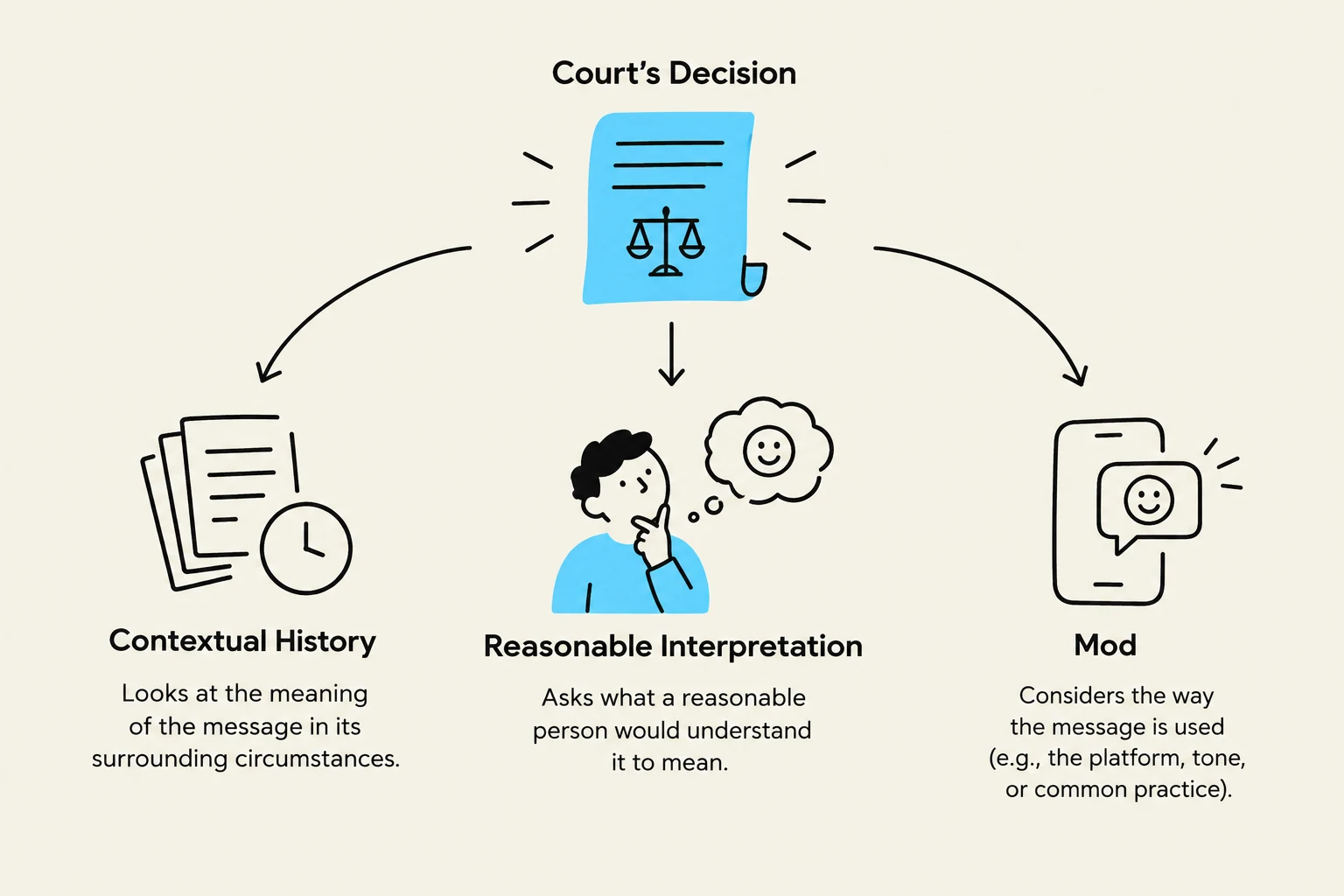
The court's reasoning was grounded in several key factors:
Context of Communication: The parties had a history of conducting business via text, establishing a pattern of digital communication.
Reasonable Interpretation: In the context of the conversation, a reasonable person would interpret the thumbs-up as an agreement to the terms presented.
Modern Usage: The court recognized that digital icons have become a standard part of modern linguistic expression, often serving as functional equivalents to traditional affirmations.
This diagram illustrates three factors considered in legal interpretation: Contextual History, Reasonable Interpretation, and Mod (how the message is used).
Analyzing the Ambiguity of Intent
To understand why the court reached this conclusion, we must look at the mathematical-like logic of "reasonable interpretation." If we define I as the interpreted intent and C as the context, the court is essentially arguing that:
I=f(E,C)
Where:
I is the legal intent (assent).
E is the emoji used.
C is the surrounding context (previous messages, industry standards, relationship between parties).
If the context C is highly formal (e.g., a high-stakes merger discussed via formal letter), the same emoji E might result in I=Acknowledgment. However, if the context C is informal and transactional (e.g., a grain sale via text), the same emoji E results in I=Assent.
Variables that Influence Legal Weight
Factor
High Weight for Assent
Low Weight for Assent
Platform
Direct messaging/Texting
Formal Email/PDF
Relationship
Established business partners
First-time strangers
Clarity of Offer
Clear, single-item proposal
Complex, multi-page document
Emoji Type
👍, ✅, 👌
😂, 🙏, 🤷
This diagram illustrates how the interpretation of an emoji can vary based on the communication platform and the relationship between the sender and receiver, affecting its legal weight.
Practical Implications for Professionals
The ruling in South West Terminal Ltd. v. Achter Land serves as a warning to professionals across all industries. Relying on "shorthand" in digital communications can lead to unintended legal obligations.
To mitigate the risk of accidental contract formation through emojis, consider the following best practices:
Explicit Language: When an agreement is reached, follow up with a text or email that uses clear, verbal language: "I confirm my acceptance of the terms outlined above."
Disclaimers: In professional settings, include a standard disclaimer in email signatures or automated responses stating that emojis do not constitute formal legal acceptance.
Standardized Protocols: Establish clear communication protocols with clients and partners regarding which platforms and methods are used for binding decisions.
Conclusion
The legal weight of an emoji is not found in the icon itself, but in the context in which it is deployed. As demonstrated by the South West Terminal Ltd. case, courts are increasingly willing to interpret digital icons through the lens of modern communication habits. While a thumbs-up might feel casual, in the eyes of the law, it can be as binding as a pen on paper.
Keep reading for free.
Create an account to finish this reading and make it part of your study routine.