Elements of Leader Character: From Self-Awareness to AI-Era Leadership
This article explores the fundamental elements of leadership, focusing on character, self-awareness, and continuous growth. It delves into the qualities of an individual leader, the challenges and importance of self-awareness, and the process of character building through emotional intelligence. The text also addresses
Leadership is often misunderstood as a position of power or a collection of charismatic behaviors. However, at its core, leadership is a "process of influence"—the ability to motivate and enable others toward a common goal. While we often fall victim to the "romance of leadership"—overestimating how much a single individual's actions drive success while ignoring market factors and collective effort—true leadership effectiveness is measured by high group performance, follower satisfaction, and employee engagement. To move from being a "good" leader to a "great" one, an individual must focus on the fundamental elements of character, self-awareness, and continuous growth.
The Foundation: Qualities of the Individual
Effective leadership begins with the personal attributes of the individual. While approximately 30% of leadership style variation is attributed to heritability, the remaining 70% is shaped by environmental factors, role models, and opportunities for development.
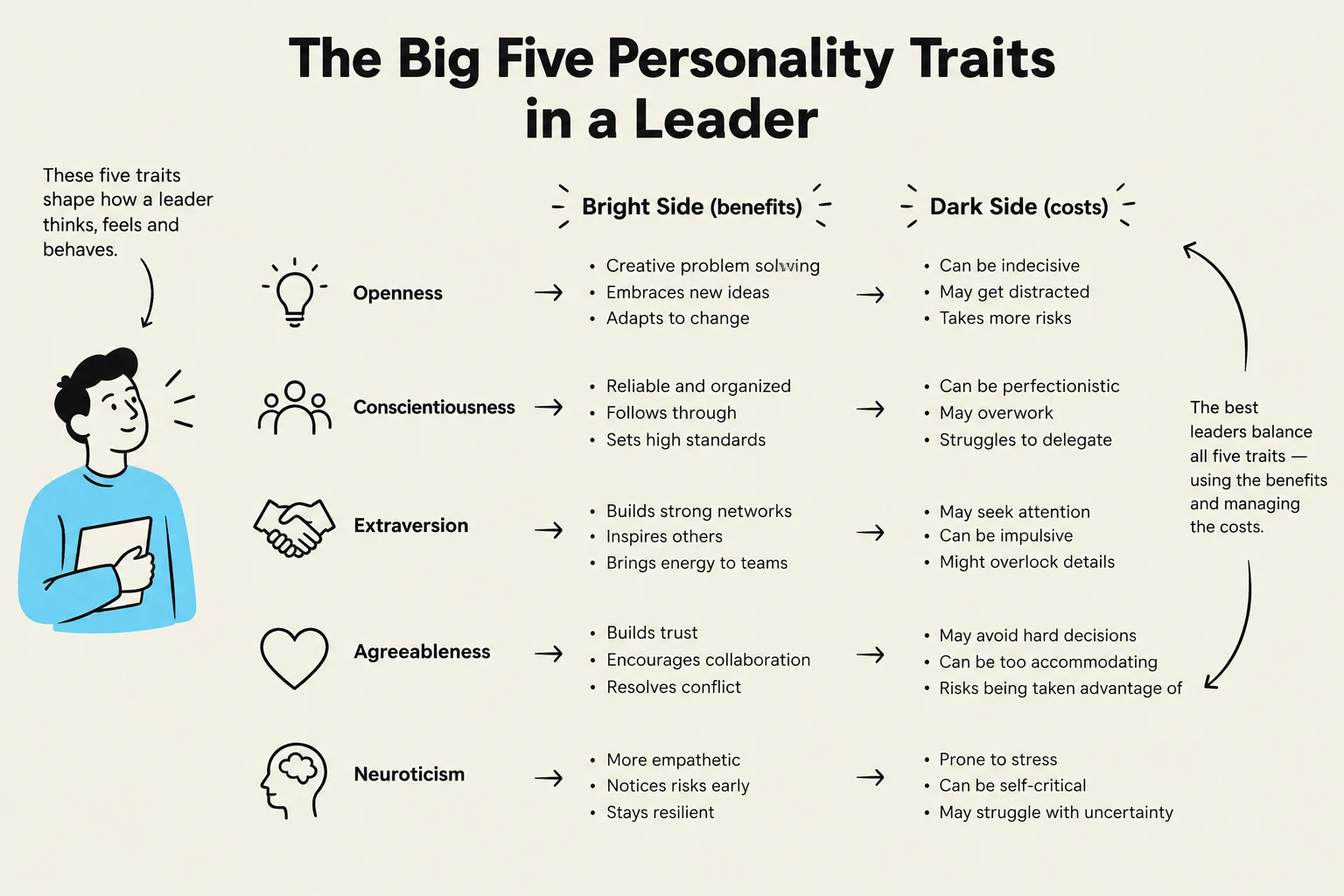
Traits that correlate positively with leadership include basic intelligence, a strong drive for responsibility, vigor, and a willingness to accept the consequences of one's decisions. It is important to distinguish between personality and leadership potential: personality shapes how someone leads, but it does not necessarily determine if they can lead. For example, an extravert might lead more visibly, while a conscientious person builds trust through reliability.
Study Tip: When analyzing leadership cases, distinguish between "Bright Traits" (like conscientiousness and emotional stability) and "Dark Traits" (like narcissism). A leader may be highly successful due to their "bright" traits while simultaneously exhibiting "dark" tendencies that create long-term organizational risk.
The Three Steps to the Fundamental State of Leadership
To achieve the "Fundamental State of Leadership"—a state where individuals actualize their full potential rather than staying within their comfort zones—leaders can follow a three-step progression:
Discover Your Greatness (Self-Awareness): Recognizing your existing strengths and identifying areas for growth.
Develop Your Greatness (Character Building): Treating intelligence and personality as fluid rather than fixed, and engaging in mindful, deliberate practice.
Deliver Your Greatness (Proactive Impact): Using social skills and creative intelligence to create workplaces that bring out the best in others.
This diagram illustrates a three-stage process of personal development: Self-Awareness (Discovery), Character Building (Development), and Proactive Impact. Each stage is associated with specific actions and outcomes, such as understanding values, building positive habits, and taking initiative.
The Mystery and Barriers of Self-Awareness
Self-awareness is the prerequisite for all personal growth, yet it is notoriously difficult to achieve. Many leaders avoid seeking self-knowledge because it can make them feel inferior. Furthermore, several structural barriers exist in professional environments:
Isolation: Managers are often cut off from honest feedback from direct reports.
Hierarchy: Subordinates may fear providing critical feedback to those in power.
Similarity Bias: Managers often hire people who mirror their own image, reducing the likelihood of being challenged.
Time Constraints: The busyness of modern work often leaves no room for the reflection required for true self-knowledge.
Interestingly, research suggests that self-awareness may be more valuable than a traditional MBA. Studies have shown that CEOs with MBAs sometimes perform worse than those without, potentially because standard management education focuses on strategy and spreadsheets rather than the internal qualities of self-awareness.
Character Building and Emotional Intelligence
Character is not a static trait; it is like a muscle that must be strengthened through "exercise". Character building involves finding role models, learning from hardship, and developing consistent habits.
A critical component of this development is Emotional Intelligence (EI). EI is the ability to perceive, understand, and regulate your own emotions and those of others. It consists of four key dimensions:
Self-awareness: Understanding your own emotional meanings.
Self-management: Managing your own emotions to recover from distress.
Social awareness: Perceiving the emotions of others.
Relationship management: Managing the emotions of others to achieve results.
Unlike some personality traits, EI is a set of competencies that can be learned and improved through coaching and feedback.
Navigating the "Dark Triad" and Ethical Challenges
Leadership is a double-edged sword. While certain traits can drive success, the "Dark Triad"—Narcissism, Machiavellianism, and Psychopathy—can lead to devastating organizational consequences:
Narcissism: Characterized by grandiosity and a need for admiration. While narcissists may appear confident and visionary, they often lack empathy and are hypersensitive to criticism.
Machiavellianism: Defined by a pragmatic, "the ends justify the means" mentality. High "Machs" are skilled at manipulation and maintaining emotional distance.
Psychopathy: In a corporate context, this may manifest as "Corporate Psychopathy," where individuals exhibit fearlessness and charm but lack remorse and disregard social norms.
These traits often lead to "moral decoupling," where people separate a leader's high performance from their poor moral character. To combat this, organizations must implement safeguards like transparent decision-making and strong ethical oversight.
The Big Five Personality Traits in a Leader illustrates the benefits and potential drawbacks of five key personality traits: Openness, Conscientiousness, Extraversion, Agreeableness, and Neuroticism, emphasizing the importance of balancing these traits for effective leadership.
Leadership in the Era of Generative AI
The rise of Generative AI (GenAI) is shifting the leadership paradigm from control and prediction to curiosity and collaboration. In this new era, leaders are no longer just managing humans; they are managing "human-AI hybrid teams".
Feature
Traditional Leadership
AI-Enabled Leadership
Primary Authority
Expertise and Position
Judgment and Ethics
Key Task
Information Processing
Interpretation and Strategy
Communication
Top-down
Facilitation and Coaching
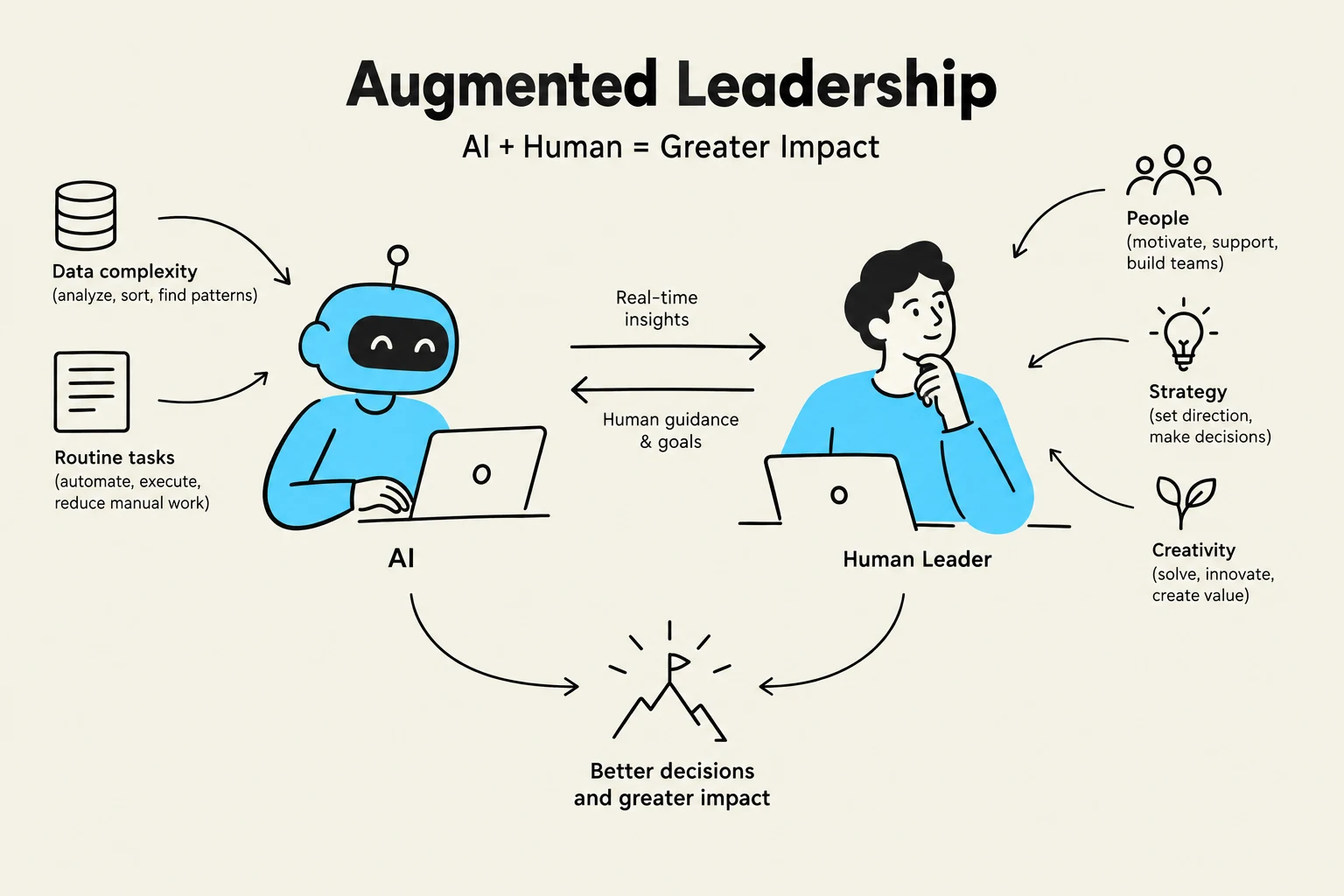
AI can act as a "leadership partner," handling complex data analysis and routine tasks, which frees the human leader to focus on what AI cannot do: empathy, moral reasoning, and authentic connection.
To succeed, future-ready leaders must develop Digital Agility and a Beginner’s Mindset—the ability to approach new technology with humility and curiosity rather than the ego of an "expert".
Exam Tip: If asked how AI affects leadership, emphasize that AI augments rather than replaces human leadership. The focus shifts from "knowing the answer" to "asking the right questions" (Prompt Engineering) and providing the ethical framework for AI-driven decisions.
This diagram illustrates the concept of Augmented Leadership, where Artificial Intelligence (AI) and Human Leaders collaborate to achieve greater impact. The AI handles data complexity and routine tasks, providing real-time insights to the human leader. The human leader, in turn, provides guidance and goals, leveraging these insights for strategy, creativity, and better decision-making, ultimately benefiting people and the overall impact.
Conclusion: The Human Element
Ultimately, the future of leadership is "AI-enabled, but human-led". While technology can provide data-driven insights, it is the human leader's character—their integrity, wisdom, and compassion—that defines the direction and culture of an organization. By focusing on self-awareness, continuous character building, and the ethical integration of technology, leaders can navigate the complexities of the modern world and deliver lasting greatness.
Keep reading for free.
Create an account to finish this reading and make it part of your study routine.