This content explains the concepts of electrolytes, non-electrolytes, strong and weak electrolytes, and how to predict precipitation reactions using solubility guidelines. It also covers net ionic equations.
In the study of aqueous chemistry, one of the most fundamental distinctions we make is whether a substance can conduct electricity when dissolved in water. This ability is not merely a physical curiosity; it is a direct consequence of how molecules interact with water to form ions. Understanding these interactions allows chemists to predict whether a reaction will result in a clear solution or the formation of a solid precipitate.
Understanding Electrolytes and Solutions
An electrolyte is defined as a solute that produces ions when it is dissolved in a solution. When these ions are present, they act as charge carriers, moving through the liquid to allow the flow of an electric current. A solution that contains these ions and can therefore conduct electricity is known as an electrolytic solution.
The process by which a substance breaks apart into ions is called dissociation (often used for ionic compounds) or ionization (often used for molecular compounds that react with water to form ions).
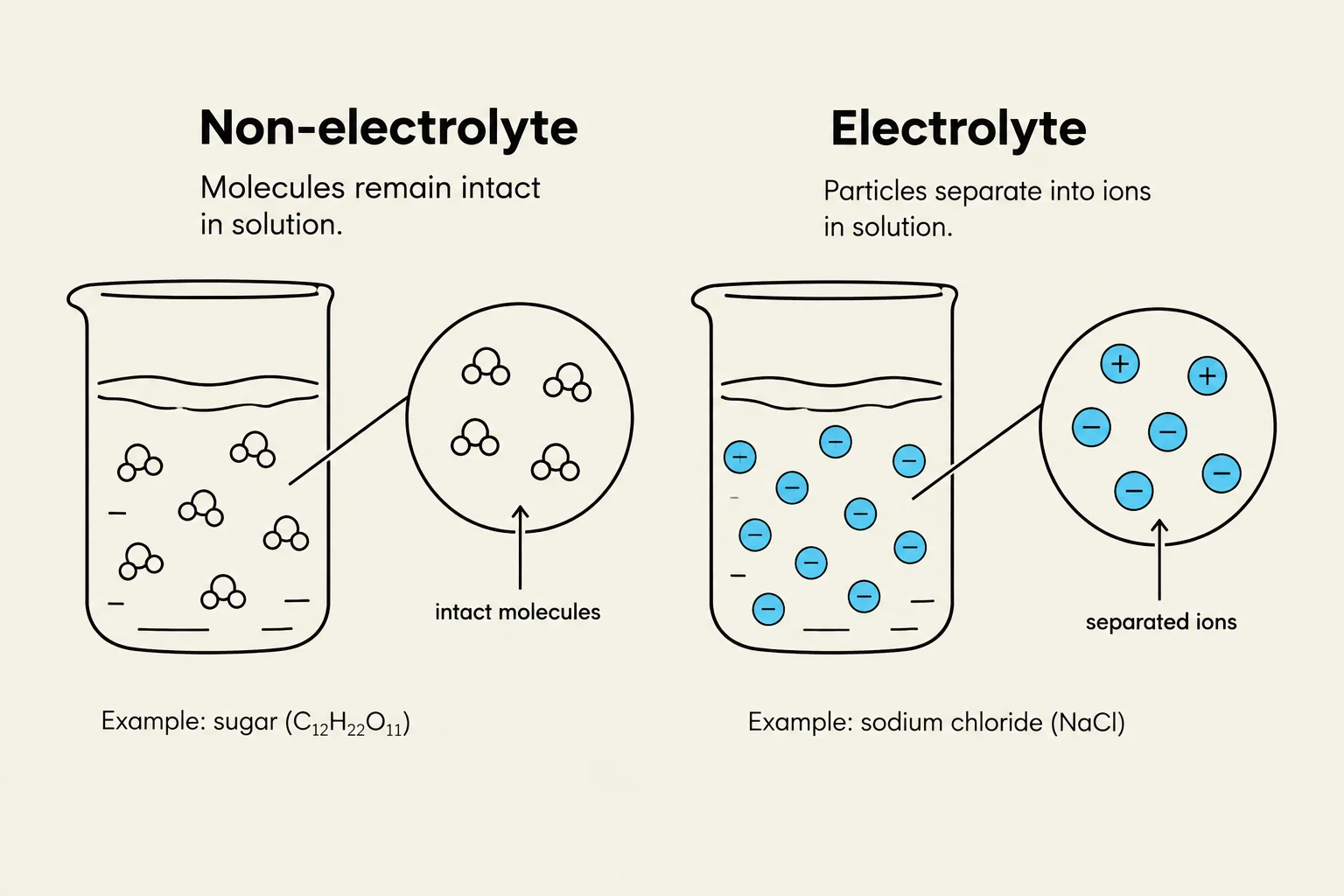
This diagram illustrates the difference between electrolytes and non-electrolytes in solution. Non-electrolytes, like sugar, have molecules that remain intact. Electrolytes, such as sodium chloride, dissociate into ions when dissolved.
Non-Electrolytes
Not all substances dissolve into ions. Non-electrolytes are substances in which no ionization occurs upon dissolving. Because they do not produce ions, they cannot conduct electrical current. Common examples include aqueous solutions of sugar (C12H22O11), ethanol, and ethylene glycol.
Classifying Electrolytes: Strong vs. Weak
Electrolytes are categorized based on their degree of dissociation in water. This degree of dissociation determines how efficiently the solution conducts electricity.
Strong Electrolytes
Strong electrolytes are substances that dissociate nearly 100% into ions in solution. Because they produce a high concentration of ions, they conduct electric current very efficiently.
For example, when 1 mole of sodium chloride (NaCl) dissolves, it produces 2 moles of ions:
1m NaCl(s)→1m Na+(aq)+1m Cl−(aq)
Similarly, sulfuric acid (H2SO4) dissociates to produce more ions per mole of solute:
1m H2SO4(s)→2m Na+(aq)+1m SO42−(aq)
Common strong electrolytes include salts like NaCl and strong acids like HNO3 and HCl.
Weak Electrolytes
Weak electrolytes only partially dissociate into ions. In these solutions, most of the substance remains in its original molecular form, with only a small fraction converted into ions. Consequently, they are only slightly conductive. A classic example is vinegar (an aqueous solution of acetic acid, CH3CO2H), which exists in a state of equilibrium:
CH3CO2H⇌CH3CO2−(aq)+H+(aq)
Exam Tip: Solubility = Electrolyte Strength
Do not confuse how much a substance dissolves (solubility) with how well it conducts electricity (electrolyte strength).
Sugar dissolves completely in water but is a non-electrolyte because it doesn't form ions.
BaSO4 is very poorly soluble, but the tiny amount that does dissolve dissociates completely into Ba2+ and SO42−, making it a strong electrolyte.
Precipitation and Solubility Guidelines
A precipitation reaction occurs when two aqueous solutions are mixed and an insoluble product forms, falling out of the solution as a solid called a precipitate. To predict whether a precipitate will form, chemists use solubility guidelines.
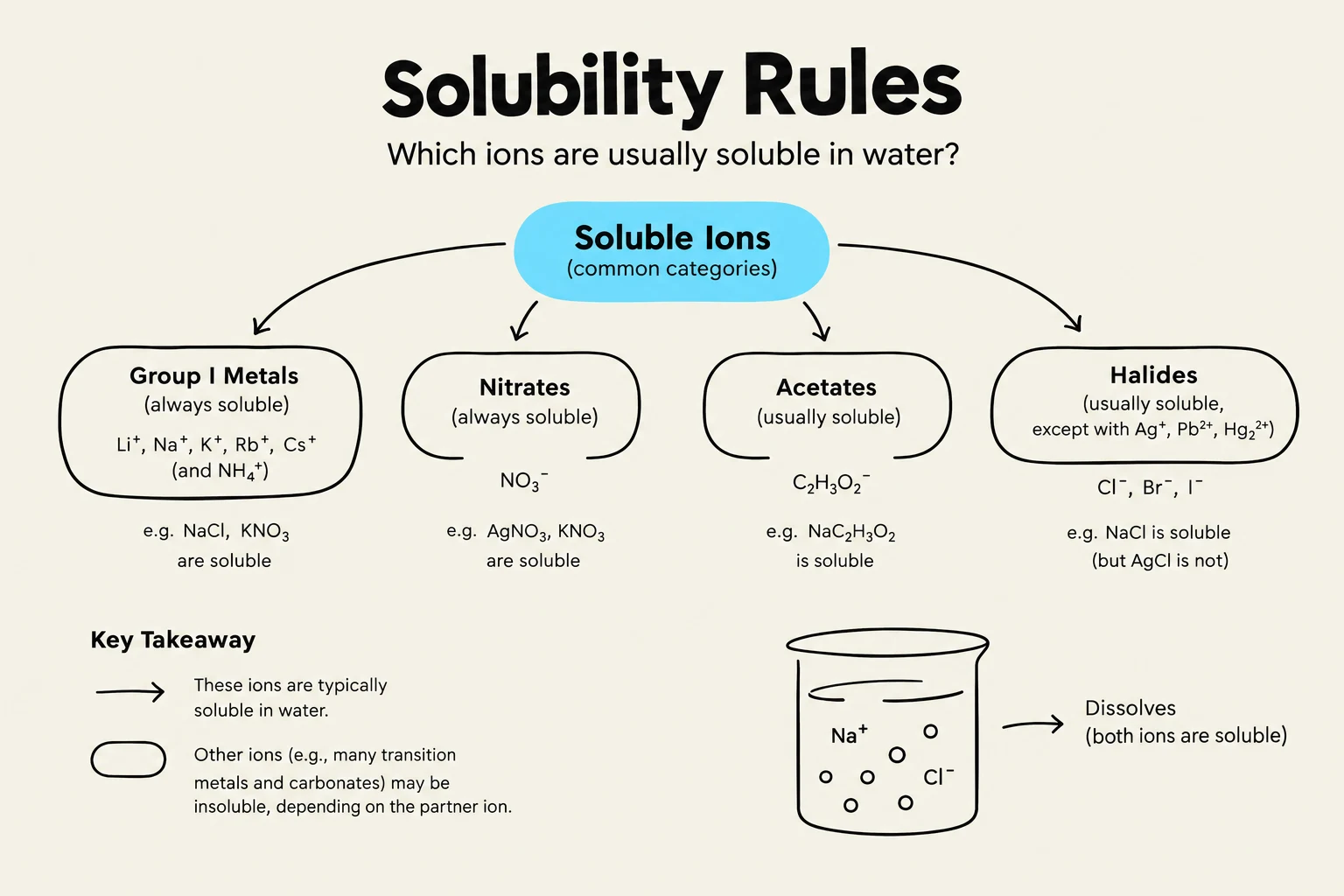
This diagram outlines solubility rules for common ions in water, categorizing them into groups like Group I Metals, Nitrates, Acetates, and Halides, and providing examples of soluble and insoluble compounds.
Key Solubility Rules
To predict the outcome of a reaction, examine the products formed. If either product is insoluble, a precipitate will form.
Generally Soluble Compounds:
Salts containing Group I elements ($Li^+, Na^+, K^+, Cs^+, Rb^+$) and Ammonium (NH4+).
Salts containing the Nitrate ion (NO3−).
Salts containing halides ($Cl^-, Br^-, I^-$), except for those containing Ag+,Pb2+, or (Hg2)2+.
Most sulfate salts (SO42−), except for CaSO4,BaSO4,PbSO4,Ag2SO4, and SrSO4.
Hydroxides of Group I elements.
Frequently Insoluble Compounds:
Most silver salts (except AgNO3 and Ag(C2H3O2)).
Most transition metal sulfides (e.g., CdS,FeS,ZnS,Ag2S).
Carbonates (e.g., CaCO3,BaCO3,FeCO3,PbCO3).
Phosphates (e.g., Ca3(PO4)2,Ag3PO4).
Chromates (e.g., PbCrO4,BaCrO4).
Worked Example: Predicting a Precipitate
Question: Predict whether a precipitate will form in the following reaction:
3AgNO3(aq)+Na2S(aq)→Ag2S(s)+2NaNO3(aq)
Step 1: Analyze the products.
The products are Ag2S and NaNO3.
Step 2: Apply solubility rules.
For NaNO3: Nitrates are generally soluble, so NaNO3 will remain in solution.
For Ag2S: Sulfides of transition metals (including silver) are highly insoluble.
Conclusion: Because Ag2S is insoluble, a precipitate will form.
Important Rule Precedence:
When rules seem to contradict, specific rules take precedence. For example, while most bromides ($Br^-$) are soluble, silver bromide (AgBr) is insoluble because the rule stating "most silver salts are insoluble" takes precedence.
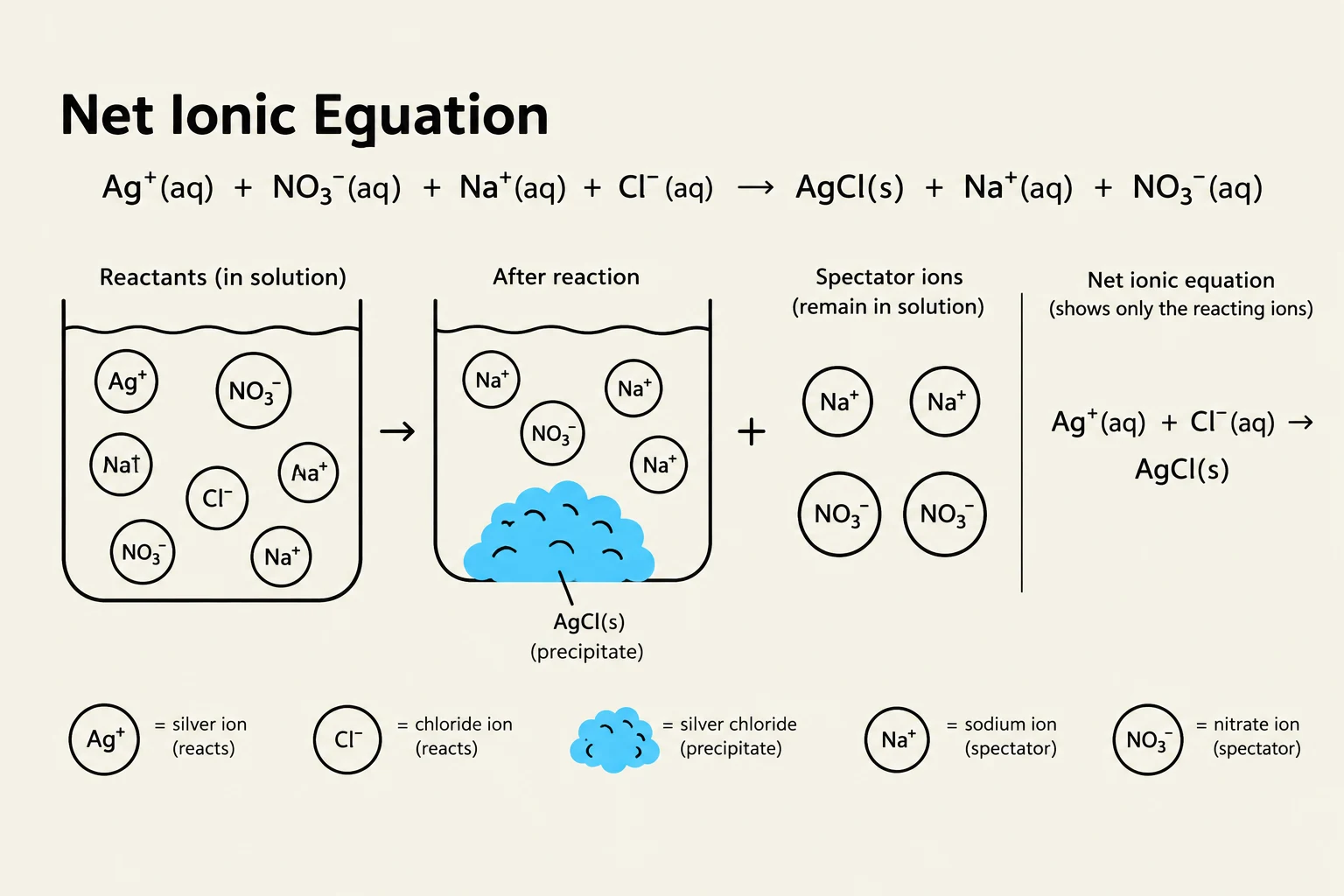
This diagram illustrates the concept of a net ionic equation in chemistry, showing the reaction between silver ions and chloride ions to form solid silver chloride precipitate, while sodium and nitrate ions remain as spectator ions in solution.
Net Ionic Equations
To focus only on the species actually participating in the chemical change, we use net ionic equations. This involves removing "spectator ions"—ions that appear on both sides of the equation unchanged and do not participate in the formation of the precipitate.