An introduction to electrolytes, including strong, weak, and non-electrolytes, and the Brønsted-Lowry theory of acids and bases, along with neutralization and titration.
In the study of aqueous chemistry, understanding how substances behave when they dissolve in water is fundamental. Some substances break apart into charged particles that allow electricity to flow, while others remain as neutral molecules. This distinction is the basis of the study of electrolytes, which leads directly into the complex and vital world of acid-base chemistry.
Electrolytes and Electrical Conductivity
An electrolyte is defined as a solute that produces ions in a solution. These ions serve as "charge carriers," meaning they are the particles responsible for the movement of electricity through the liquid.
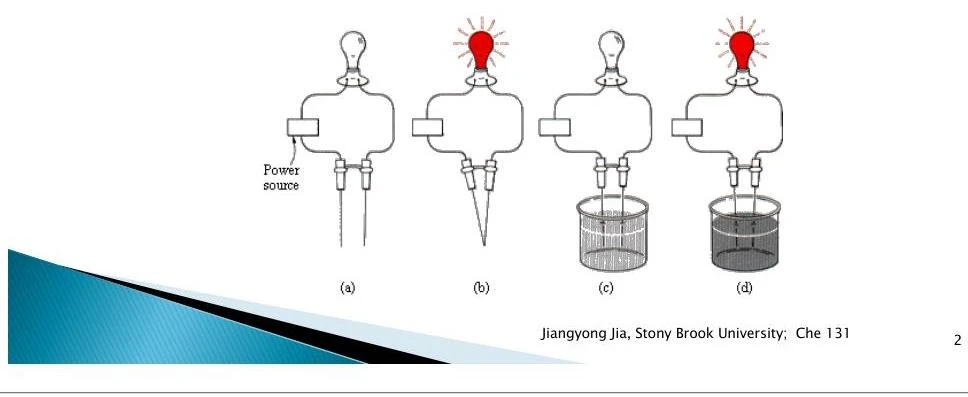
To determine if a substance is an electrolyte, scientists often use a simple electrical conductivity test. By placing electrodes into a solution connected to a power source, one can observe the brightness of a light bulb to gauge the concentration of ions present.
Diagrams illustrating the conductivity of different substances when connected to a power source and a light bulb. (a) shows a circuit with two electrodes in air. (b) shows the electrodes brought close together. (c) shows the electrodes immersed in a solution. (d) shows the electrodes immersed in a different solution, with the light bulb illuminated, indicating conductivity.
Strong Electrolytes
Strong electrolytes undergo nearly 100% ionic dissociation. This means that when the substance dissolves, almost every molecule breaks apart into individual ions. Because of this high concentration of mobile ions, strong electrolytes conduct electric current very efficiently.
Common examples include:
Strong Acids: HCl, HBr, HI, HNO3, H2SO4, and HClO4.
Strong Bases: Group 1A hydroxides (like NaOH and KOH) and heavy Group 2A hydroxides (like Ca(OH)2 and Ba(OH)2).
Soluble Salts: Such as NaCl and KBr.
Note on Solubility: Do not confuse solubility with electrolyte strength. For example, BaSO4 has very low solubility, but the tiny amount that does dissolve dissociates completely into Ba2+ and SO42− ions, making it a strong electrolyte.
Weak Electrolytes
Weak electrolytes only partially dissociate into ions. Instead of breaking apart completely, they exist in a state of chemical equilibrium where the unionized molecules and the produced ions coexist. Because the concentration of ions is low, these solutions are only slightly conductive.
A classic example is acetic acid (vinecous acid), which can be represented by the following equilibrium equation:
CH3CO2H(aq)⇌CH3CO2−(aq)+H+(aq)
Non-Electrolytes
Non-electrolytes are substances that undergo no ionization upon dissolution. While they may dissolve completely in water, they remain as neutral molecules rather than forming ions, and therefore cannot conduct electricity. Examples include sugar (C12H22O11), ethanol, and ethylene glycol.
Brønsted–Lowry Acid-Base Theory
Once we understand how ions behave, we can look at specific types of reactions involving hydrogen ions (H+). The Brønsted–Lowry theory defines acids and bases based on the transfer of protons.
Brønsted–Lowry Acids: These are proton donors—species that give away an H+ ion.
Brønsted–Lowry Bases: These are proton acceptors—species that receive an H+ ion.
The Hydronium Ion
In aqueous solutions, a "free" hydrogen ion (H+) does not actually exist in isolation. Because H+ is highly reactive, it immediately associates with a water molecule (H2O) to form the hydronium ion (H3O+).
Conjugate Acid-Base Pairs
When an acid donates a proton, it is transformed into a different species. This relationship creates conjugate acid-base pairs.
The conjugate base is what remains after the acid has lost its proton.
The conjugate acid is what is formed after the base has accepted a proton.
Consider the reaction between hydrochloric acid and water:
HCl(aq)+H2O(l)→H3O+(aq)+Cl−(aq)
In this reaction, HCl is the acid (donor) and H2O is the base (acceptor). Consequently, Cl− is the conjugate base of HCl, and H3O+ is the conjugate acid of H2O.
Exam Tip: Water is an amphiprotic substance, meaning it can act as either a proton donor or a proton acceptor depending on what it is reacting with.
Neutralization and Titration
When a Brønsted–Lowry acid reacts with a Brønsted–Lowry base, a neutralization reaction occurs, typically producing a salt and water. For example:
HCl(aq)+NaOH(aq)→NaCl(aq)+H2O(l)
Titration: Measuring Concentration
A titration is a volumetric method used to determine the concentration of an unknown substance by reacting it with a standard solution (a solution of known concentration).
During a titration, we look for two key moments:
Equivalence Point: The point where enough titrant has been added to completely react with the unknown substance.
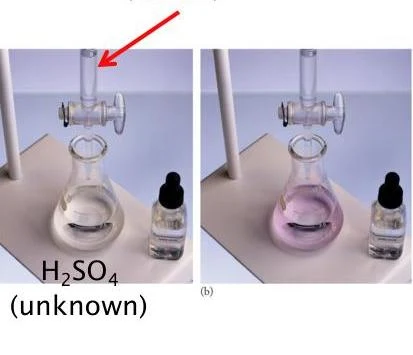
End Point: The point where a chemical indicator changes color, signaling that the reaction is complete.
Titration experiment showing a color change in a flask.
Worked Example: Stoichiometry from Titration
Problem: What is the concentration of sulfuric acid (H2SO4) if 15.00 mL of it reacts with 18.45 mL of a 0.0973 M NaOH solution?
Step 1: Write the balanced equationH2SO4+2NaOH→Na2SO4+2H2O
Step 2: Calculate moles of base (NaOH)molesbase=Molarity×Volume (L)molesbase=0.0973 M×0.01845 L=0.00180 mol
Step 3: Use stoichiometry to find moles of acid
From the equation, 1 mole of acid reacts with 2 moles of base.
molesacid=0.00180 mol base×2 mol base1 mol acid=0.0009 mol acid
Step 4: Calculate molarity of the acidMacid=0.015 L0.0009 mol=0.060 M
Keep reading for free.
Create an account to finish this reading and make it part of your study routine.