Electrical Inspection Scope: High-Voltage vs. Low-Voltage Systems
Learn to distinguish between high-voltage power systems and low-voltage signal systems for accurate electrical inspections. Understand what falls within an inspector's scope, including residential power, distribution, and branch circuits, and what is considered out-of-scope, such as communication lines and control syst
When performing an electrical inspection, one of the most critical skills is not just identifying a defect, but determining whether the component in question actually falls within your legal or professional jurisdiction. An inspector who spends time documenting faults in a doorbell circuit might be wasting resources, while an inspector who overlooks a faulty high-voltage connection in a solar array could be leaving a life-safety hazard unaddressed. Understanding the "scope of work" is the foundation of a professional inspection.
The Core Distinction: Power vs. Signal
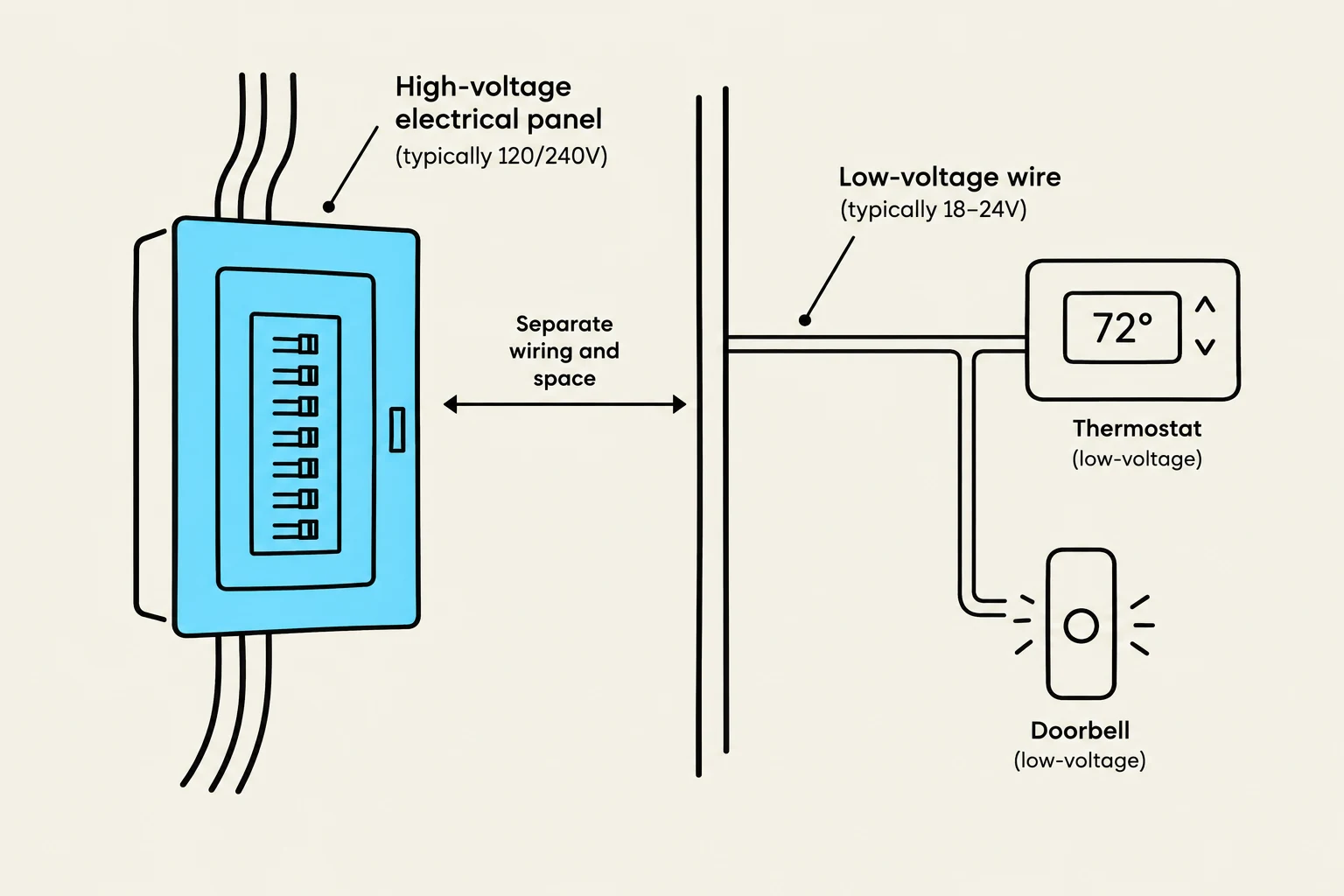
The primary way to define inspection boundaries is by distinguishing between high-voltage (power) systems and low-voltage (signal or control) systems. In a residential context, high-voltage systems are designed to deliver significant energy to drive appliances, lighting, and heating elements. These systems typically operate at 120V, 240V, or higher in industrial settings.
Low-voltage systems, conversely, are often used for communication, data transmission, or control signals. These systems carry much lower levels of energy, often measured in millivolts or low volts, and are generally designed to prevent electric shock to the user during normal operation.
Exam Tip: If you are asked to determine if a component is "in-scope," first ask: "Does this component provide the primary power for a load, or does it merely carry a signal to control a load?"
Diagram illustrating the separation of high-voltage electrical panels from low-voltage wiring for thermostats and doorbells.
In-Scope: High-Voltage Power Systems
For most residential electrical inspectors, the "in-scope" territory includes everything from the service entrance to the final branch circuit outlet. This includes:
Service Equipment: Meter sockets, main disconnects, and service lateral connections.
Distribution Equipment: Main service panels, sub-panels, and circuit breakers.
Branch Circuits: The wiring that runs through walls to provide power to outlets, switches, and fixed appliances (like ovens or water heaters).
Grounding and Bonding: The critical safety paths that ensure fault currents return to the source to trip a breaker.
These systems are high-risk because they carry enough current to cause significant arc flashes, fires, or fatal electrocutions.
Out-of-Scope: Low-Voltage and Signal Systems
"Out-of-scope" does not mean these systems are unimportant; it simply means they fall under different regulatory standards (such as telecommunications or specialized low-voltage codes) rather than the standard electrical power code. Common out-of-scope items include:
Communication Lines: Telephone lines, coaxial cable for internet, and ethernet cabling.
Signal/Control Systems: Doorbell wiring, smart home sensors, and security system alarms.
Class 2 Circuits: Many low-voltage lighting controllers and thermostat wires fall into this category due to their limited power-carrying capacity.
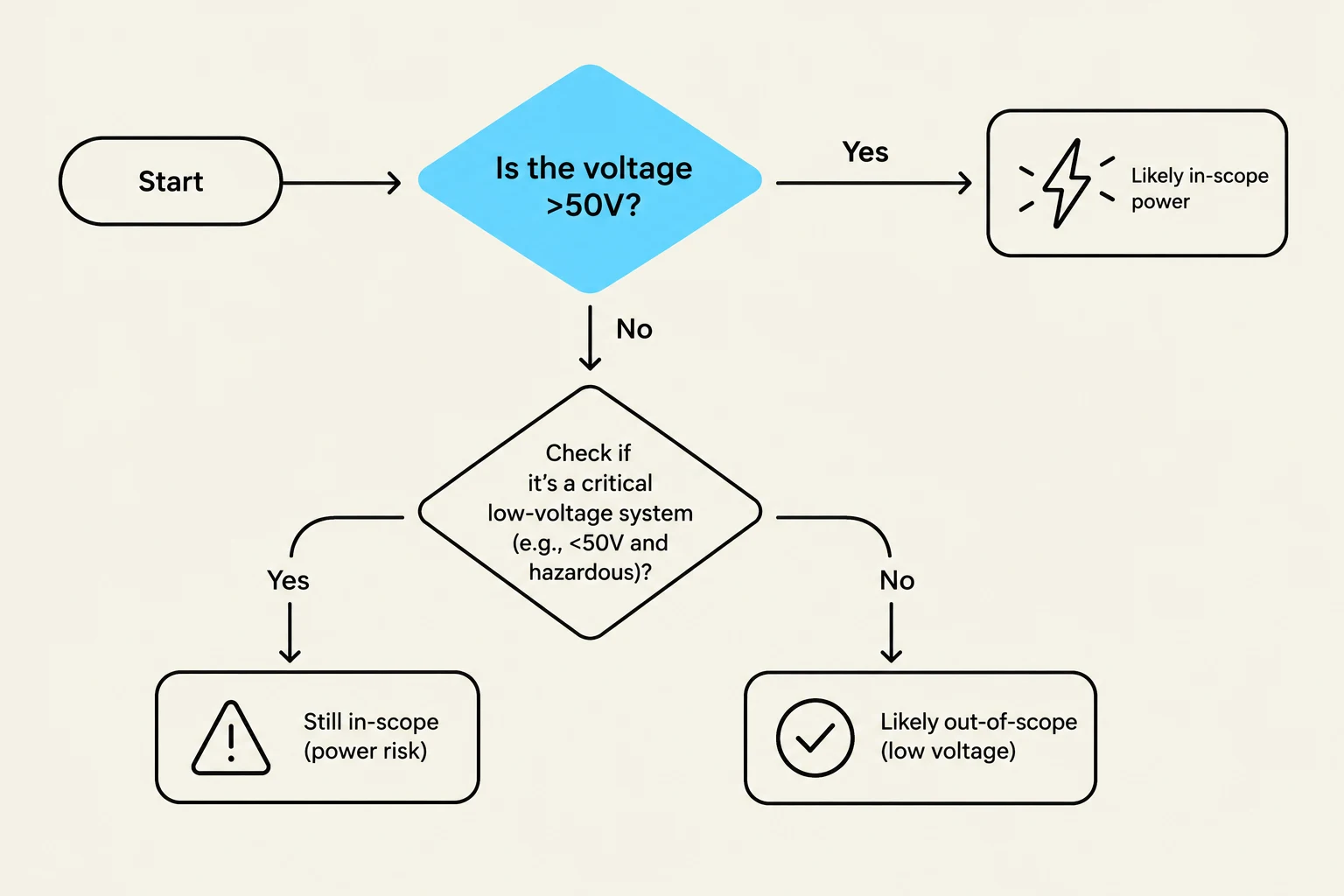
Flowchart for determining if a power source is in-scope based on voltage and criticality.
The "Gray Area": Solar Photovoltaic (PV) Systems
One of the most common points of confusion for modern inspectors is the solar PV system. Solar systems exist at the intersection of high-voltage power and specialized DC (Direct Current) technology.
To navigate this, you must look at the component's function:
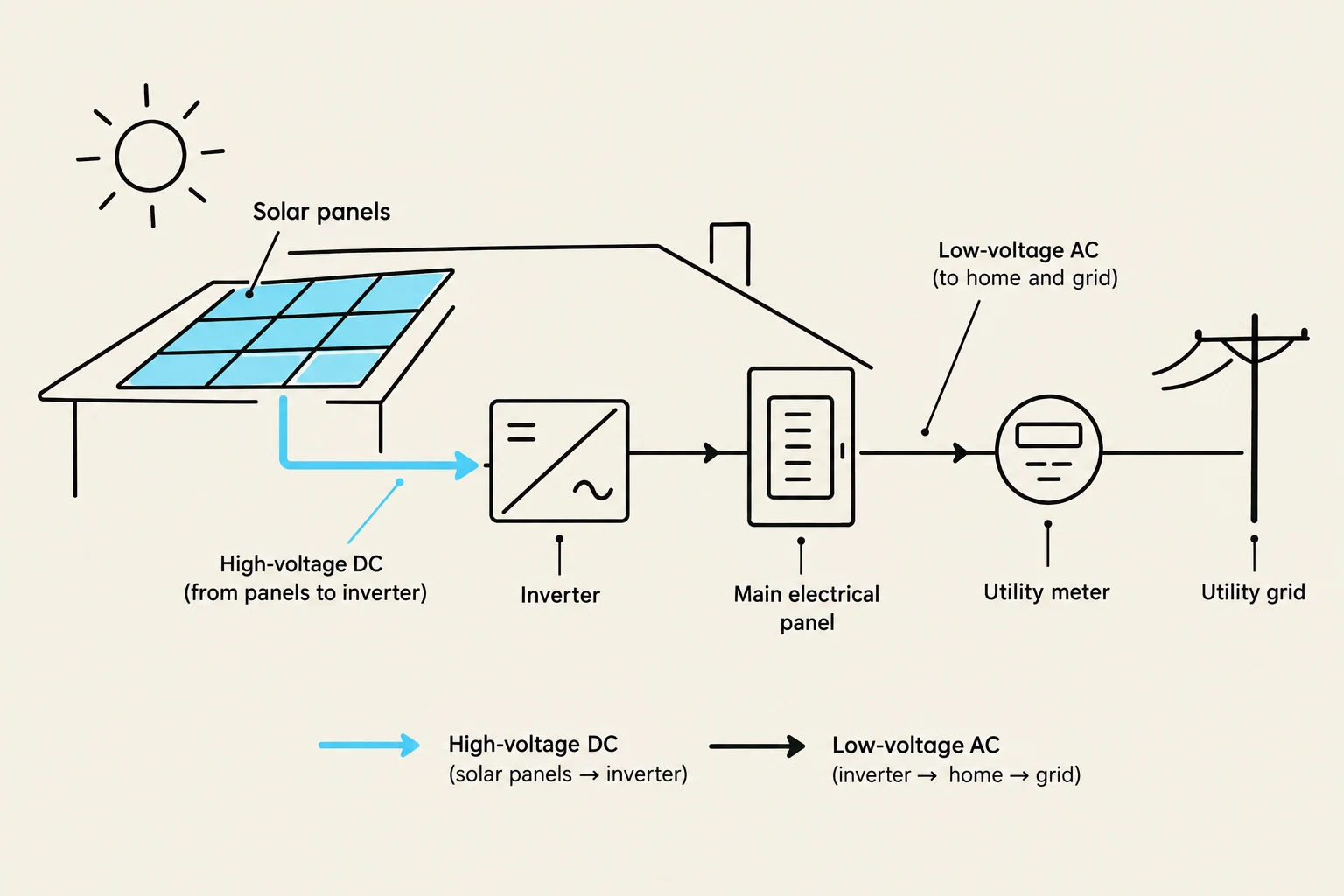
The Solar Panels and DC Wiring: The wiring from the panels to the inverter is high-voltage DC. While it is "low-voltage" in the sense that it isn't 120V AC, it is high-power and carries significant energy. In many jurisdictions, the DC side of a solar array is considered in-scope because it poses a fire and shock hazard.
The Inverter and AC Interconnection: Once the solar energy is converted to AC and fed into the home's main panel, it is definitively in-scope, as it becomes part of the standard residential electrical distribution system.
Monitoring and Communication: The small wires used for "smart" solar monitoring or data logging are often low-voltage signal wires and may be considered out-of-scope.
Diagram illustrating the process of converting solar energy into usable electricity for a home and the grid.
Worked Example: The Inspection Scenario
Imagine you are inspecting a home and encounter the following three items. How would you categorize them?
Item A: A frayed wire leading to a doorbell button.
Analysis: The doorbell operates on a transformer that steps voltage down to a very low level (typically 16V–24V). This is a signal/control circuit.
Result: Out-of-scope.
Item B: A loose connection in a 20-amp kitchen circuit breaker.
Analysis: This is part of the branch circuit distribution, carrying 120V AC to power high-draw appliances.
Result: In-scope.
Item C: A solar array DC disconnect switch that appears corroded.
Analysis: Even though it is DC, the solar array produces high-power energy that can cause arcs and fires. It is a critical component of the power generation system.
Result: In-scope.
Summary Table of Boundaries
System Type
Typical Voltage
Example Components
Inspection Status
Power (AC)
120V / 240V
Outlets, Breakers, Panels
In-Scope
Power (DC)
High DC Voltage
Solar Array Wiring
In-Scope
Signal/Control
< 50V
Doorbells, Thermostats
Out-of-Scope
Data/Comm
Very Low
Ethernet, Coax, Phone
Out-of-Scope
By maintaining these boundaries, an inspector ensures they are providing a thorough safety assessment of the high-energy systems that pose the greatest risk to the property and its occupants.
Keep reading for free.
Create an account to finish this reading and make it part of your study routine.